In the world of annual refresh cycles, there’s always been a big question mark around what to do with all of the old tech we too readily abandon. There are a number of options for disposing and recycling these objects that often contain rare earth and sometimes harmful material. The concept of upcycling has also become an increasingly popular option – offering a new lease on life for old technology. After all, your three-year-old smartphone may not be the latest and greatest, but that doesn’t mean it’s necessarily worthless.
During this morning’s CES kickoff press conference, Samsung outlined its new Galaxy Upcycling at Home program. For now, we got some pretty broad strokes about the program – and we’ll likely get more information at this Friday’s Galaxy Unpacked event. Here’s what the company had to say, “The new program reimagines the lifecycle of an older Galaxy phone and offers consumers options on how they might be able to repurpose their device to create a variety of convenient IoT tools.”
Examples from the presser include a baby monitor, pet care sensor for turning on lights remotely and a more abstract “digitally safe home” using Samsung Knox. It will be interesting to see what else the company’s got in store in that front – and certainly there’s something to be said for keeping old tech relevant even after its planned obsolescence.
The other piece of the puzzle is one of the more fun initiatives the company has introduced in recent years, with boxes that can be converted into house hold objects. The company announced this morning that all of its QLED, UHD TV and audio projects will feature the packaging.
Per Samsung,
As part of an ongoing commitment to eco-consciousness, Samsung is creating products and solutions with sustainability at the core. For example, Samsung’s new Solar Cell Remote Control—made in part with recycled plastic—can be charged via solar or indoor lighting, reducing battery waste.
For the last couple of years, Samsung’s CES press conferences have featured a parade of futuristic home robots. They’re are smart, dexterous and impressive (and reasonably adorable). But home robots are hard. Like, really, really hard. There’s a reason the robotic vacuum continues to be one real viable home robot nearly 20 years after the Roomba’s introduction.
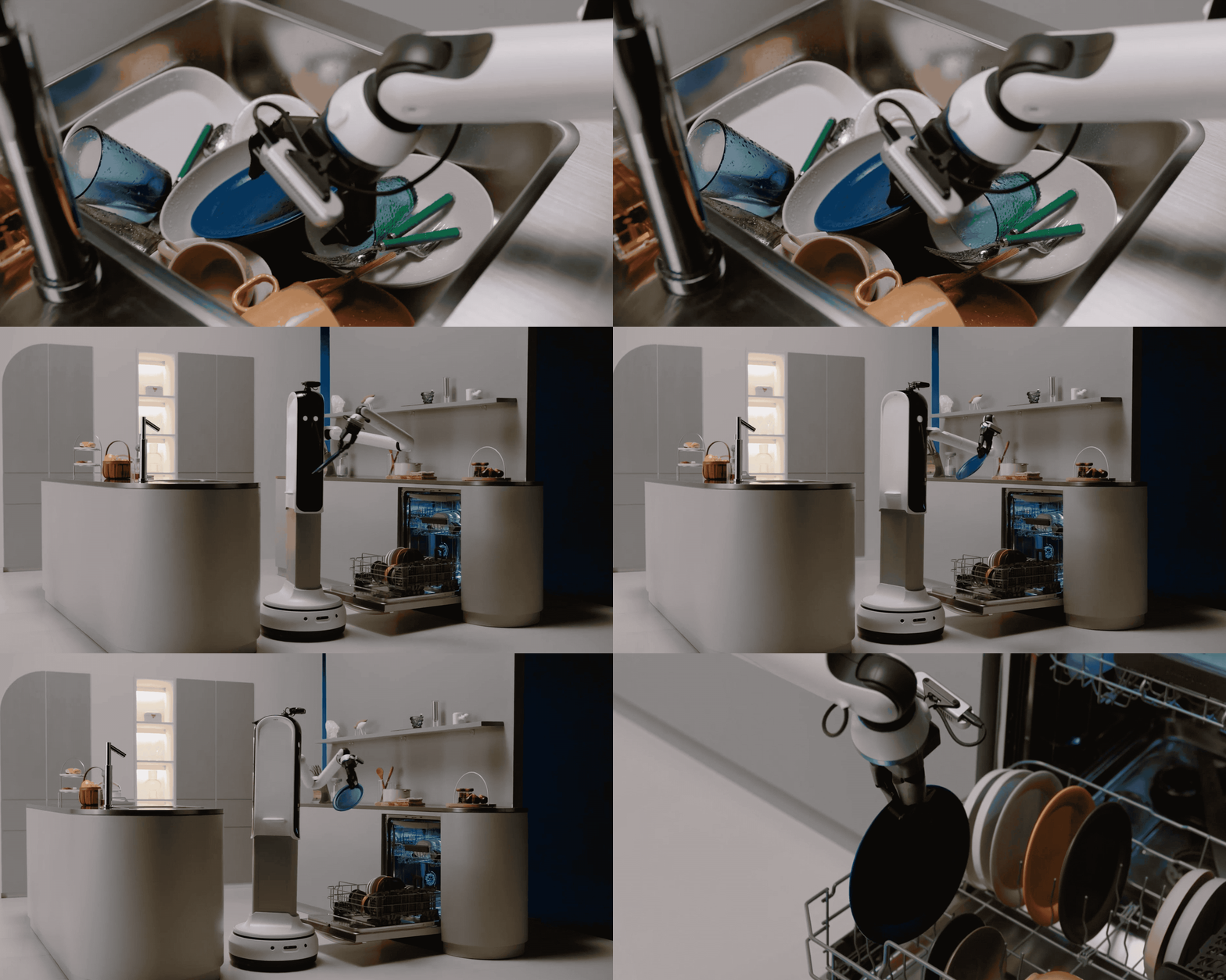
It’s the same reason the JetBot 90 AI+ Vacuum seems to be the one really viable bit of home robotics from the event. The company also showed off updates to the Bot Handy it introduced at last year’s show. That, coupled with the new Bot Care, is far more in line with the kind of humanoid designs science fiction has led us believe we’ll be getting in the next few years.
And science fiction seems to still be an operative descriptor here. At last years show, the robots put on a kind of Chuck E. Cheese-style presentation, running through choreographed tasks on stage, with limited human interaction. Understandably – there’s a lot that goes into this sort of thing, and for the moment, the technology feels like proof of concept more than anything.
Image Credits: Samsung
The company mentioned the “not too distant future” in reference to the tech, while the small print at the corner of the screen said “This robot is undergoing research and development, and is not yet for sale.” That seems to be putting it mildly, as the wheeled Bot Care reminds its owner of a meeting and pops up a screen for a conference call.
I don’t think anyone has an illusions that we’ll be seeing any of this tech during the current epidemic, though I suppose there’s an argument to be made that this is the “new normal” the company is prepping us for. The Bot Handy moving dishes from the sink to dishwasher seems roughly as realistic.
Image Credits: Samsung
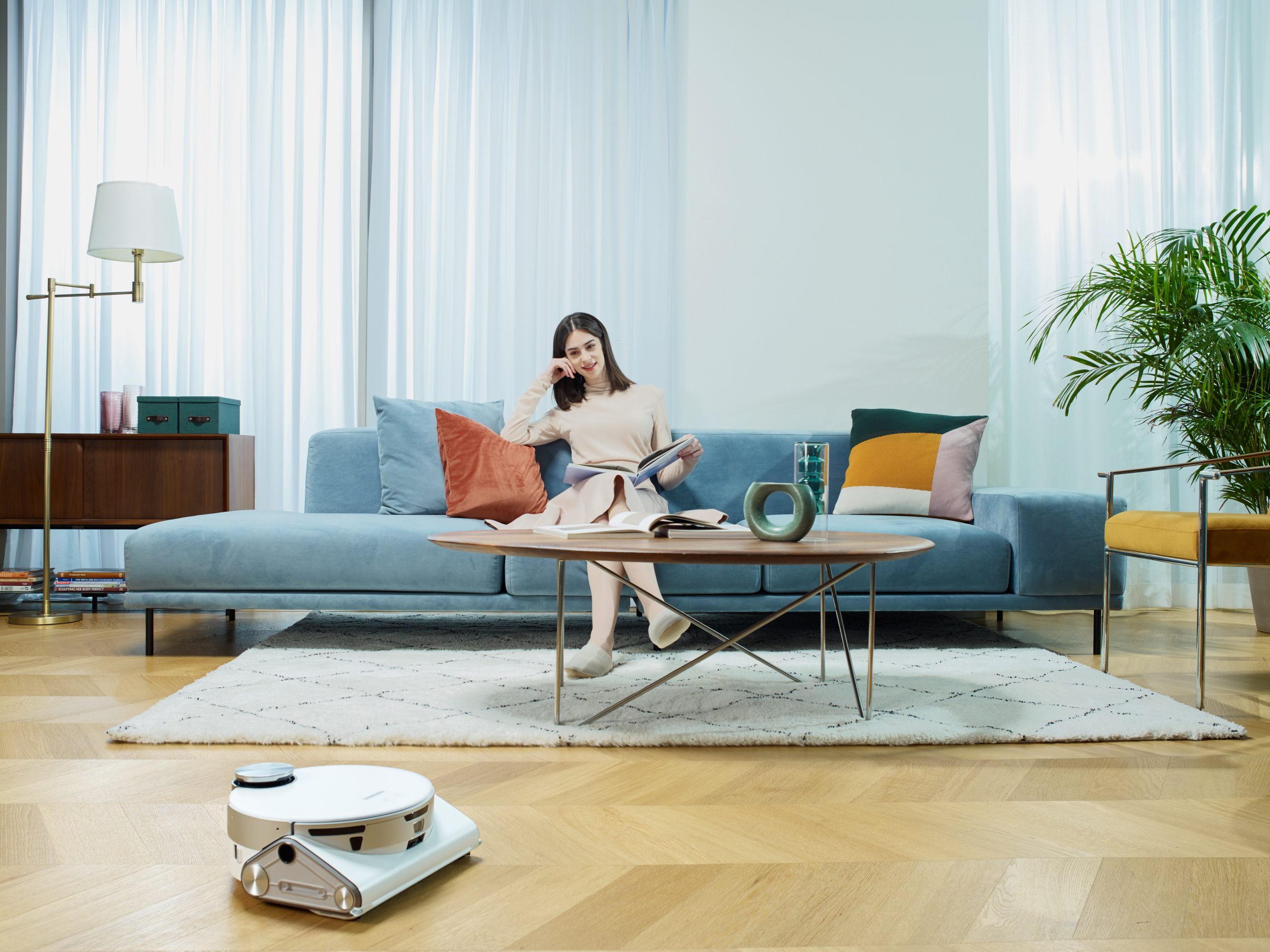
I’m happy to be wrong, but I don’t think any of us are holding our breath for a viable version of this tech in the near term. We can, however, appreciate the JetBot 90 AI+ Vacuum. That, after all, has a rough date, arriving in the U.S. at some point in the first half of this year.
The robot vacuum features an on-board LiDAR sensor, coupled with an object detection algorithm that helps it build an ideal path around the user’s home. Interestingly, the camera can also be viewed remotely by the user, doubling as a kind of security cam (though Samsung seems to avoid actually using the word) and a pet monitor.
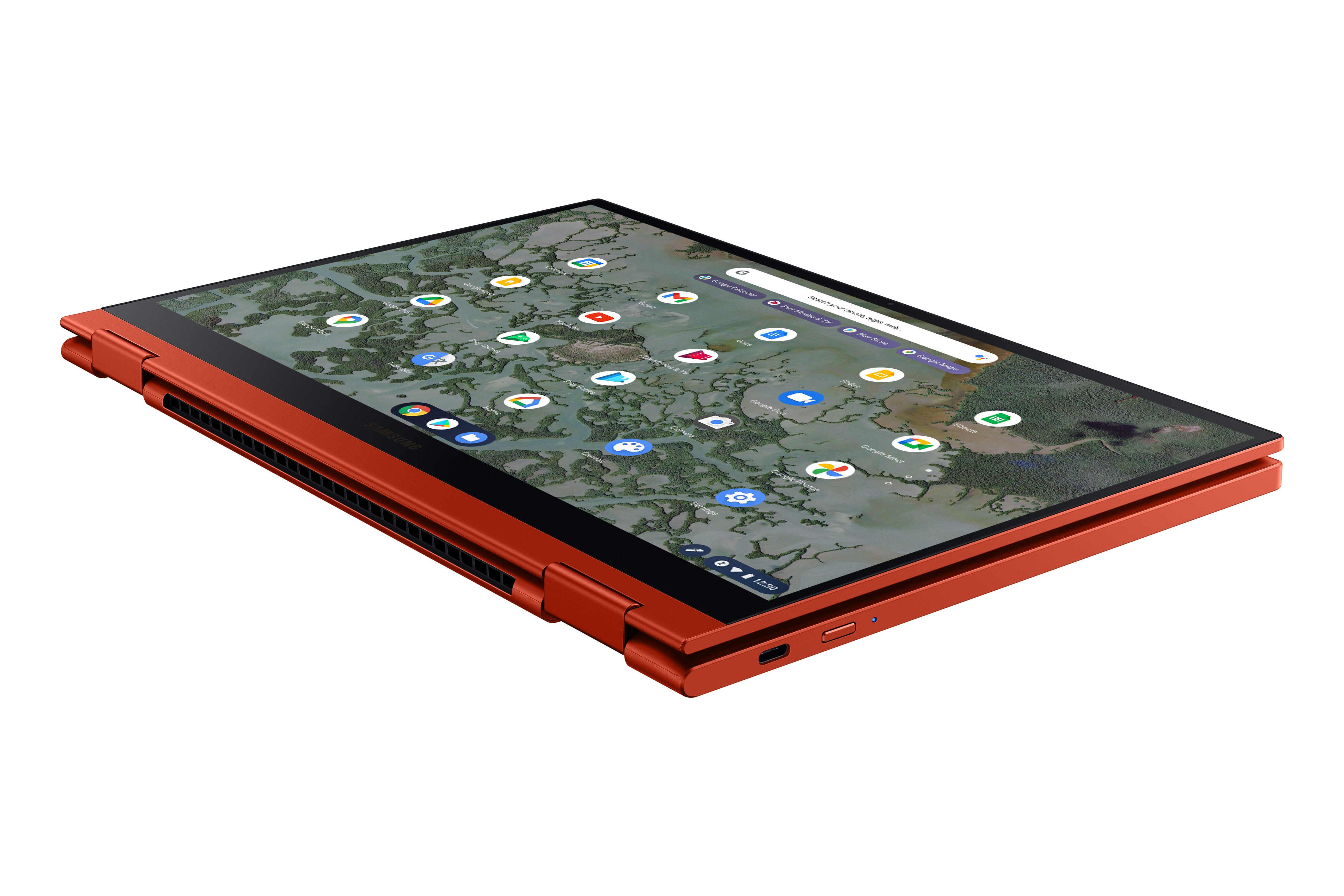
Happy almost CES! Sure the year’s biggest consumer electronics show hasn’t officially kicked off, but, well, what do such arbitrary signposts really mean in a year like 2021, right? Samsung just dropped what’s almost certainly one of its biggest pieces of news for the show, with the arrival of the Galaxy Chromebook 2.
The two-in-one follows almost a year to a day after the announcement of the original. It appears to share a fair bit of the charm of its predecessor, but notably has a much improvement price point. This time out the Chrome OS powered portable starts at a far more reasonable $549 – down from $999.
Image Credits: Samsung
Mind you, that’s for the one running a 10th gen Intel Celeron processor. If you want the Core i3, that starts at $699. It’s a bit of a jump, but a better starting point for users looking at the product as day-to-day machine. And besides, it’s still significantly less expensive than the original. Keep in mind here that last year’s model started with an i5 – which is to say the price drop comes with a bit of a processor downgrade.
Battery life was an issue on the original and is still a bit of a question here. The device now sports a QLED display (which Samsung claims is “world’s first” for a Chromebook), rather than the original’s 4K AMOLED, which could go a ways toward improving longevity.
The changes between the first and second gen product are a pretty clear indicator that companies are still trying to figure out precisely what a “premium Chromebook” entails. After all, it wasn’t all that long ago that the phrase was a bit of an oxymoron. The company’s computing GM Shoneel Kolhatkar sums up the general though process here pretty well in the associated press announcement,
Many kids grew up using Chromebooks in school, and as they enter the workforce, their needs evolve, they’re looking for premium, powerful hardware that can elevate that intuitive Google experience. We designed the Galaxy Chromebook 2 with these users in mind, taking the popular features from Galaxy Chromebook—incredible visuals, great specs, and gorgeous design and color—and bringing them to a wider base of customers.
In a sense, Samsung is taking a similar journey as the one Google made from the Pixelbook to the Pixelbook Go. And with Google pretty quiet on that front for the moment, there’s a decent sized market opening for Samsung here.
The Galaxy Chromebook 2 arrives later this quarter, sporting a 13.3 inch display, 4/8GB of RAM and 64/128GB of storage. And yes, it still comes in “Fiesta Red” or gray, if you prefer.
Tile is preparing to introduce a new product this year that will serve as a rival to Apple’s long-awaited AirTags and other lost item trackers coming to the market, including those from Samsung, TechCrunch has learned. While previous Tile trackers have leveraged Bluetooth to help users locate lost items — like a misplaced set of keys, for example — Tile’s new product will take advantage of UWB (ultra wideband) technology to find the missing items. It will also use augmented reality to help guide users to the lost item’s location via the Tile mobile app.
Like Bluetooth and Wi-Fi, UWB is a short-range, wireless communication protocol, but one that operates at very high frequencies. It can be used to capture spatial and directional data, which is where it comes in handy to lost item finders, like Tile’s trackers.
Apple last year began to give third-party developers access to its U1 chip, which uses UWB technology to make the iPhone spatially aware, via its “NearbyInteraction” framework. Some Android devices also ship with the technology. It’s unclear to what extent Tile is using the new frameworks with its forthcoming product, and the company is likely under NDA with regard to its work with Apple specifically, per earlier reports.
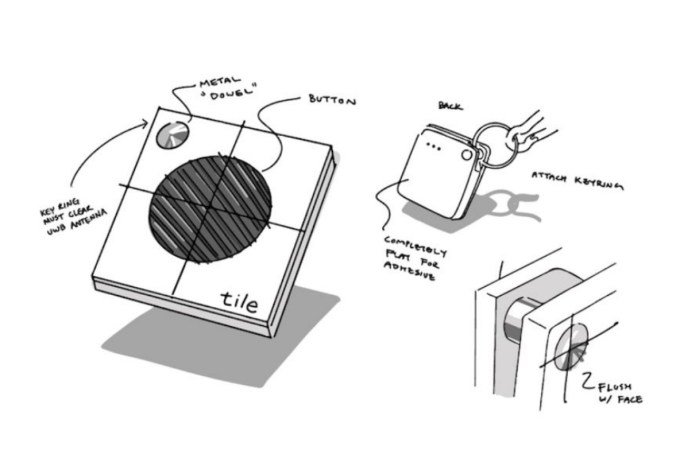
Based on Tile’s internal concept art for the device (shown below), Tile’s UWB model will look similar to its other small trackers, like the Tile Mate and Tile Pro. It will also have a square shape, center button, and flat back to support being mounted using an adhesive. And like other Tile dongles, it can be attached to a keychain.
Image Credits: Tile concept art
Typically, Tile dongles would be attached to things like keys, remote controls, handbags, duffels, luggage, or other small carry items, or stuck to larger devices like personal electronics or bikes. However, lost items could only be located by way of Bluetooth, when nearby, or via Tile’s “community find” network when further away. The latter leveraged the Tile app installed on its users’ phones to help locate any Tile tracker set to a lost mode, then ping the item’s owner when the item was found. This has allowed Tile users in the past to locate lost items like those left on an airplane by mistake, for example.
The new Tile tracker, on the other hand, will use UWB to make the finding process easier than before.
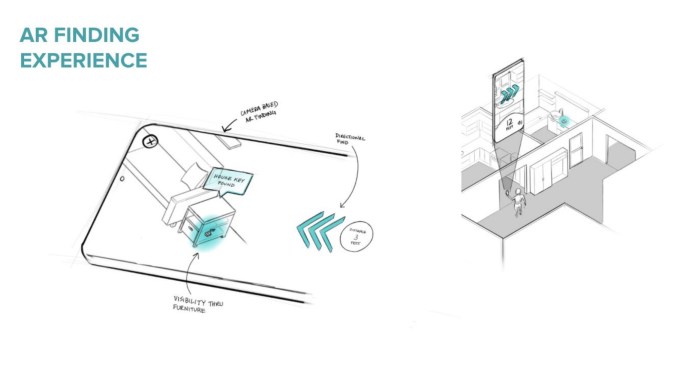
Because UWB offers spatial awareness capabilities, it will be able to locate missing items inside or outside, even when you can’t hear the tracker’s ring. This could help when the missing item is buried under something — like a sofa cushion — or inside something like a dresser drawer, for example. It can also help to find items more easily in a larger space, like a house with multiple floors.
The Tile app, meanwhile, will allow users to launch to an AR-enabled camera view that will help to guide them to the item’s location using overlays, like directional arrows and an AR view of the item’s location.
Image Credits: Tile internal concept art
Per sources familiar with Tile’s plans, we understand Tile expects to release the new tracker later this year with support for both iOS and Android devices. Pricing is unknown. Tile will still sell its popular Bluetooth-enabled devices, of course, as a good portion of the market does not yet own a UWB-enabled smartphone at this time — the technology is only found in newer devices.
Though Tile has historically led the market in comparison with other third-party lost item trackers, the company is due to face increased competition in 2021 as new trackers arrive from top smartphone brands, like Samsung and Apple.
A UWB-powered tracker could help allow Tile to maintain its position in the market. Tile, as of last year, had sold 26 million Tile devices, and was locating around 6 million items per day across 195 countries. Tile’s website now says its devices reach over 230 countries and territories. With this scale, Tile today leads the market. But Apple’s AirTags could have a first-party advantage with deep integrations into its “Find My” app — a concern that was brought up by Tile in last year’s antitrust hearings in reference to how Apple wields its platform and market power to overrun competitive businesses.
Tile is not speaking publicly about its plans for a UWB device at this time.
“While we can’t comment on our product roadmap, we’re constantly looking to improve our customer experience and solve the pain point of finding lost items,” a spokesperson for Tile told TechCrunch.
TMYTEK recently raised a Series A+ round of about $10 million for products that make it easier to test 5G millimeter wave equipment. So far, the company’s clients include KDDI, NTT DoCoMo and research institutions. But the Taiwanese startup has aspirations to sell its own base stations, too, competing with well-established players like Nokia, Ericsson, Samsung and Huawei. TMYTEK plans to use its expertise, gleaned from helping other researchers develop 5G infrastructure, to create what its chief executive officer describes as a “complete 5G industrial chain.”
Its latest funding round was led by TMYTEK’s manufacturing partner Inventec, one of the largest OEMs in Taiwan, and brings the startup’s total funding so far to $13.3 million. Other investors included Taisic Materials, ITEQ, Tamagawa Electronics and Taiwan’s National Development Fund. TMYTEK also recently took part in SparkLabs Taipei’s accelerator program.
Co-founder and chief executive officer Su-Wei Chang told TechCrunch that it plans to raise a Series B next to develop and commercialize its base stations. To get ready for its base station business, TMYTEK recently joined the O-RAN Alliance, founded by some of the world’s biggest telecoms to create more interoperable mobile networks, in a bid to encourage the development of new technology and faster deployment.
Chang said TMYTEK’s base in Taiwan gives it a strategic advantage. 5G manufacturing is an important part of Taiwan’s economy, with exports reaching record highs during the second half of 2020, thanks in part to demand for 5G-related equipment and technology for smartphones, autonomous vehicles and smart devices.
Chang studied at University of Massachusetts Amherst and when TMYTEK was founded six years ago, he was often asked why he didn’t stay in the United States, where it would have been easier to secure startup funding. But being in Taiwan puts the company closer to many important markets, including Japan, where 30% of its current business comes from, and gives TMYTEK a good foundation to expand into the U.S. and European market, he said.
It has also given the company a supply chain advantage. TMYTEK has manufacturing partners across Asia, including Inventec in Taiwan, and factories in Vietnam and Thailand, in addition to China. Chang said this means TMYTEK was not limited by the COVID-19 pandemic or the U.S.-China trade war.
Before launching TMYTEK in 2014, Chang and co-founder Ethan Lin both worked at Academia Sinica, one of the top research institutions in Taiwan, where they focused on millimeter waves even though at the time most researchers were more interested in the mid-band spectrum.
But as more devices and applications began to crowd the 4G spectrum, mmWave became less niche. With Qualcomm’s launch of next-generation 5G mmWave hardware and chips, and more carriers launching mmWave coverage, mmWave is poised to become mainstream.
Millimeter waves offer powerful signals with wide bandwidth and low latency, but drawbacks include difficulty traveling through obstacles like buildings. It also has a limited range, which is why millimeter waves need more base stations. Beamforming, which directs signals toward a specific device, and antenna array, or multiple antennas that work like a single antenna, are used to extend its coverage.
Making mmWave development faster
One of the main challenges for the millimeter wave market, however, is the lack of R&D tools to speed up their development and time to market, resulting in higher costs and slower deployment.
To keep up with market opportunities, TMYTEK transitioned from design and manufacturing projects for clients to offering 5G-focused solutions like the BBox, which stands for “beamforming box.” The BBox was created after a professor at National Taiwan University told Chang that his team was working on antenna design, but didn’t have the resources to work on beamforming technology, too. It lets researchers create 16 beams and control the signal’s amplitude and phase with software, so they can test how it works with antennas and other hardware more quickly. TMYTEK claims the BBox can save researchers and engineers up to 80% in time and cost.
Chang said TMYTEK realized that if researchers at NTU, one of Taiwan’s largest research universities, needed a solution, then other labs did, too. So far, it has delivered 30 sets to companies including KDDI, NTT DoCoMo, Fujitsu, several Fortune 500 companies and research institutions.
While the BBox was created for antenna designers, the company also began exploring solutions to help other designers, including algorithm developers who want to test beam tracking, communicate with base stations and collect data.
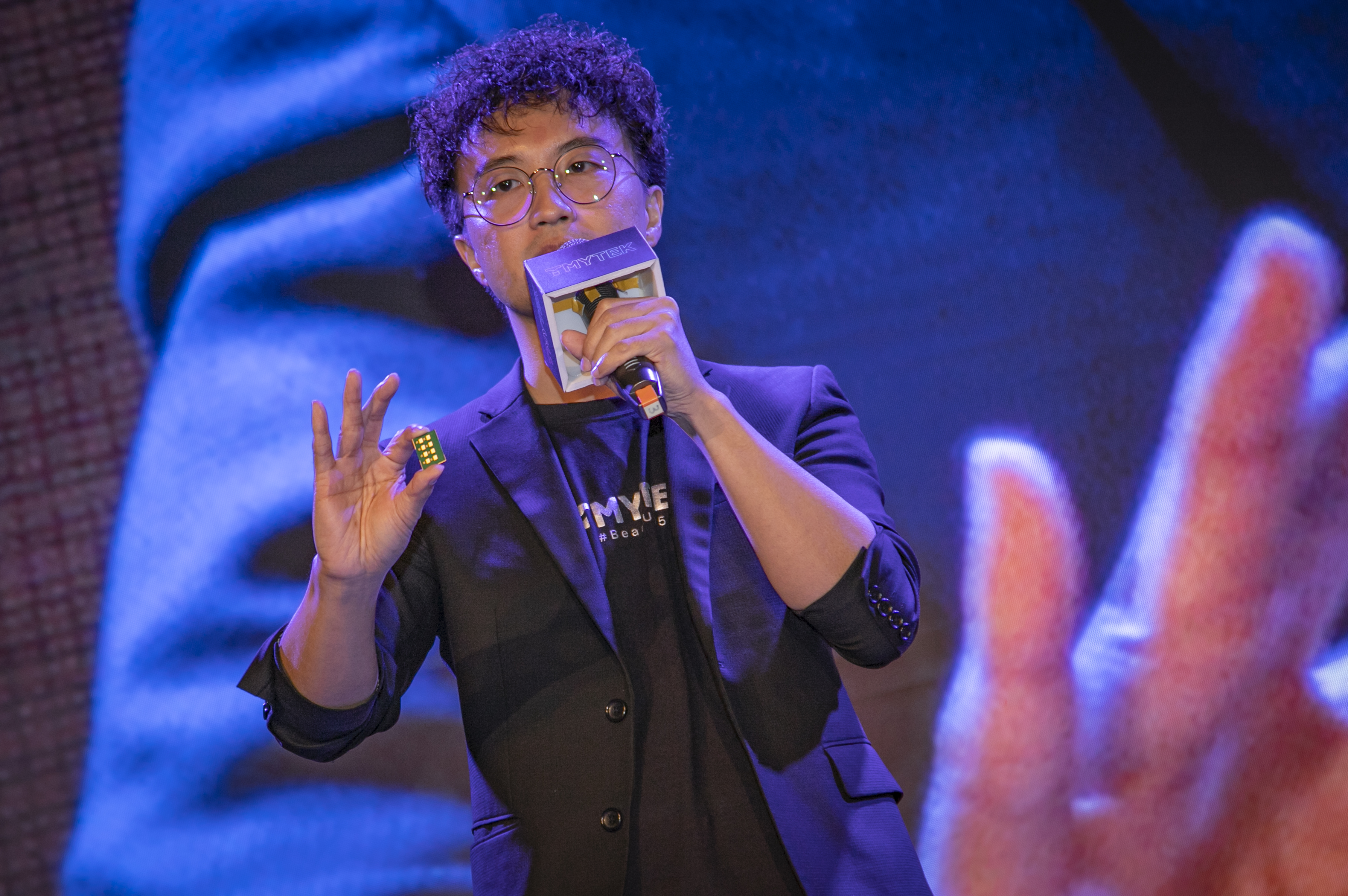
TMYTEK vice president Ethan Lin holds the antenna-in-package for its XBeam millimeter wave testing solution (Image Credits: TMYTEK)
For that scenario, TMYTEK created the XBeam, which it describes as a “total solution,” and is meant for the mass production phase, testing modules, smartphones and base stations before they are shipped. Traditional solutions to test modules rely on mechanical rotators, but Chang said this is more suited to the research and development process. The XBeam, which is based on the BBox, electronically scans beams instead. The company claims the XBeam is up to 20 times faster than other testing solutions.
TMYTEK created the XBeam’s prototype in 2019 and launched the commercialized version in November 2020.
The BBox and XBeam will help TMYTEK build its own base station business in two ways, Chang said. First, having its own solutions will allow TMYTEK to test base stations and bring them to market faster. Second, the startup hopes building a reputation on effective research and development tools will help it market its base stations to private and public networks. This is especially important to TMYTEK’s ambitions since their base stations will be up against products from major players like Nokia, Ericsson, Samsung and Huawei.
“Our advantage at TMYTEK is that we’re doing the design and we have good partners for manufacturing. Inventec, our investor, is a top five manufacturer in Taiwan,” he said. “And TMYTEK also builds our own testing solution, so our value is that we can provide a total solution to our customers.”
Stop me if you’ve heard this one before. Samsung’s next flagship is set to debut January 14. The company just confirmed earlier rumors surrounding the date for its next Unpacked event (virtually, of course). This one sports the name, “Welcome to the Everyday Epic.”
“Over the past year, mobile technology has taken center stage in everyday life as people are working remotely and spending more time at home,” the company writes. “The accelerated transition to a mobile-first world brings with it the need for devices that can transform everyday life into an extraordinary experience.”
The event’s timing is an interesting artifact of 2021’s wacky show scheduling, with the COVID-19 pandemic still very much being front of mind. Past Unpackeds were generally timed around Mobile World Congress. That show has been delayed until the summer, however, in hopes of returning to an in-person event. So Samsung has opted to kickstart sales a month or so earlier this year.
In fact, the event is a mere days after CES. Gone are the days a gadget journalist could take a few days to decompress after the year’s biggest hardware show. It also, perhaps, doesn’t bode well for Samsung’s announcements during CES itself (though the electronics giant has more than enough divisions to keep its presence at the show interesting).
Another odd change this year is the fact that you can already reserve the S21, sight unseen. There’s little doubt it will be a solid phone, though there are plenty of questions around how the company will up the ante in the era of flagging smartphone sales. The leaks so far have been kind of underwhelming, though Samsung’s usually got a couple of fun surprises up its sleeve.
We’ve already seen enough of the Galaxy Buds Pro that they don’t qualify as a surprise, exactly. But the company has a solid enough track record with earbuds that there’s reason to be excited. The AirPods Pro competitors are are said to be priced at a reasonable $199.
Welcome back to This Week in Apps, the weekly TechCrunch series that recaps the latest in mobile OS news, mobile applications and the overall app economy.
The app industry is as hot as ever, with a record 204 billion total downloads and $120 billion in global consumer spend in 2019. Not including Chinese third-party app stores, iOS and Android users in 2020 downloaded 130 billion apps and spent a record $112 billion. In 2019, people spent three hours and 40 minutes per day using apps, rivaling TV.
Due to COVID-19, time spent in apps jumped 25% year-over-year on Android. Apps aren’t just a way to pass idle hours — they’re also a big business. In 2019, mobile-first companies had a combined $544 billion valuation, 6.5x higher than those without a mobile focus.
This week (after a week off for the holidays), we’re taking a look at holiday app store spending, how the Chinese gaming licensing rules have impacted the App Store, Apple’s move to ban a party app that could have helped spread COVID, and the collaborative musical created by TikTok users, among other things.
Top Stories
Christmas Day app spending grows 35% year-over-year
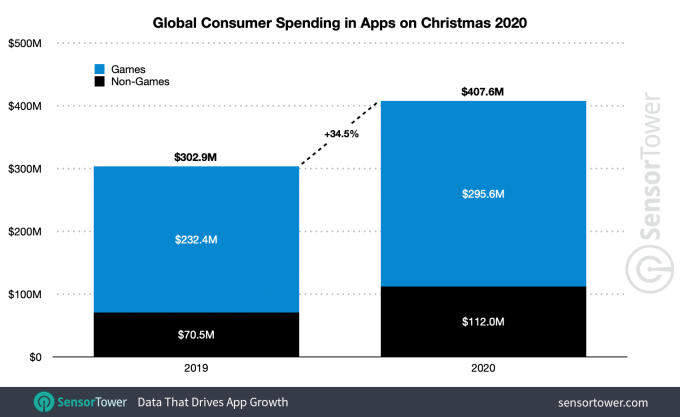
Global app spending didn’t seem to be impacted by the pandemic in 2020, according to data from Sensor Tower. The firm reports that consumers spent $407.6 million in apps from the iOS App Store and Google Play on Christmas Day, 34.5% from the $303 million spent in 2019. The majority of the spending was on mobile games, up 27% year-over-year to $295.6 million. Tencent’s Honor of Kings led the games category, while TikTok led non-game apps with $4.7 million in spending on Christmas Day.
Image Credits: Sensor Tower
As in prior years, Apple accounted for the majority of the spending, or 68.4% ($278.6M) vs Google Play’s $129M. The spending was led by the U.S., who accounted for ~$130 million of the total
Apple takes a stand on pandemic parties
Apple’s App Store Review guidelines don’t specifically detail how the company will handle apps that could contribute to the spread of COVID-19, but Apple found a way to draw the line when it came to a social app that encouraged unsafe gatherings. This past week, Apple banned the app Vybe Together, which had allowed people to locate “secret” indoor house parties in their area, sometimes including those held in violation of state guidelines.
NYT reporter Taylor Lorenz first called attention to the problem with a tweet. The app had been posting to TikTok to gain attention, but its account has since been removed. Following its removal, the company defended itself by saying that it was only meant for small get-togethers and the founder lamented being “canceled by the liberal media.”
There’s no good defense, really, for the unnecessary and ill-timed promotion of an app that encouraged people from different households to gather, which spreads COVID. And what the founder seemed to not understand, by nature of his recent tweets and statements on the app’s website, is that many cities and states also alreadyprohibit small private gatherings of varying degrees, including those he believes are fine, like small parties in folks’ “own apartments with people in your area.”
The U.S. is coping with 346,000 COVID deaths, and in New York, where the app was promoting NYE parties, 74% of all COVID-19 cases from Sept.-Nov. 2020 have been linked to private gatherings.
The media may have reported on what the app was doing, but ultimately the decision to “cancel” it was Apple’s. And it was the correct one.
iOS games have long been required to obtain a Chinese gaming license in order to operate in the country, but Apple skirted this rule for years by hosting unlicensed titles even as Android app stores complied. Apple began to enforce the rule in 2020 and gave publishers a Dec. 31, 2020 deadline to obtain the license — a process that can be tedious and time-consuming.
Clearly, a large number of publishers were not able to meet the deadline. Included in the new sweep were Ubisoft’s Assassin’s Creed Identity and NBA 2K20. Qimai says only only 74 of the top 1,500 paid games remained following the removals. To date, Apple purged more than 46,000 titles from the China App Store, the report said.
TikTok births a “Ratatousical”
The TikTok musical version of Ratatouille has become a real thing. The pandemic forced a lot of creative types out of work in 2020, leading them to find new ways to express themselves online. On TikTok, this collective pent-up energy turned into a large-scale collaborative event: a musical version of Disney’s Ratatouille. (Or Ratatousical, as it was nicknamed.) TikTokers composed music, wrote lyrics and dialogue, choreographed dances, designed costumes, sets and more, as they worked together through the app.
Surprisingly, Disney is allowing a charity version of this collaboration to become a real event without any interference or lawsuits. The Ratatouille musical live-streamed on Jan. 1 at 7 p.m. Eastern, and will be available via video-on-demand through Jan. 4, for a minimum $5 donation to The Actors Fund.
The musical itself was lighthearted fun for a younger, Gen Z crowd. It also cleverly incorporated actual TikTok videos that featured the app’s well-known visual effects — like cloning yourself or the flashing colored lights typically associated with TikTok’s “you think you can hurt me” meme, for example. That made it more accessible and familiar to kids who had spent the past year being entertained via the internet.
TikTok users, of course, aren’t the only ones designing, creating and editing productions through remote and collaborative processes in 2020 — Hollywood itself has had to reorient itself for remote work at a much larger scale. TikTok was simply the platform of choice for theater kids looking for something to do.
It will be interesting to see if the TikTok-based collaborative process that birthed this musical ultimately becomes a one-off event that arose from the pandemic’s impacts — including the ability for many creative people to devote time and energy on side projects, for example, due to shuttered productions and stay-at-home orders. Or perhaps in-app collaborations have a real future? Time will tell.
TikTok has already proven it can drive the music charts, fashion trends, and app downloads, so it can probably generate an audience for this production, as well. But the cynic may wonder if such an event would have been as popular and buzzworthy had it been some entirely original production, rather than one based on already popular and beloved Disney IP. But you may as well watch — it’s not like you have any other plans these days.
Weekly News
Platforms
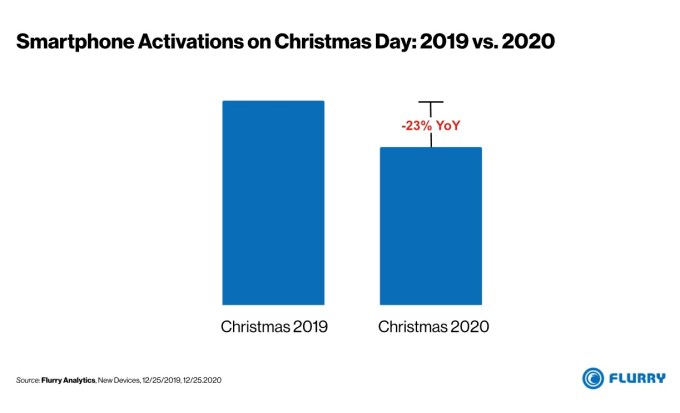
The iPhone 11 was the most activated device on Christmas Day 2020, according to Flurry data, with activations 5% higher versus the 7 day average between December 18 to December 24. However, overall new smartphone activations were down 23% year-over-year, likely because of the economic hardships due to the COVID health crisis, including delayed stimulus checks.
App downloads were up 33% in 2020, up 25% compared with 2019, according to data from AppsFlyer. Mobile marketers spent $74.6B globally to drive installs, slightly down from the $74.2B spent in 2019.
Samsung teams up with Epic Games on Apple battle over Fortnite. Samsung and Epic Games worked together on the “Free Fortnite” marketing campaign, which recently involving sending packages to influencers that contained a Free Fortnite bomber jacket and Samsung Galaxy Tab S7. Fortnite was the Samsung Galaxy Store game of the year in 2020, and the store also distributes the Epic Games app which distributes the Fortnite updates. This is an odd move as Epic alleges the app stores leverage their power to engage in monopolistic practices, but this makes it clear that Samsung is offering them distribution. Apple has the right to set its own pricing for its services (and it recently lowered commissions for small businesses, too). But even if Epic Games is not the knight in shining armor one would hope for, its lawsuit could help set precedent. And regulators may still decide one day that Apple can’t dictate rules about how businesses operate outside its app store — meaning, they should have the right to collect their own payments, for example.
Augmented Reality
Image Credits: The New York Times
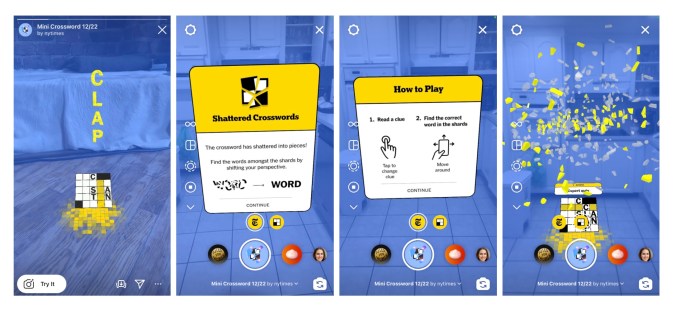
The New York Times gets into AR gaming. The media company has experimented with augmented reality as a way to augment storytelling both in its app and through other efforts on social media. But it has now taken AR into the world of gaming with an AR-enabled crossword puzzle where you swipe to rotate broken pieces floating above the puzzle to find clues.
Social & Photos
Telegram photo by Jakub Porzycki/NurPhoto via Getty Images
Telegram begins to make money. The messaging app, now nearing 500 million users, will introduce an ad platform for its public one-to-many channels that is “user-friendly” and “respects privacy.” The company says it needs to generate revenue to cover the costs of server and traffic. Telegram earlier abandoned a blockchain token project due to regulatory issues.
Mr. Beast announces the second annual “Finger on the App” challenge on Feb. 19. The game doles out $100,000 to whoever can keep their finger on their smartphone the longest, via an app designed for this purpose. Last year, it was a four-way tie after 70 hours, and the prize money was divided. The new app introduces in-app challenges to dissuade cheating. YouTuber Mr. Beast rose to fame for his philanthropic-based viral videos and stunts. He has made sizable donations to people in need and those impacted by the pandemic. But this year, the otherwise silly game has a darker tone as it involves competitors who will likely be in more desperate situations.
Bumble uproar over indoor bikini and bra photos. The dating app found itself in the middle of a small controversy this week when a woman who wanted to pose in her bra had her photos taken down. The company said its existing policy prohibits things like shirtless bathroom mirror selfies and indoor photos of people wearing swimsuits and underwear. Bumble’s policies were crafted in response to user data and feedback, but may also help to prevent adult sites from spamming with fake profiles. However, there’s still something weird about an app that markets itself as female-friendly telling a woman to go put some clothes on.
TikTok launches its first personalized annual recap feature. The company “year on TikTok” in-app experience joins other personalized wrap-ups like the Top Nine for Instagram or Spotify’s Wrapped. It also introduces a floating, tappable button to connect users to the experience. This could pave way for other sorts of mini-applications in the future.
Clubhouse power users invited to special club. A select group of creators inside the already invite-only audio conversations app have now been given exclusive access to tools and private meetings with Clubhouse leadership and influencers. In one meeting, the creators discussed monetization strategies. The app grew to popularity amid the pandemic as people have been prevented from typical forms of networking, but it’s also struggled with moderation as conversations go off the rails. Today, Clubhouse alsohostsmanyadulttopics, as well, which would give the app a 17+ rating if it were actually submitted to the App Store instead of being in a private beta.
Streaming
HBO Max’s mobile app set a single-day download record following the release of “Wonder Woman 1984.” During the release weekend (Fri.-Sun.) the app saw 554K downloads, including 244K downloads on Sunday alone, reported Apptopia. The firm estimates the app now has just under 12M mobile users.
Health & Fitness
Five top menstruation apps have been called out by U.K.-based charity Privacy International for collecting and storing “excessive” information on their users’ personal health and habits. The organization argues the apps should work without a registration requirement and should store data on the phone. The apps cited for privacy abuses included Clue, Flo, Maya, MIA, and Oky.
Government & Policy
The U.S. government appealed the injunction against its TikTok ban on Dec. 28. Two U.S. judges had already stopped Trump’s E.O. from being carried out. U.S. District Court Judge Carl Nichols on Dec. 7 determined the Commerce Dept. had overstepped its authority, and declared the action “arbitrary and capricious.” The department said it would continue to pursue the ban, which it did this past week by filing the appeal. It’s still unclear what will happen to TikTok and this specific case the days to come when President-Elect Biden takes office, but many suspect it could be dropped as the new administration focuses on more pressing issues, like the COVID crisis.
Tappity raises $1.3 million for its interactive and educational video library for kids. The Y Combinator-backed startup using live action actors responding to kids’ actions in the apps to teach standards-based science.
Tencent-backed edtech startup Yuanfudao raises $300 million from Jack Ma’s Yufeng Capital. The company, which earned $1.53B USD in 2020, makes a variety of remote learning products, including live tutoring platform Yuanfudao, Zebra AI Class, online question bank Yuantiku, question searching app Xiaoyuan Souti, and arithmetic problem checking app Xiaoyuan Kousuan.
Language learning app Fluent Forever raises $4.9 million in a round led by Denver-based Stout Street Capital. A competitor to Duolingo and Babble, the app using personalized learning, ear training, visual aids, and spaced repetition to help students learn new words and phrases.
Dailyhunt parent company Verse Innovation raises $100 million from Google, Microsoft and Falcon Edge’s Alpha Wave Incubation, valuing its business at over $1 billion. The company will use the round to scale its short-form video app, Josh, and more.
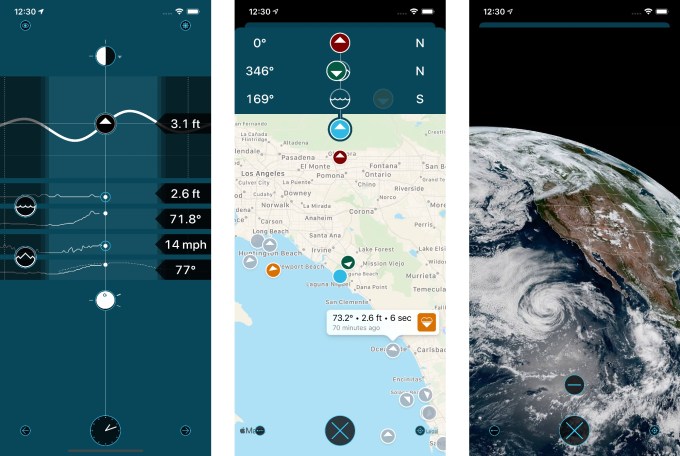
The popular app maker Iconfactory released a new app, Waterscope, that is a weather app more specifically designed to provide users with information on water conditions. Creator Craig Hockenberry explains the app is something he largely built for himself, an ocean swimmer often in need of information about the tides, wave heights, water temperature, wind speed, air temperature, forecasts and more. The app could be useful to those who live around the water, whether they’re swimming, fishing, boating or anything else. iOS only.
Run Boggo Run
Image Credits: BuzzFeed
This endless runner is BuzzFeed’s first mobile game, which makes it worth noting if not exactly recommending. The mental health-themed game, inspired by BuzzFeed’s animated series The Land of Boggs, was created by BuzzFeed Animation Studios. In the game, characters try to avoid things like stress monsters and gremlins, which is a humorous take on the anxieties of 2020. However, early user reviews indicate the game’s controls are too difficult and complain the game is too hard to be fun. How stressful! $0.99 on iOS and Android.
Enso
A new meditation game Enso promises to help users relax, meditate or fall asleep faster using gameplay that involves soothing visuals and sounds, composed by A.I. The app consists of 5-minute journeys where users concentrate on a task while guiding their movements and breath to achieve their goals. iOS and Android.
Portal
Image Credits: Portal
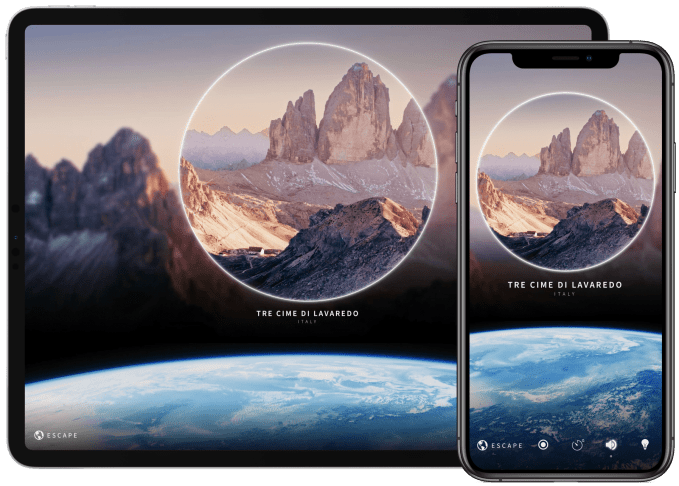
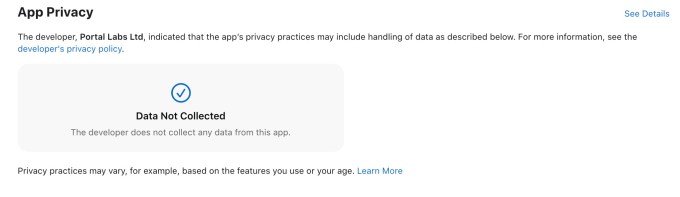
Not Facebook’s Portal! This sleep and relaxation-focused app, also called Portal, has been updated with Apple’s new privacy measures in mind. The company announced in December it will not collect user data from its app, and will now no longer use any in-app analytics tracking. The app also never required a login or collected personal information, and didn’t include third-party ads and ad trackers.
That’s resulted in an App Store rare find:
How refreshing.
The Portal app is a free download and offers a $35 per year membership for those who want access to the full content library.