Wednesday, October 13, 2021

Funnel, a no-code tool for marketers to organize disparate data sources, raises $66M in ‘pre-IPO’ round

The world of marketing has become a world of marketing tech. But marketers are not necessarily engineers, so working with the terabytes of data their campaigns produce can be a challenge. Today, a Stockholm startup called Funnel, which has built a no-code platform to help manage that process, is announcing $66 million in funding, a growth round that underscores the demand in the market for such tools. Funnel is describing this as a “pre-IPO” round: it will be its last before it files to go public, likely in his home market, and likely in the next six to 18 months.

Fourth Swedish National Pension Fund (AP4) and Stena Sessan are co-leading the round, with previous backers Balderton Capital, Eight Roads, F-Prime, Oxx, and Industrifonden also participating, among others. Fredrik Skantze, the co-founder and CEO, said the company is not disclosing its valuation but he said it was considerably higher than its pre-money valuation in its last round, a pre-pandemic $47 million Series B in January 2020.

As a measure of Funnel’s size, the company has about 1,200 large customers, with about half of them in the U.S. They include brands like Home Depot, trivago, Skechers, Samsung, Vodafone, Logitech, Skyscanner, and SAS – Scandinavian Airlines, as well as Havas Media, a division of the French advertising and PR giant, Ogilvy and DAC Group.

The challenge that Funnel is tackling is that marketing has become a massively digitized business: although outdoor, print, television and other analogue campaigns still account for 40% of marketing spend, that leaves 60% to digital.

That is a proportion that is still very much on the rise, not least because digital marketing provides a more measurable picture of how well a campaign is doing: people engage and respond on social media; they click on links; they share information to other platforms. The growing ubiquity of digital marketing also means that the data sources that a marketer typically uses are also growing.

“Four or five years ago, a marketer typically used seven data sources,” said Skantze. “Then that grew to 10. Now, our customers might be using 20 to 30 or even 70 or 80 data sources. If you are active in 50 markets that becomes a complex problem.”

But that also poses a data problem. When there are fewer platforms and marketing campaigns running, a marketer has typically relied on using spreadsheets to analyse data, or tools specific to a single campaign. However, that becomes untenable as the data sources grow and as the expectations of what marketers want to get out of that information grow along with it. Working with the data that is produced thus usually requires the help of a data scientist to organise it to be reported in a more usable way.

“It’s not enough to simply use the raw data,” Skantze said. “Facebook alone has 700 metrics, and the data you will get from a campaign just goes to a data warehouse. So you have to make it business-ready, you have to normalize it. That means using something like SQL. And that means marketers themselves cannot work directly with that funnel of data.”

Funnel’s platform is able to “read”, organize and create reports for the various datasets coming out of these campaigns, by way of sets of rules that are pre-designed, or a company can customize for itself. It currently handles some 550 different data sources (from social media platforms to search engines and much more: basically any digital platforms that might be used by a marketer to run a campaign). And it is adding more in as and when customers use them, Skantze said. Through drop-down menus, non-technical marketers can do, he said, “all the things they would have previously asked an IT person to do, to stage the data.”

The key also is that it’s focused on marketing, which also sets it apart from other competitors providing low-code tools to help organize data for further business intelligence or reporting applications.

“Five years ago I would have thought that BI tools would solve this, but the problem is is that they are too horizontal, and cover any type of data, whether it is marketing, geographical, financial or so on. So within marketing it might cover only five data sources, while we have 550,” he said. “You can’t solve the problem of pulling in the data unless you are vertical in some sort of segment. It’s the same with snowflake: it has 200 connectors but they are in too many areas.”

Funnel’s future growth may seem all but assured: more online activity breeds more marketing activity, and marketers are being expected to report and provide more, not less, insights about what they do and discover about their customers. On the other hand, the market is evolving. People do not want to be tracked; regulations are coming into force that are making it harder to gather marketing data; there is a growing body of technology that is looking for ways of creating “synthetic” datasets that could mean less reliance on pulling data out of marketing campaigns, which could mean less business for the Funnels of the world; and platforms are also changing their tune.

“The restrictions that Apple has placed on tracking on iOS has had a big impact especially for B2C companies,” Skantze said. “They are not seeing the same level of performance as before. It’s something our customers are concerned with but so far that hasn’t affected us. Our role is to pull down data, so that others can understand it. We are a bit like Switzerland here. We are a step away from the mechanics of adtech.”

Regardless of how that develops, this is a good argument for diversifying to cover more than marketing in its platform.

There are a number of tools in the market today that are also creating ways to better order data troves so that they can be used for better business intelligence. They include Collibra and Acryl and many others. The key with Funnel is that it is presented firmly as a tool for non-technical people, and it has been built with marketing in mind, Skantze noted. That being said, the company has plans to extend beyond marketing over time. “We are already pulling data for sales teams and e-commerce teams,” he said, and it is also eyeing up a move into providing data reporting tools for the finance sector.

“Pre-IPO” rounds in the context of this latest fundraise is about bringing in institutional investors who will also be a part of the IPO process.

“We are long term investors who look for companies we like and hold them for a long time. We were impressed with the size of the global opportunity and the team’s ambition to build a large software company,” said Jannis Kitsakis, senior portfolio manager at AP4, in a statement.

“Funnel has shown strong, predictable growth with impressive go to market metrics and a global footprint,” added Fredrik Konopik, Investment Director at Stena Sessan. “We feel that the company is well positioned for the public market in Sweden.”


from blogger-2 https://ift.tt/2Xa16Ru
via IFTTT

Tuesday, October 12, 2021

Plume raises $300M as it passes 1.2B devices in 35M homes using its smart WiFi service

Plume — a communications startup that partners with carriers to provide smart mesh WiFi to improve broadband connectivity in homes, and then offers other smart home services on top of that network — has been in the middle of a massive boom in its business fueled by the rapid uptake, use, and complete reliance on broadband in the home working as best as it can.

Now it has closed a huge funding round to ride the wave. The Palo Alto-based startup has raised another $300 million led by SoftBank Vision Fund 2 at a valuation of $2.6 billion. Plume’s CEO and founder Fahri Diner said the startup will be using the money to continue building out its software platform, inking and servicing more deals with carriers, and generally expanding its horizons.

“Two years ago, the killer app was WiFi, managing the pods,” he said, referring to the system of mesh routers that are used to improve the speed and quality of a WiFi network in homes. “That is no longer it, although it’s still a big piece of it. Access control and device security are growing fast, and people are also engaging with our motion sensors since indoor cameras are going away because of privacy reasons. IOT, health, energy management, and home security are all areas we have been testing for two years and they work, so we will be leaning into a lot of stuff.”

Other investors in this latest round were not disclosed but previous backers include a strong mix of strategic and financial investors: Charter Communications, Comcast Cable, Foxconn, Insight Partners, Jackson Square Ventures, Liberty Global Ventures, Presidio Ventures, Qualcomm, Samsung, Service Electric Cablevision, Shaw Ventures, Silicon Valley Bank, and UpBeat Venture Partners among them. Insight was the sole backer in its last round, investing $270 million at a $1.35 billion valuation in the startup. The fact that this latest SoftBank-led round is coming just eight months later is a mark of how rapidly Plume’s business has been growing.

Indeed, Covid-19 and the impact it had on how we use our broadband at home has probably been the biggest driver of Plume’s business in the last year.

As more people have been compelled to stay home to work, study, and pass the time, the more strain we’ve been putting on those home networks. In some cases, like mine, that strain also quickly led to major cracks: I am myself a Plume user; after trying a number of other things it was the only solution that could get the broadband to work well and reliably in our London Victorian house.

I guess we weren’t the only ones. Plume said that business ballooned in the last two quarters, adding 13 million new households to total 35 million (“more than our biggest customer, Comcast,” Diner pointed out to me); and it added 350 million more devices to its platform bringing the total to 1.2 billion devices; plus 60 more broadband carrier customers to now total 240 million globally (these include cable companies, telcos, and wireless carriers that also offer broadband).

It’s also now partnering with those carriers to branch out beyond their own broadband. In an OTT-style play, in the UK, Plume and Virgin Media are selling HomePass, which includes the Plume pod and software to manage it and run other services, across all of the UK (25 million households), regardless of whether Virgin is providing the broadband underpinning the service or not.

All of this is banked around services for consumers and the connected home. These are two areas where the startup will definitely continue to expand its reach, as outlined by the range of managed services Diner said the company has been working on for some time, along with others tapping into the connected home and specifically electronic objects that already have some degree of interfacing with the internet (think here: Plume letting you know when your connected Nespresso machines is about to need cleaning). These are due to start to get rolled out later this year when Plume releases an update of its app.

But further along, the company’s next steps will likely be outside the home, Diner said. One big area where you could see it doing more, for example, is in the area of industrial environments, where there are vast networks of often remote devices that are costly to connect to networks in a reliable way, which also need monitoring — two areas where Plume could figure in the future.

“We might segment the market into residential, business, and industrial IoT,” he said. “We have a phenomenal foothold in residential, which we are now moving into small business. Industrial is also in our scope. We have ambitious plans and this financing gives us more capability.” What is not in scope, he added, is enterprise campuses, where often there is already extensive internet wiring and bespoke WiFi solutions that fit into a company’s particular networking and security configurations.

“The pandemic has dramatically accelerated the adoption of digital services, increasing our dependence on smart devices,” said Nagraj Kashyap, Managing Partner at SoftBank Investment Advisers, who joined the Plume Board of Directors, in a statement. “Through its innovative cloud data platform, we believe Plume’s consumer-first approach provides customers with reliable connectivity in their homes and beyond. We are pleased to partner with Fahri and the team to support their ambition of reinventing services for smart spaces globally.”


from blogger-2 https://ift.tt/3BBUNVB
via IFTTT

Thursday, October 7, 2021

Epic Games CEO Tim Sweeney calls out Apple for promoting its services in the iPhone Settings screen

Epic Games CEO Tim Sweeney, whose high-profile antitrust lawsuit against Apple is now under appeal, is today calling out the iPhone maker for giving itself access to an advertising slot its competitors don’t have: the iPhone’s Settings screen. Some iOS 15 users noticed Apple is now advertising its own services at the top of their Settings, just below their Apple ID. The services being suggested are personalized to the device owner, based on which ones they already subscribe to, it appears.

For example, those without an Apple Music subscription may see an ad offering a free six-month trial. However, current Apple Music subscribers may instead see a prompt to add on a service they don’t yet have, like AppleCare coverage for their devices.

Sweeney suggests this sort of first-party advertising is an anticompetitive risk for Apple, as some of the services it’s pushing here are those that directly compete with third-party apps published on its App Store. But those third-party apps can’t gain access to the iPhone’s Settings screen, of course — they can only bid for ad slots within the App Store itself.

Writes Sweeney: “New from the guys who banned Fortnite: settings-screen ads for their own music service, which come before the actual settings, and which aren’t available to other advertisers like Spotify or Sound Cloud.”

Sweeney had been retweeting another post by Mobile Dev Memo analyst Eric Seufert, who himself was sharing an image credited to Glassfy co-founder Francesco Zucchetta.

Zucchetta tells TechCrunch he spotted the ad on an iPhone 8 he owned which was running iOS 15. But others have seen the ads on newer devices, as well. And some respondents noted they were receiving Apple’s promotions as push notifications, too.

The issue here is tricky because the promotion isn’t always a situation where Apple is disadvantaging a rival to its own benefit.

For example, on an iPhone 13 Pro Max we have which is running iOS 15.1, the prompt was used to inform us we still had a certain number of days left to add AppleCare+ coverage. (We already have most of Apple’s other subscriptions.). But in this case, there aren’t third-party apps offering a direct competitor to AppleCare, in the same way that Spotify directly competes with Apple Music. Instead, warranty companies like Asurion partner with mobile carriers like AT&T and Verizon to sell their iPhone insurance plans, instead of selling direct to consumers through the App Store.

Some might even argue that a reminder to add warranty coverage is a useful feature, not an unwanted intrusion.

While Sweeney’s tweet has raised awareness of the first-party promotions in Settings, they are not new.

Apple has often used the iPhone’s Settings screen to market its services to its customers in much of the same way as it’s doing now.

Last year, for example, it was spotted running promotions for Apple Arcade, AppleCare and Apple TV+ in Settings. Outside of this screen, Apple has also promoted its own services in other unusual ways, including through the use of push notifications. And it has cross-promoted its services inside its own apps for years — like prompts to subscribe to Apple Music while using iTunes.

But regulators today are taking a closer look at platforms and how they’re using or abusing their market power. Google is currently appealing a record penalty in the EU for its requirement that device manufacturers preinstall Google’s suite of apps with the phones they sell. Samsung, meanwhile, said it would stop running ads in its first-party apps on Galaxy devices. (It had displayed ads for other companies and those that promoted its own products, at times.)

Epic Games didn’t have any further comments on Sweeney’s tweet, including whether or not the company would be using this latest bit of information in its upcoming appeal. Apple has been asked for comment but has not responded.


from blogger-2 https://ift.tt/3BoKpAq
via IFTTT

Tuesday, September 21, 2021

The iPhone 13 Pro goes to Disneyland

This year’s iPhone review goes back to Disneyland for the first time in a couple of years for, uh, obvious reasons. I’m happy to report that the iPhone 13 Pro and iPhone 13 performed extremely well and the limited testing I was able to do on the iPhone mini and iPhone 13 Pro Max showed that for the first time you’re able to make a pretty easy choice based on size once you’ve decided you’re ok without telephoto.

One of the major reasons I keep bringing these iPhones back to Disneyland is that it’s pretty much the perfect place to test the improvements Apple claims it is making in an intense real-world setting. It’s typically hot, the network environment is atrocious, you have to use your phone for almost everything these days from pictures to ticket scanning to food ordering and you’re usually there as long as you can to get the most out of your buck. It’s the ideal stress test that doesn’t involve artificial battery rundowns or controlled photo environments. 

In my testing, most of Apple’s improvements actually had a visible impact on the quality of life of my trip, though in some cases not massive. Screen brightness, the longer telephoto and battery life were all bright spots.

Performance and battery

The battery of the iPhone 13 Pro hit just over the 13 hour mark in the parks for me running it right to the dregs. Since there was so much video testing this year, the camera app did stay on screen longer than usual at just over 1hr of active ‘on screen’ usage which does put a bit of a strain on the system. I’d say that in real-world standard use you’ll probably get a bit more than that out of it so I’m comfortable saying that Apple’s estimate of an hour or more longer video playback time from the iPhone 12 Pro is probably pretty accurate. 
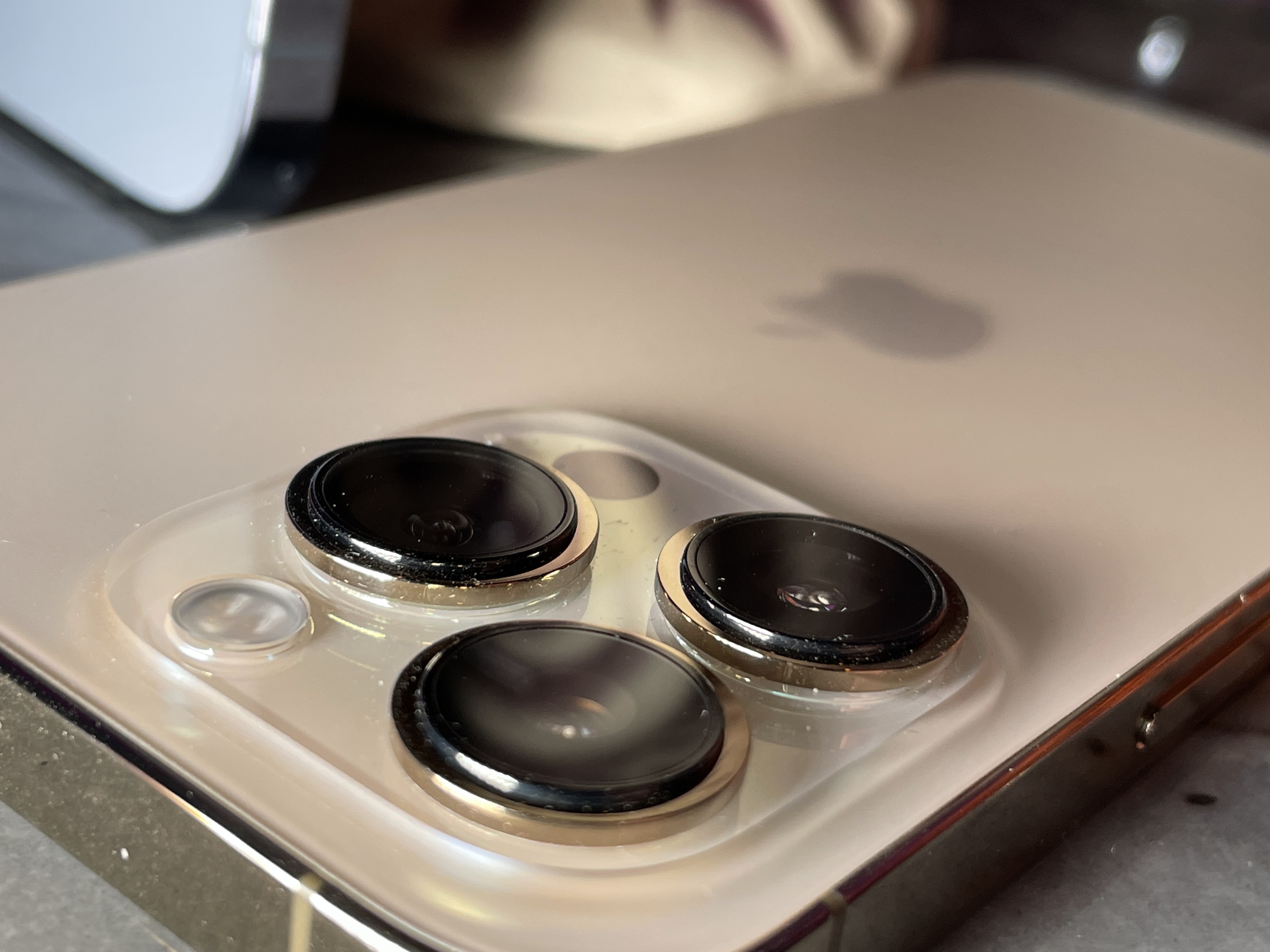
Image Credits: Matthew Panzarino

Though it was hard to get the same level of stress on the iPhone 13 Pro Max during my tests, I’d say you can expect even more battery life out of it, given the surplus it still had when my iPhone 13 Pro needed charging. Bigger battery, more battery life, not a big shock.

If you’re using it in the parks and doing the rope drop I’d say I would plan on taking it off the charger at 6am or so and plan to have a charger handy by about 4pm so you don’t go dead. That’s not a bad run overall for an iPhone in challenging conditions and with heavy camera use. 

Apple’s new ProMotion display was a nice upgrade as well, and I did notice the increased screen brightness. Typically the bump in brightness was only truly noticeable side-by-side with an iPhone 12 Pro with high-key content displayed on the screen. Popping open the Disneyland app for the barcode meant a bit better consistency in scanning (though that’s pretty hard to say for sure) and a visual increase in overall brightness in direct sun. Out of the Sun I’d say you’d be hard pressed to tell.

The variable refresh rate of the ProMotion screen cranking all the way up to 120hz while scrolling Safari is a really nice quality of life improvement. I’m unfortunately a bit jaded in this department because I’ve done a ton of my computing on the iPad Pro for the past couple of years, but it’s going to be an amazing bump for iPhone users that haven’t experienced it. Because Apple’s system is not locked at 120hz, it allows them to conserve battery life by slowing down the screen’s refresh rate when viewing static content like photos or text when not scrolling. I’m happy to say that I did not see any significant ramping while scrolling, so it’s really responsive and seamless in its handling of this variability.

The new A15 chip is, yes, more powerful than last year. Here’s some numbers if that’s your sort of thing:

Impressive as hell, especially for more battery life not less. The power-per-watt performance of Apple’s devices continues to be the (relatively) un-sung victory of its chips department. It’s not just that this year’s iPhones or the M1 laptops are crazy fast, it’s that they’re also actually usable for enormous amounts of time not connected to a charger. For those curious, the iPhone 13 Pro appears to have 6GB of RAM. 

Design

Image Credits: Matthew Panzarino

The design of the iPhone continues to be driven by the camera and radio. Whatever is necessary to support the sensors and lenses of the camera package and whatever is necessary to ensure that the antennas can accommodate 5G are in control of the wheel at this point in the iPhone’s life, and that’s pretty natural. 

The camera array on the back of the iPhone 13 Pro is bigger and taller in order to accommodate the three new cameras Apple has installed here. And I do mean bigger, like 40% bigger overall with taller arrays. Apple’s new cases now have a very noticeable raised ridge that exists to protect the lenses when you’re setting the case down on a surface. 

Everything else is sort of built around the camera and the need for wireless charging and radio performance. But Apple’s frosted glass and steel rim look retains its jewel-like quality this year and they’re still really good looking phones. I doubt the vast majority of people will see them long without a case but while you do they’re nice looking phones.

The front notch has been pared down slightly due to improvements in camera packaging, which leaves a tiny bit more screen real-estate for things like videos, but we’ll have to wait to see if developers find clever ways to use the extra pixels. 

Now, on to the cameras.

Cameras

It seems impossible that Apple continues to make year-over-year improvements that genuinely improve your optionality and quality of images that are enough to matter. And yet. The camera quality and features are a very real jump from the iPhone 11 Pro across the board and still a noticeable improvement from the iPhone 12 Pro for you early adopters. Anything older and you’re going to get a blast of quality right to the face that you’re going to love. 

The camera packaging and feature set is also more uniform across the lineup than ever before with Apple’s IBIS in camera sensor shift stabilization system appearing in every model — even the iPhone 13 mini which is a crazy achievement given the overall package size of this sensor array.

In my experience in the parks this year, Apple’s improvements to cameras made for a material difference no matter which lens I chose. From low light to long zoom, there’s something to love here for every avid photographer. Oh, and that Cinematic Mode, we’ll talk about that too. 

Telephoto

Of all of the lenses I expected improvement from, the telephoto was actually not that high on my list. But I was pleasantly surprised by the increased range and utility of this lens. I am an admitted telephoto addict, with some 60% of my photos on iPhone 12 Pro taken with the tele lens over the wide. I just prefer the ability to pick and choose my framing more closely without having to crop after the fact. 

Having Night Mode on the telephoto now means that it doesn’t fall back to the wide lens with crop in dark conditions as it used to. Now you get that native telephoto optics plus the Night Mode magic. This means much better black points and great overall exposure even hand held at zoom — something that felt just completely out of reach a couple of years ago.
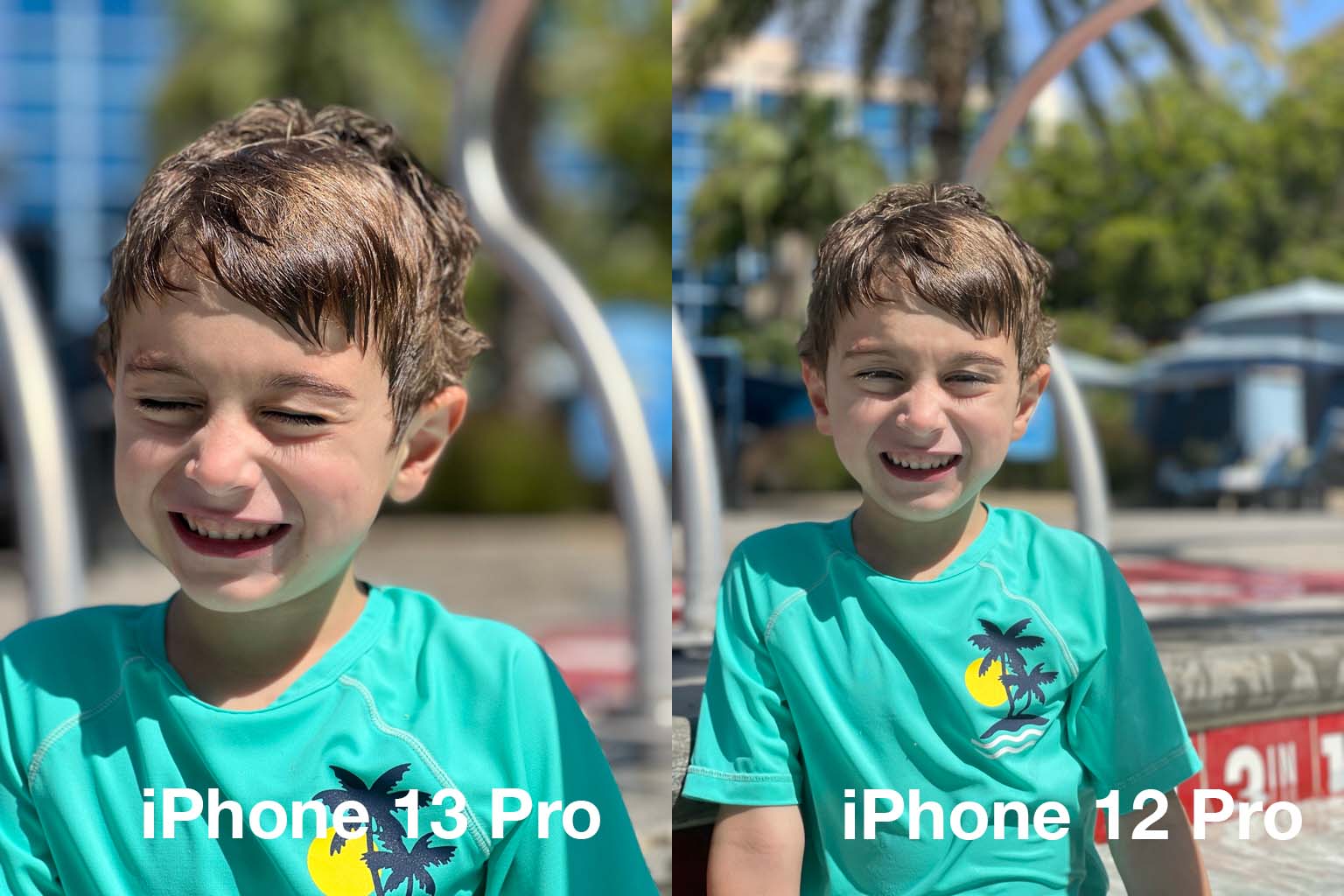
Image Credits: Matthew Panzarino

With the higher zoom level, portraits are cropped tighter, with better organic non-portrait-mode bokeh which is lovely. With this new lens you’re going to be able to shoot better looking images of people, period.

If you’re a camera person, the 3x reminds me a lot of my favorite 105mm fixed portrait lens. It’s got the crop, it’s got the nice background separation and the optical quality is very, very good on this lens package. Apple knocked it out of the park on the tele this time around. 

Image Credits: Matthew Panzarino

The longer optical range was also very handy in a Disneyland world where performers are often kept separate from guests — sometimes for effect but mostly because of pandemic precautions. Being able to reach out and get that shot of Kylo Ren hyping up the crowd was a fun thing to be enabled to do.

Wide

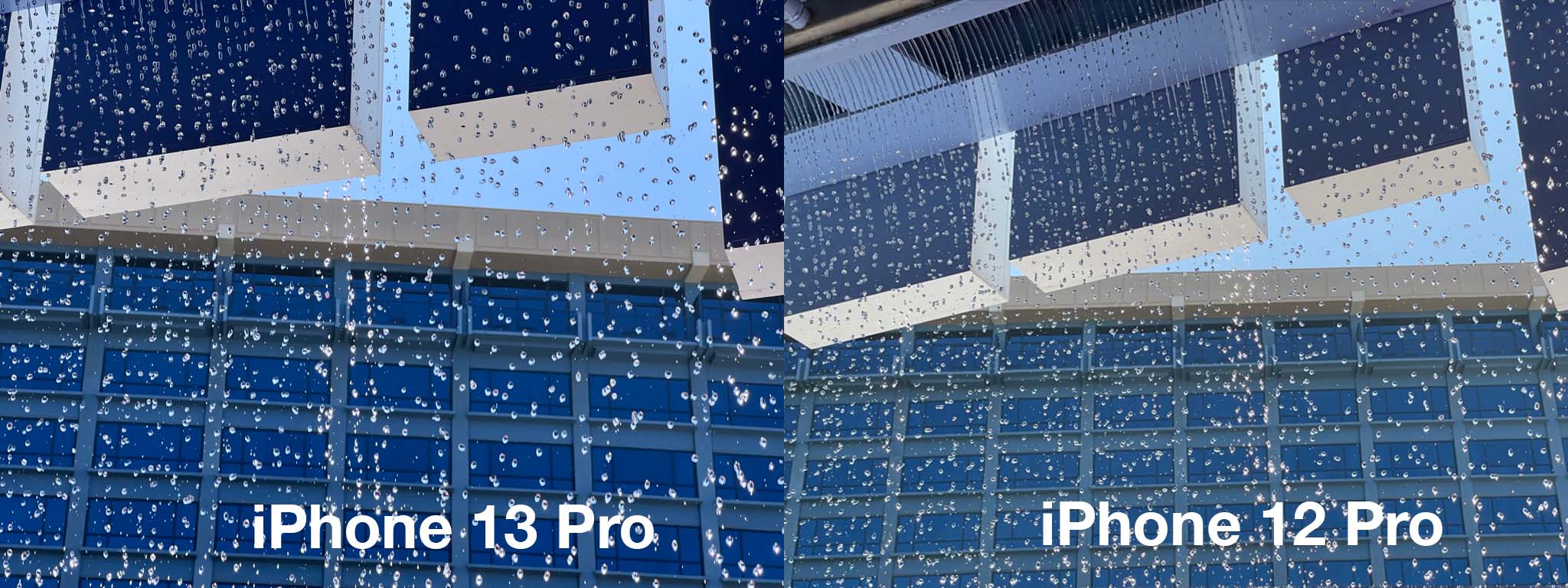
Apple’s wide lens gets the biggest overall jump in sensor technology. A larger Æ’/1.5 aperture and new 1.9µm pixels roughly doubles the light gathering — and it shows. Images at night and inside ride buildings had a marked improvement in overall quality due to deeper blacks and better dynamic range. 
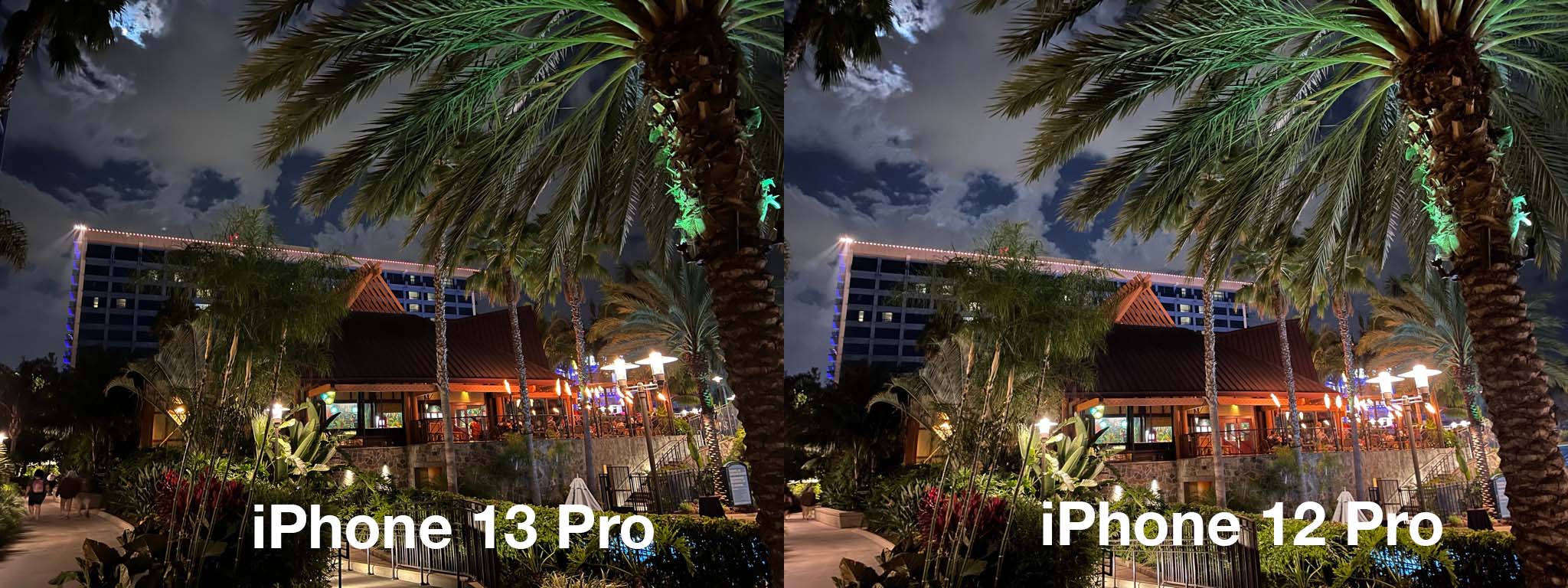
Image Credits: Matthew Panzarino

With Night Mode enabled, the deeper light gathering range and improved Smart HDR 4 makes for deeper blacks and a less washed out appearance. If I had to characterize it, it would be ‘more natural’ overall — a theme I’ve seen play out across the iPhone cameras this time around. 

Image Credits: Matthew Panzarino

Without Night Mode enabled, the raw improvement in image quality due to more light being captured is immediately evident. Though I think there are few situations where you need to turn off Night Mode any more, subjects in motion in low light are one of those and you’ll get a few inches extra of wiggle room with this new sensor and lens combo in those instances. 

Having sensor shift OIS come to the wide on the iPhone 13 across the range is a huge godsend to both still shots and video. Though I’m spoiled having been able to play with the iPhone 12 Pro Max’s stabilization, if you haven’t shot with it before you’re going to be incredibly happy with the additional levels of sharpness it brings.

Ultra Wide

Apple’s ultra wide camera has been in need of some love for a while. Though it offered a nice additional perspective, it has suffered from a lack of auto-focus and sub-par light gathering ability since its release. This time around it gets both a larger Æ’/1.8 aperture and autofocus. Apple claims 92% more light gathering and my testing in pretty rough lighting conditions shows a massive improvement across the board. 

Image Credits: Matthew Panzarino

Typically at Disneyland I like to shoot the wide in one of two ways: up close to create a fisheye-type perspective for portraits or to snag a vista when the lighting or scene setting is especially good. Having auto focus available improves the first a ton and the wider aperture gives the second a big boost too. 

Check out these shots of a moonlit Trader Sam’s, a snap that you might grab because the lighting and scenery are just right. The iPhone 12 Pro isn’t bad at all here but there is an actually quite clear difference between the two in exposure. Both of these were taken with Night Mode disabled in order to compare the raw improvement in aperture.
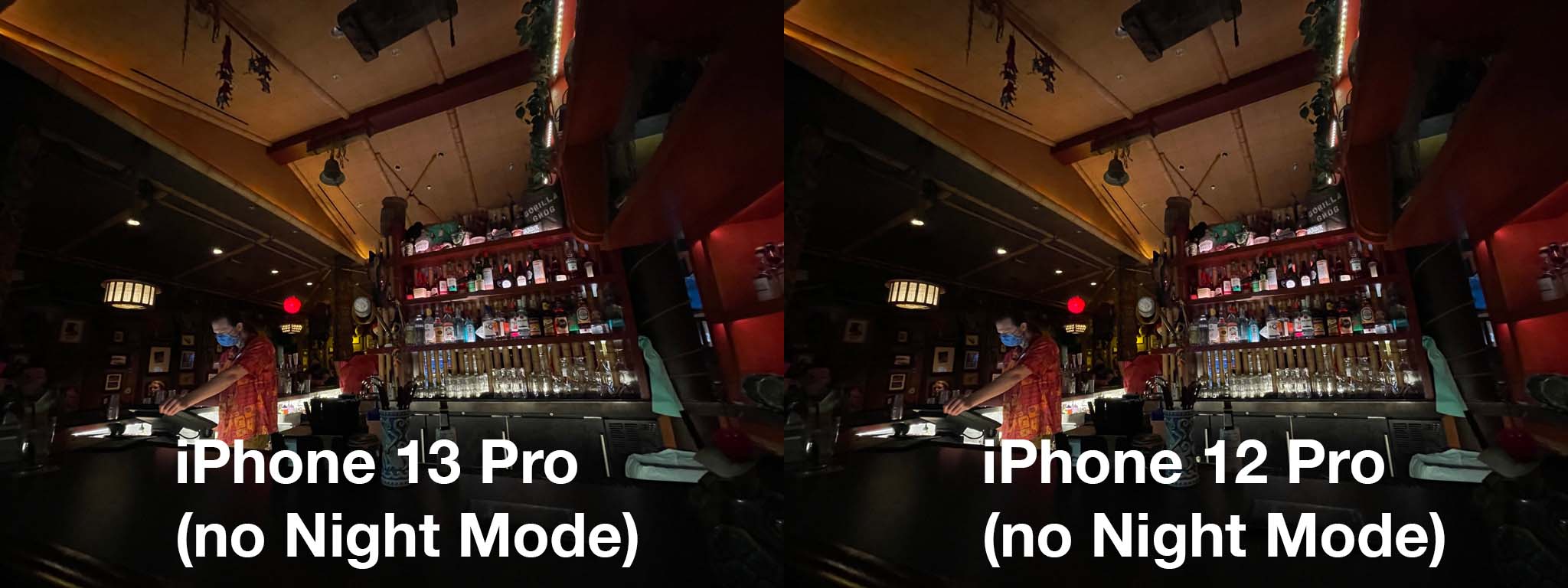
Image Credits: Matthew Panzarino

The delta is clear, and I’m pretty impressed in general with how much Apple keeps improving this ultra wide camera, though it seems clear at this point that we’re hitting the upper limits of what a 12MP sensor at this size can bring to a lens with such a wide POV. 

The new ISP also improves Night Mode shooting here too — and with a bit more raw range to work with given the wider aperture, your night mode shots lose even more of that bright candy-like look and get a deeper and more organic feeling. 

Macro photos and video

Another new shooting possibility presented by the iPhone 13 Pro is a pretty impressive macro mode that can shoot as close as 2cm. It’s really, really well done given that it’s being implemented in a super wide lens on a smartphone. 

I was able to shoot incredibly detailed snaps very, very close-up. We’re talking ‘the surface texture of objects’ close; ‘pollen hanging off a bee’s thorax’ close; dew…well you get the idea. It’s close, and it’s a nice tool to have without having to carry a macro attachment with you. 

Image Credits: Matthew Panzarino

I found the sharpness and clarity of the macro images I captured to be excellent within the rough 40% area that comprised the center of the capture area. Due to the fact that the macro mode is on the ultra wide, there is a significant amount of comatic aberration around the edges of the image. Basically, the lens is so curved you get excess blurring at the edges of a hyper-spherical element. This is only truly visible at very close distances at the minimum of the focal range. If you’re a few cm away you’ll notice and you’ll probably crop it out or live with it. If you’re further away getting a ‘medium macro’ at 10cm or whatever you’ll likely not notice it much.

This is a separate factor from the extremely slim field-of-focus that is absolutely standard with all macro lenses. You’re going to have to be precise at maximum macro, basically, but that’s nothing new.

Given how large scale Disneyland is I actually had to actively seek out ways to use the macro, though I’d imagine it would be useful in more ways in other venues. But I still got cool shots of textures in the bottles in Radiator Springs and some faux fungi at Galaxy’s Edge. 

Macro video is similarly fun but requires extremely stable hands or a tripod to really take advantage of given that the slightest movement of your hands is going to move the camera a massive amount of distance proportional to the focal area. Basically, tiny hand moves, big camera moves in this mode. But it’s a super fun tool to add to your arsenal and I had fun chasing bugs around some flower petals in the garden of the Grand Californian hotel with it.

Image Credits: Matthew Panzarino

As a way to go from world scale down to fine detail it’s a great way to mix up your shots.

One interesting quirk of the ultra wide camera being the home of macro on iPhone 13 Pro is that there is a noticeable transition between the wide and ultra-wide cameras as you move into macro range. This presents as a quick-shift image transition where you can see one camera clicking off and the other one turning on — something that was pretty much never obvious in other scenarios even though the cameras switch all the time depending on lighting conditions and imaging judgement calls made by the iPhone’s camera stack. 

Users typically never notice this at all, but given that there is now an official macro camera available when you swoop in close to an object while you’re on 1x then it’s going to flip over to the .5x mode in order to let you shoot super close. This is all totally fine, by the way, but can result in a bit of flutter if you’re moving in and out of range with the cameras continuously switching as you enter and exit ‘macro distance’ (around 10-15cm). 

When I queried about this camera switching behavior, Apple said that “a new setting will be added in a software update this fall to turn off automatic camera switching when shooting at close distances for macro photography and video.”

This should solve this relatively small quirk for people who want to work specifically at the macro range. 

Photographic Styles and Smart HDR 4

One of the constant tensions with Apple’s approach to computational photography has been its general leaning towards the conservative when it comes to highly processed images. Simply put, Apple likes its images to look ‘natural’, where other similar systems from competitors like Google or Samsung have made different choices in order to differentiate and create ‘punchier’ and sometimes just generally brighter images. 
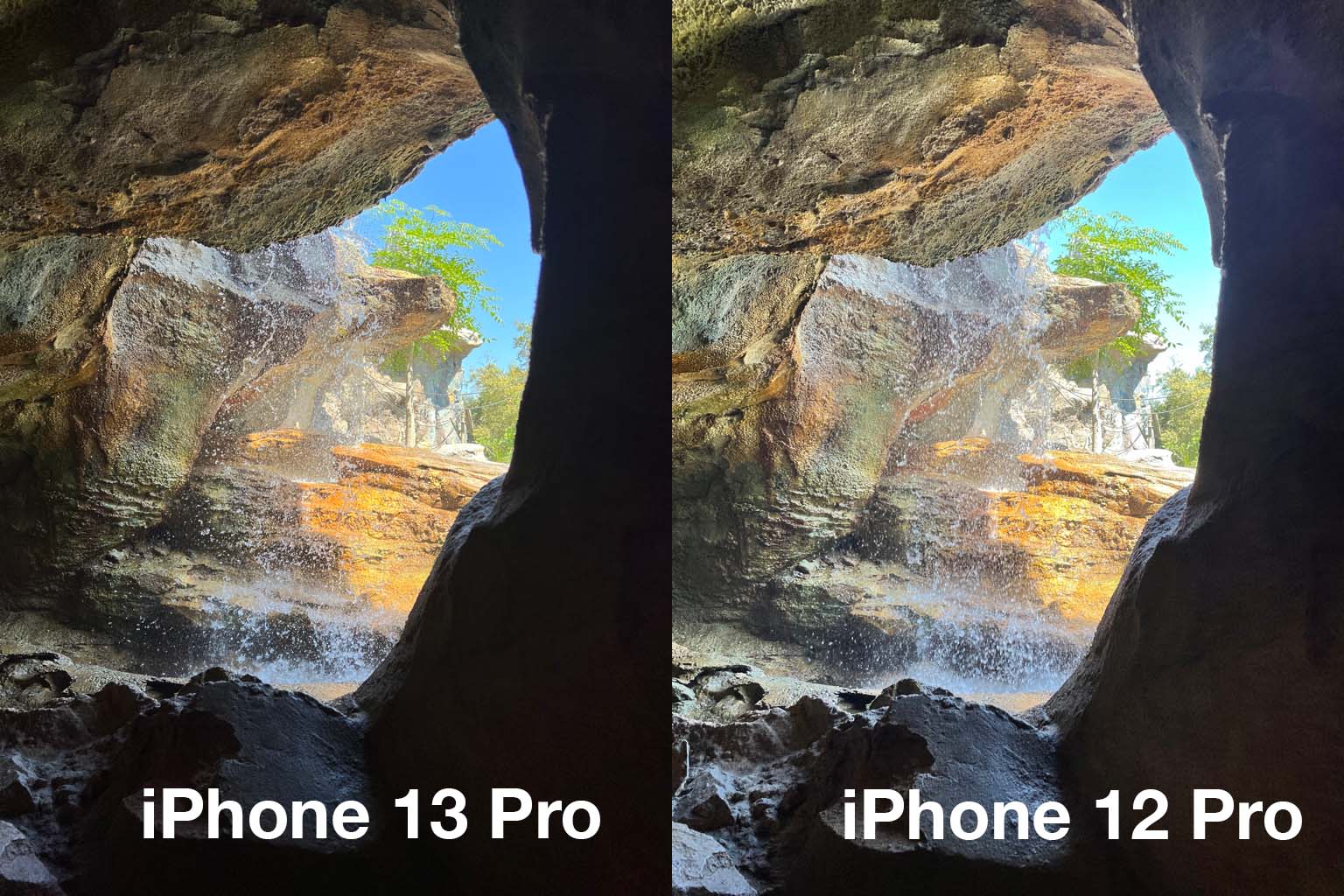
Image Credits: Matthew Panzarino

I did some comparisons of these approaches back when Apple introduced Night Mode two years ago.  

The general idea hasn’t changed much even with Apple’s new launches this year, they’re still hewing to nature as a guiding principle. But now they’ve introduced Photographic Styles in order to give you the option of cranking two controls they’re calling Tone and Warmth. These are basically vibrance and color temperature (but only generally). You can choose from 5 presets including no adjustments or you can adjust the two settings on any of the presets on a scale of -100 to +100. 

I would assume that long term people will play with these and recommendations will get passed around on how to get a certain look. My general favorite of these is vibrant because I like the open shadows and mid-tone pop. Though I would assume a lot of folks will gravitate towards Rich Contrast because more contrast is generally more pleasing to the human eye. 
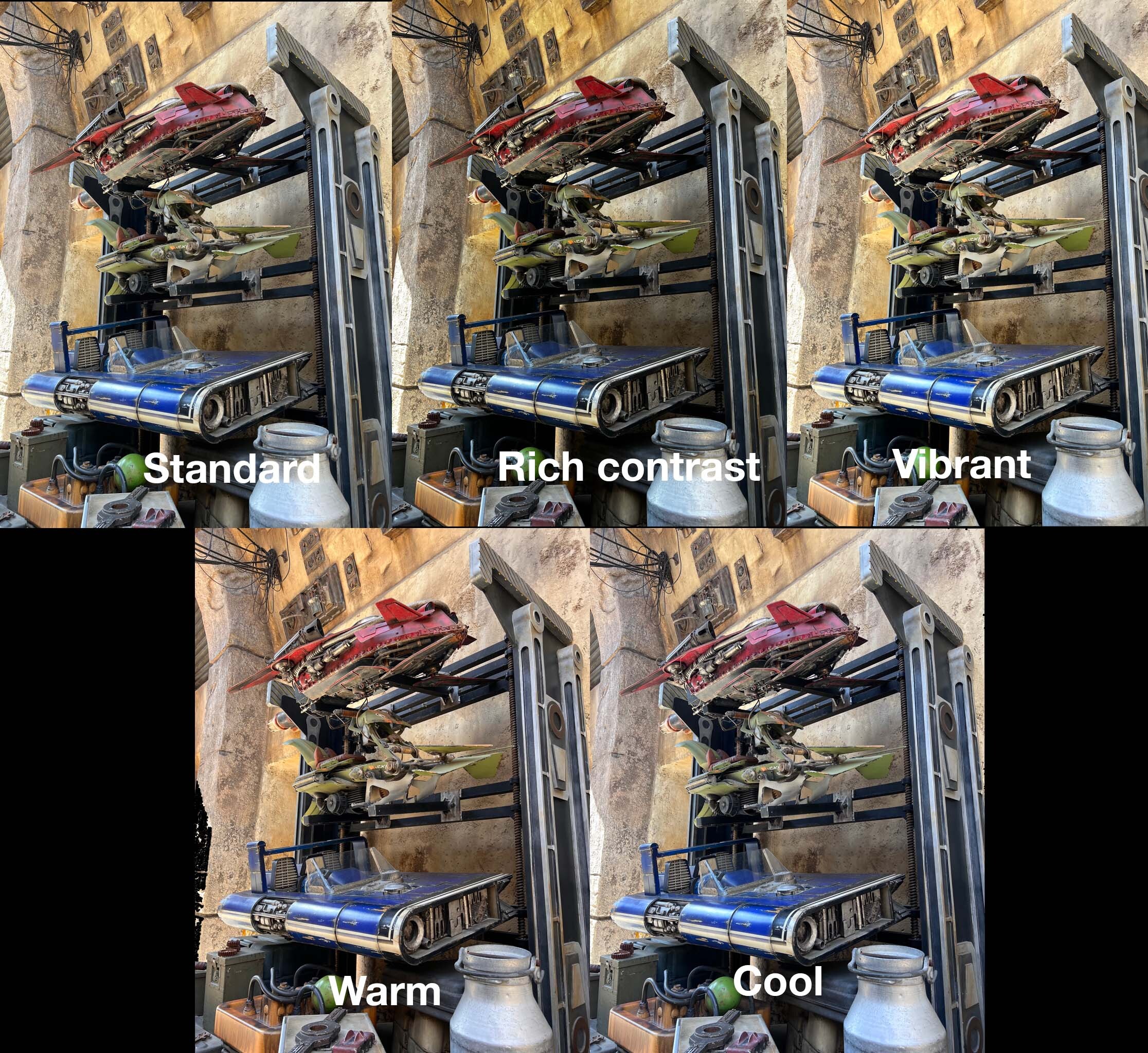
Image Credits: Matthew Panzarino

In this shot of some kid-sized speeders, you can see the effects on the shadows and midtones as well as the overall color temperature. Rather than being a situational filter, I view this as a deep ‘camera setting’ feature, much like choosing the type of film that you wanted to roll with in a film camera. For more contrast you might choose a Kodak Ektachrome, for cooler-to-neutral colors perhaps a Fuji, for warm skin tones perhaps a Kodak Portra and for boosted color maybe an Ultramax. 

This setting gives you the option to set up your camera the way you want the color to sit in a similar way. The setting is then retained when you close camera.app. This way when you open it, it’s set to shoot the way you want it to. This goes for the vast majority of camera settings now under iOS 15, which is a nice quality of life improvement over the old days when the iPhone camera reset itself every time you opened it. 

It’s worth noting that these color settings are ‘imbedded’ in the image, which means they are not adjustable afterwards like Portrait Mode’s lighting scenarios. They are also not enabled during RAW — which makes sense.

Smart HDR4 also deserves a mention here because it’s now doing an additional bit of smart segmentation based on subjects in the frame. In a situation with a backlit group of people, for instance, the new ISP is going to segment out each of those subjects individually and apply color profiles, exposure, white balance and other adjustments to them — all in real time. This makes for a marked improvement in dark-to-light scenarios like shooting out of windows and shooting into the sun. 

I would not expect much improvement out of the selfie camera this year, it’s just much the same as normal. Though you can use Cinematic Mode on it which is fun if not that useful in selfie modes.

Cinematic Mode

This is an experimental mode that has been shipped live to the public. That’s the best way to set the scene for those folks looking to dive into it. Contrary to Apple’s general marketing, this won’t yet replace any real camera rack focus setup on a film set, but it does open up a huge toolset for budding filmmakers and casual users that was previously locked behind a lot of doors made up of cameras, lenses and equipment. 

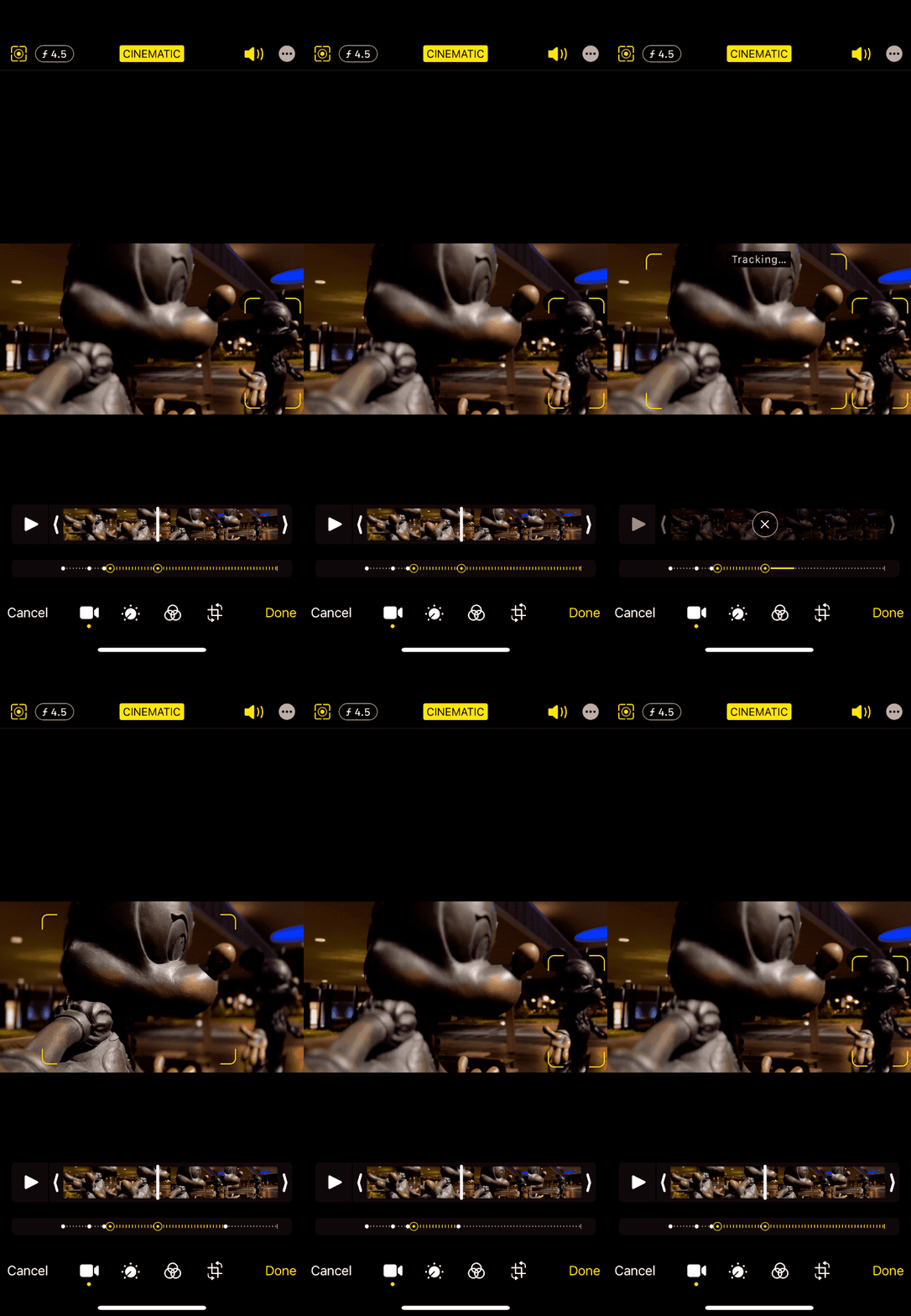
Cinematic Mode uses the camera’s depth information, the accelerometer and other signals to craft a video that injects synthetic bokeh (blur) and tracks subjects in the frame to intelligently ‘rack’ focus between them depending on what it thinks you want. There is also some impressive focus tracking features built in that allow you to lock onto a subject and follow them in a ‘tracking shot’ which can keep them in focus through obstacles like crowds, railings and water. I found all of these depth-leveraging features that did tracking to be incredibly impressive in my early testing, but they were often let down a bit by the segmentation masking that struggled to define crisp, clear borders around subjects to separate them from the background. It turns out that doing what portrait mode does with a still image is just insanely hard to do 30 times a second with complex, confusing backgrounds. 

The feature is locked to 1080p/30fps which says a lot about its intended use. This is for family shots presented on the device, AirPlayed to your TV or posted on the web. I’d imagine that this will actually get huge uptake with the TikTok filmmaker crowd who will do cool stuff with the new storytelling tools of selective focus.

Image Credits: Matthew Panzarino

I did some test shooting with my kids walking through crowds and riding on carousels that was genuinely, shockingly good. It really does provide a filmic, dreamy quality to the video that I was previously only able to get with quick and continuous focus adjustments on an SLR shooting video with a manually focused lens. 

That, I think, is the major key to understanding Cinematic Mode. Despite the marketing, this mode is intended to unlock new creative possibilities for the vast majority of iPhone users who have no idea how to set focal distances, bend their knees to stabilize and crouch-walk-rack-focus their way to these kinds of tracking shots. It really does open up a big bucket that was just inaccessible before. And in many cases I think that those willing to experiment and deal with its near-term foibles will be rewarded with some great looking shots to add to their iPhone memories widget.

Image Credits: Matthew Panzarino
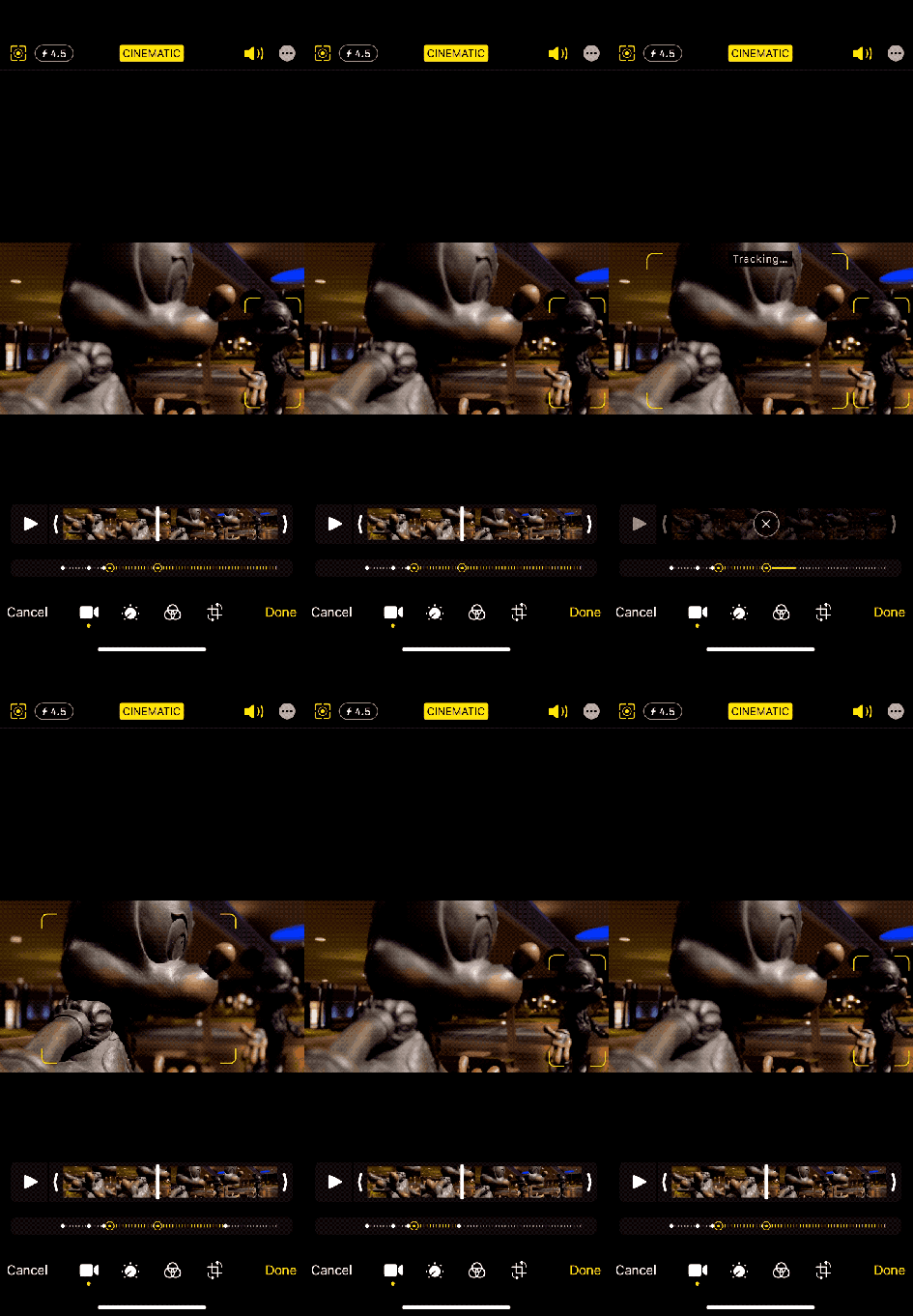
Image Credits: Matthew Panzarino

I’ll be writing more about this feature later this week so stay tuned. For now, what you need to know is that an average person can whip this out in bright light and get some pretty fun and impressive results, but it is not a serious professional tool, yet. And even if you miss focus on a particular subject you are able to adjust that in post with a quick tap of the edit button and a tap on a subject — as long as it’s within the focal range of the lens.

As a filmmaking tool for the run and gun generation it’s a pretty compelling concept. The fact is that it allows people to spend less time and less technical energy on the mechanics of filmmaking and more time on the storytelling part. Moviemaking has always been an art that is intertwined with technology — and one of the true exemplars of the ideal that artists are always the first to adopt new technology and push it to its early limits.

It’s kind of hard to explain because I think most of us are so used to the language of film these days but having these tools in your arsenal is a huge step forward in how everyone’s home videos will look and feel over the next few years.

Just as Apple’s portrait mode has improved massively over the past 6 years, I expect Cinematic Mode to keep growing and improving. The relatively sketchy performance in low light and the locked zoom are high on my list to see bumps next year, as is improved segmentation. It’s an impressive technical feat that Apple is able to deliver this kind of slicing and adjustment not only in real-time preview but also in post-shooting editing modes, and I’m looking forward to seeing it evolve. 

Assessment

This is a great update that improves user experience in every way, even during an intense day-long Disneyland outing. The improved brightness and screen refresh means easier navigation of park systems and better visibility in daylight for directions and wait times and more. The better cameras mean you’re getting improved shots in dark-to-light situations like waiting in lines or shooting from under overhangs. The nice new telephoto lets you shoot close-up shots of cast members who are now often separated from the crowds by large distances, which is cool — and as a bonus acts as a really lovely portrait lens even while not in Portrait mode.

Overall this was one of the best experiences I’ve had testing a phone at the parks, with a continuous series of ‘wow’ moments with the cameras that sort of made me question my confirmation bias. I ended up with a lot of shots like the night mode wide angle and telephoto ones I shared above that impressed me so much I ended up doing a lot of gut checking asking other people in blind tests what they thought of the two images. Each time I did so the clear winner was the iPhone 13 — it really is just a clear cut improvement in image making across the board.

The rest of the package is pretty well turned out here too, with massive performance gains in the A15 Bionic with not only no discernable impact on battery life but a good extra hour to boot. The performance chart above may give the wow factor but that performance charted on the power usage of the chip across a day is what continues to be the most impressive feat of Apple’s chip teams. 

The iPhones 13 are an impressive field this year, providing a solid moat of image quality, battery life and now, thankfully, screen improvements that should serve Apple well over the next 12 months.

Image Credits: Matthew Panzarino


from blogger-2 https://ift.tt/3ubGXqp
via IFTTT

Thursday, September 2, 2021

Alphabet X’s exosuit

Last week, Kathryn Zealand shared some insight on the eve of Women’s Equality Day. The post highlighted an issue that’s been apparent to everyone in and around the robotics industry: there’s a massive gender gap. It’s something we try to be mindful of, particularly when programming events like TC Sessions: Robotics. Zealand cites some pretty staggering figures in the piece.

According to the stats, around 9% of robotics engineers are female. That’s bad. That’s, like, bad even by the standards of STEM fields in general — which is to say, it’s really, really bad. (The ethnic disparities in the same source are worth drawing attention to, as well.)

Zealand’s piece was published on LinkedIn — fitting, given that the overarching focus here is on hiring. Well worth your time, if you’re involved in the hiring process at a robotics firm and are concerned about broader diversity issues (which hopefully go hand in hand for most orgs). Zealand offers some outside of the box thinking in terms of what, precisely, it means to be a roboticist, writing:

We have a huge opportunity here! Women and other under-represented groups are untapped pools of talented people who, despite not thinking of themselves as “roboticists,” could be vital members of a world-changing robotics team.

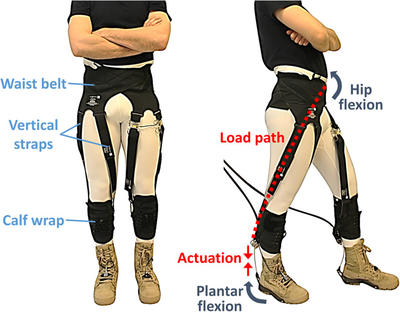
I’m going to be real with you for a minute, and note what really caught my eye was that above image. See, Zealand is a Project Lead at Alphabet X. And what you have there is a robotic brace — or, rather, what appears to be a component of a soft exosuit.

Image Credits: Bryce Durbin/TechCrunch

Exosuits/exoskeletons are a booming category for robotics right now that really run the gamut from Sarcos’ giant James Cameron-esque suit to far subtler, fabric-based systems. Some key names in the space include Ekso Bionics, ReWalk and SuitX. Heck, even Samsung has shown off a solution as part of a robotics department that appears to be largely ornamental at the moment.

Image Credits: Harvard Biodesign Lab

Most of these systems aim to tackle one of two issues: 1) Augmenting workers to assist with difficult or repetitive tasks for work and 2) Provide assistance to those with impaired mobility. Many companies have offers for both. Here’s what Harvard’s Biodesign Lab has to say on the matter:

As compared to a traditional exoskeleton, these systems have several advantages: the wearer’s joints are unconstrained by external rigid structures, and the worn part of the suit is extremely light. These properties minimize the suit’s unintentional interference with the body’s natural biomechanics and allow for more synergistic interaction with the wearer.

Alphabet loves to give the occasional behind-the-scenes peak at some of its X projects, and it turns out we’ve had a couple of glimpses of the Smarty Pants project. Zealand and Smarty Pants make a cameo in a Wired UK piece that ran early last year about the 10th anniversary of Google/Alphabet X. The piece notes that that the project was inspired by her experience with her 92-year-old grandmother’s mobility issues.

Image Credits: Alphabet X

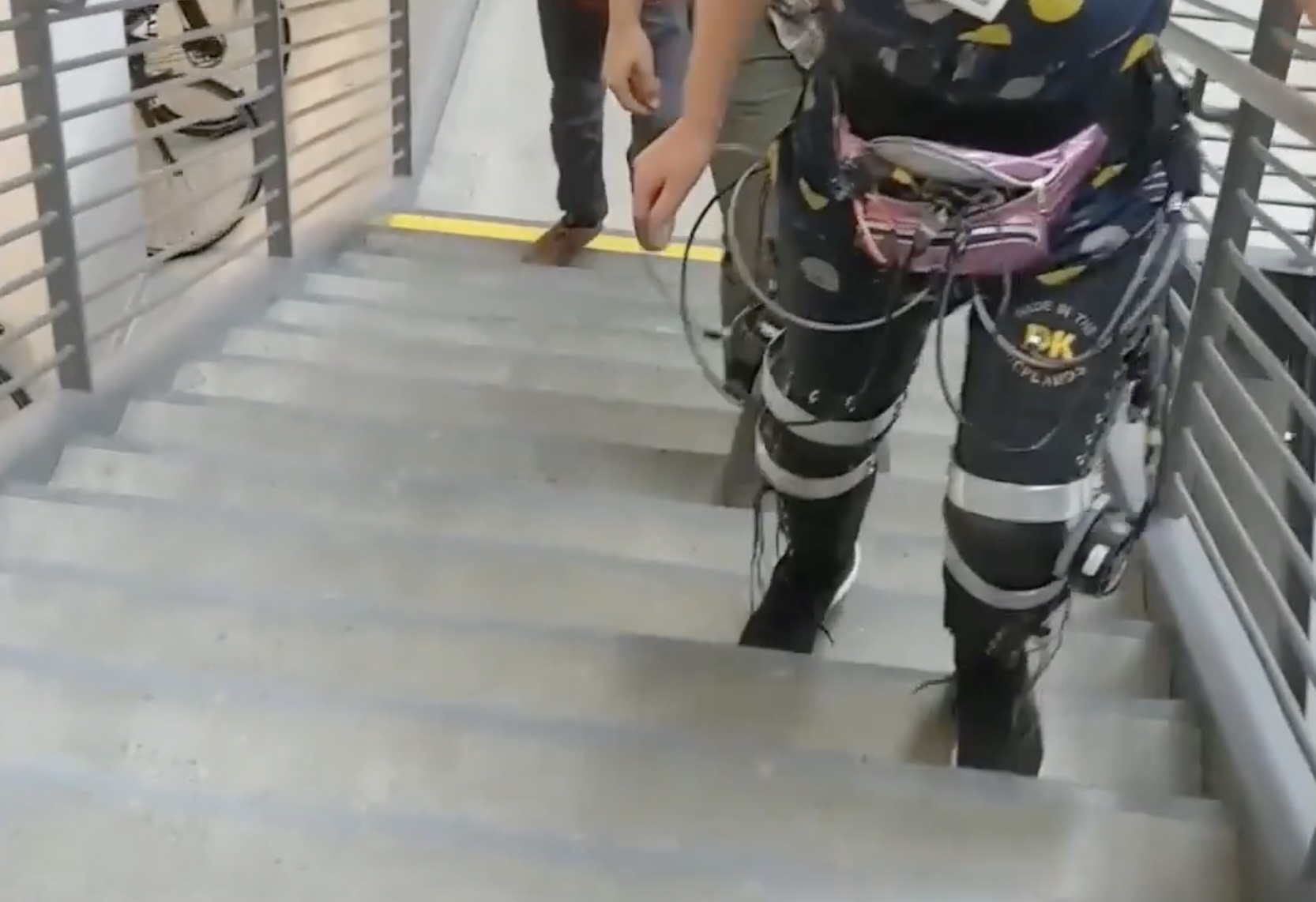
The piece highlights a very early Raspberry Pi-controlled setup created by a team that includes costume designers and deep learning specialists (getting back to that earlier discussion about outside the box thinking when it comes to what constitutes a roboticist). The system is using sensors in an attempt to effectively predict movement in order to anticipate where force needs to be applied for tasks like walking up stairs. The piece ends on a fittingly somber note, “Fewer than half of X’s investigations become Projects. By the time this story is published it will probably have been killed.”

My suspicion is that the team is looking to differentiate itself from other exosuit projects by leveraging Google’s knowledge base of deep learning and AI to build out those predictive algorithms.

Alphabet declined to offer additional information on the project, noting that it likes to give its moonshot teams, “time to learn and iterate out of the spotlight.” But last October, we got what is probably our best look at Smarty Pants, in the form of a video highlighting Design Kitchen, Alphabet X’s lab/design studio.

Image Credits: Alphabet X

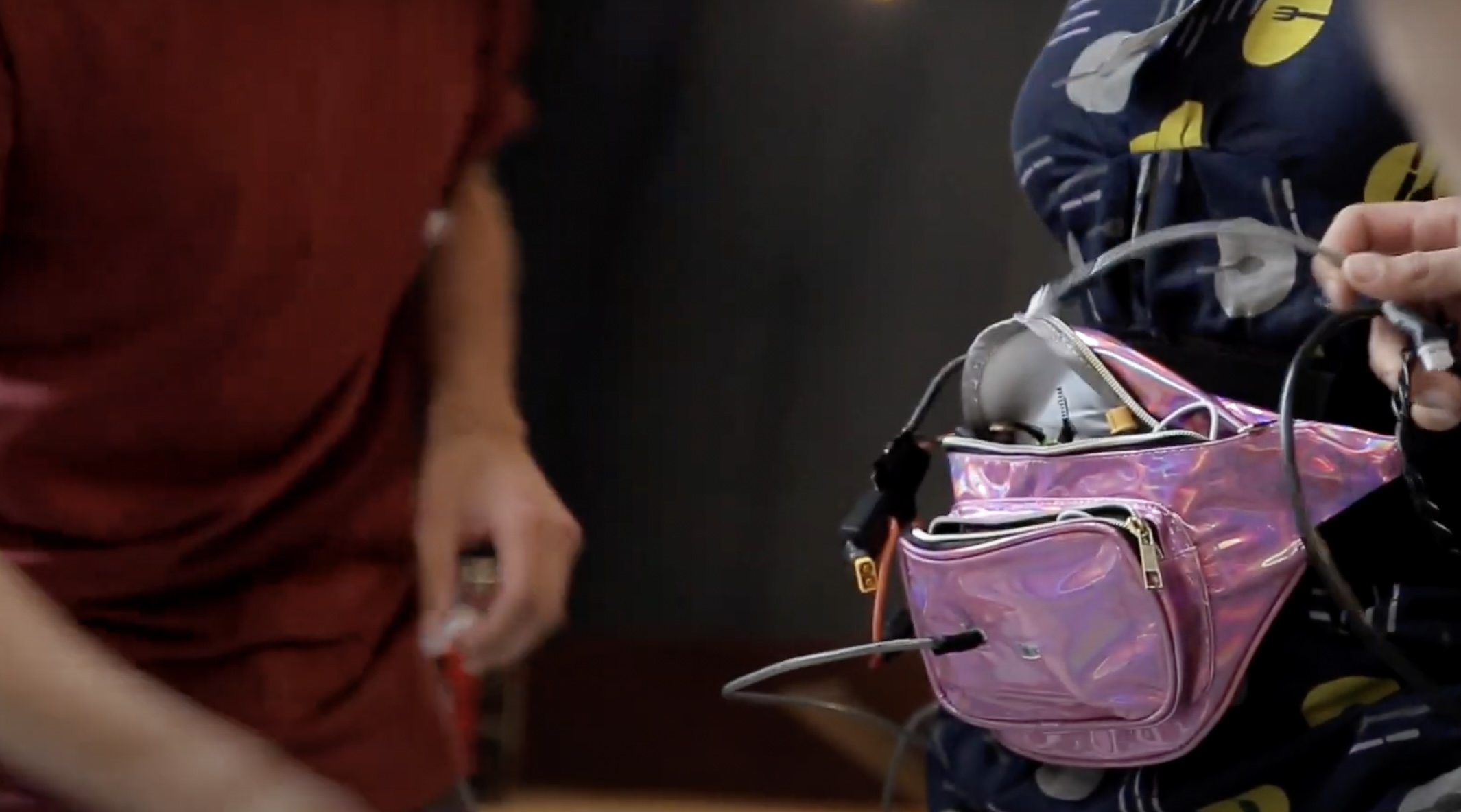
The Wired piece mentions a “pearlescent bumbag,” holding the aforementioned Raspberry Pi and additional components. For you yanks, that’s a fanny pack, which are not referred to as such in the U.K., owing to certain regional slang. Said fanny pack also makes an appearance in the video, providing, honestly, a very clever solution to the issue of hanging wires for an early-stage wearable prototype.

“One of the things that’s really helped the team is being really focused on a problem. Even if you spent months on something, if it’s not actually going to achieve that goal, then sometimes you honor the work that’s been done and say, ‘we’ve learned a ton of things during the process, but this is not the one that’s actually going to solve that problem.’ ”

The most notable takeaway from the video is some additional footage of prototypes. One imagines that, by the time Alphabet feels confident sharing that sort of stuff with the world, the team has moved well beyond it. “It doesn’t matter how janky and cardboard-and-duct-tape it is, as long as it helps you learn — and everyone can prototype, even while working from home,” the X team writes in an associated blog post.

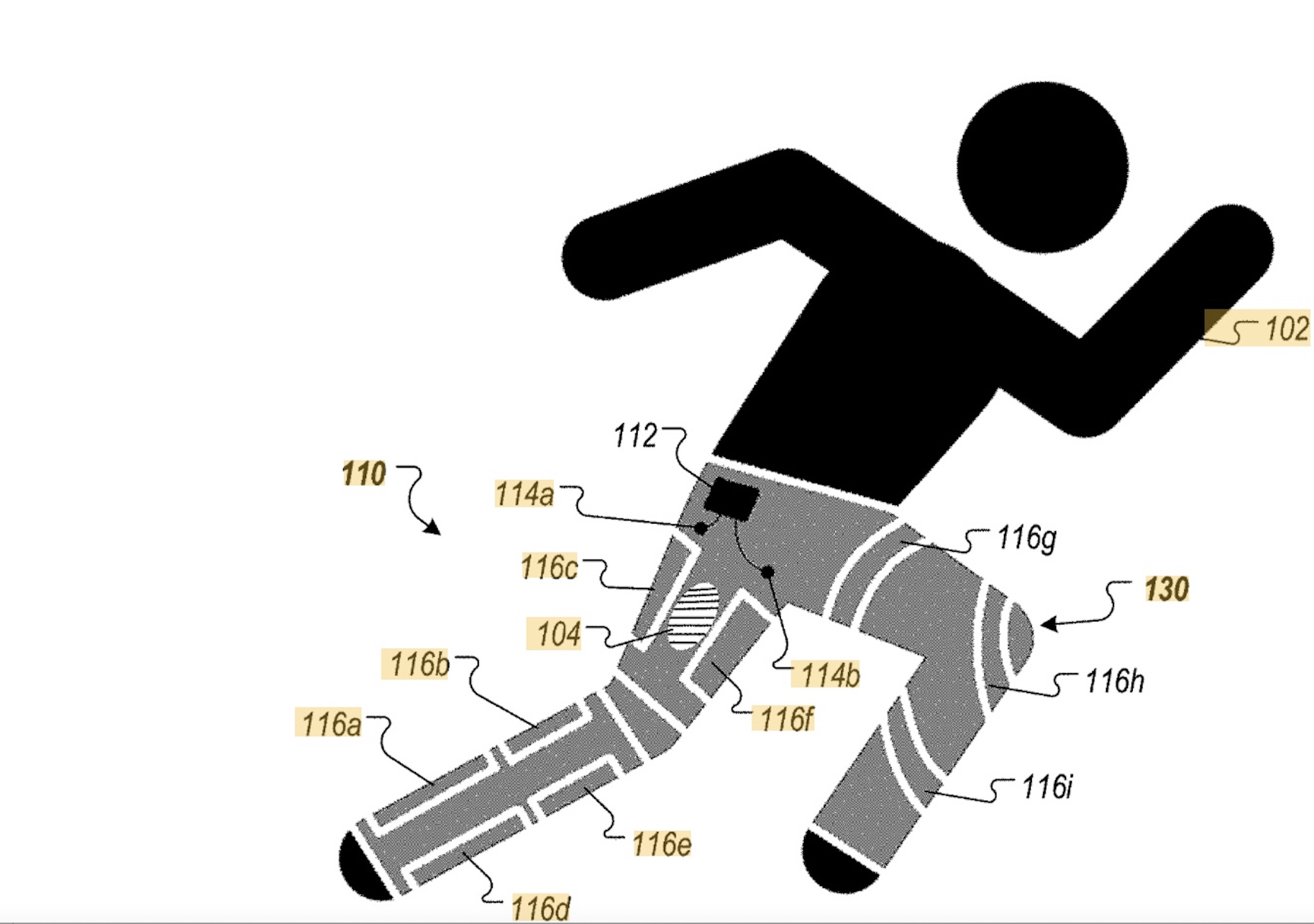
The one other bit of information we have at the moment is a granted patent application from last year, which comes with all of the standard patent warnings. Seeing a patent come to fruition is often even more of a longshot (read: moonshot) than betting on an Alphabet X project to graduate. But they can offer some insight into where a team is headed — or at least some of the avenues it has considered.

Image Credits: Alphabet X

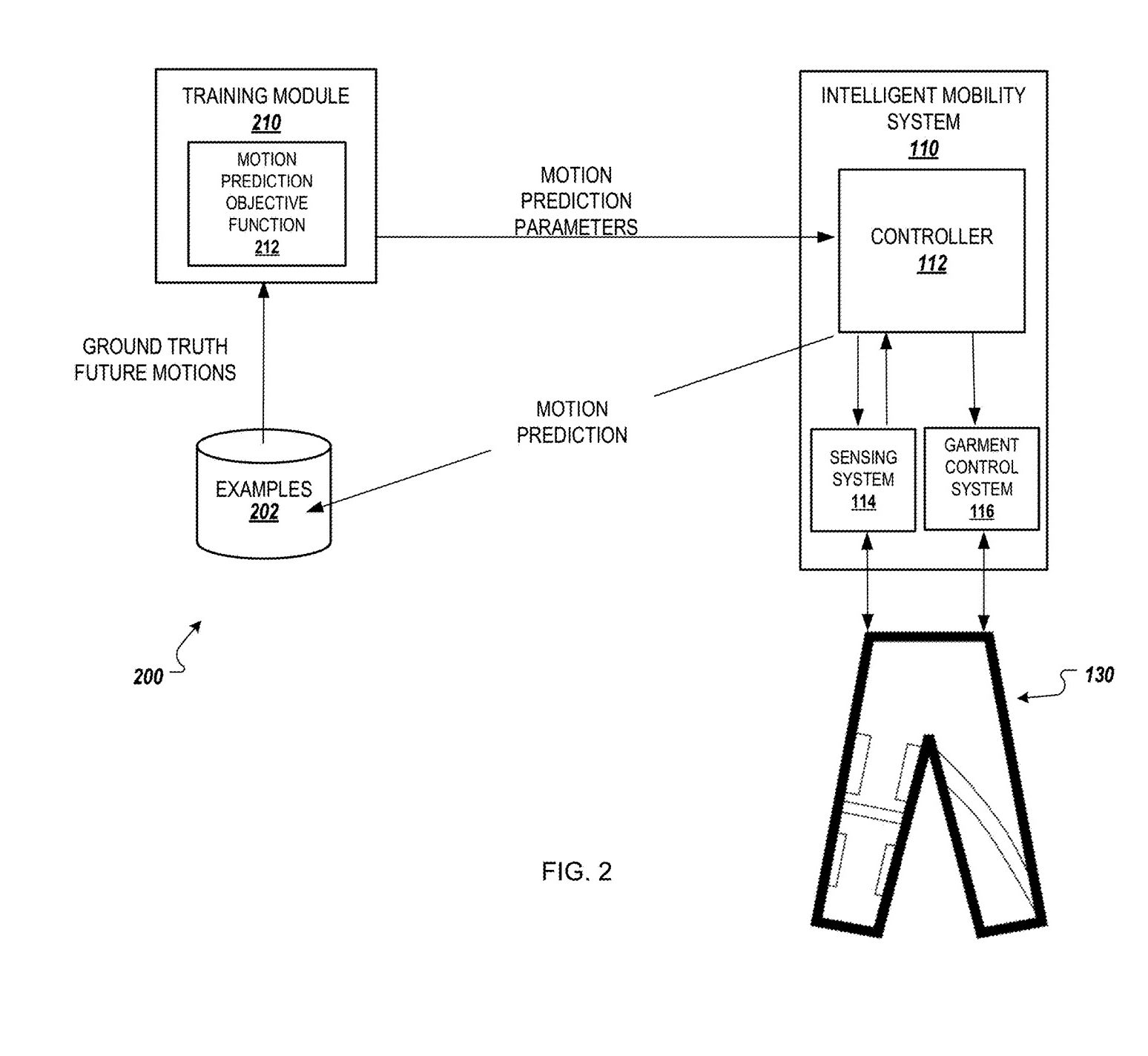
The patent highlights similar attempts to anticipate movement as those highlighted above. It effectively uses sensors and machine learning to adjust the tension on regions of the garments designed to assist the wearer.

Image Credits: Alphabet X

The proposed methods and systems provide adaptive support and assistance to users by performing intelligent dynamic adjustment of tension and stiffness in specific areas of fabric or by applying forces to non-stretch elements within a garment that is comfortable enough to be suitable for frequent, everyday usage. The methods include detecting movement of a particular part of a user’s body enclosed within the garment, determining an activity classification for that movement, identifying a support configuration for the garment tailored to the activity classification, and dynamically adjusting a tension and/or a stiffness of one or more controllable regions of the garment or applying force to non-stretch fabric elements in the garment to provide customized support and assistance for the user and the activity the user is performing.

It’s nice seeing Alphabet take a more organic approach to developing robotics startups in-house, rather than the acquisitions and consolidations that occurred several years back that ultimately found Boston Dynamics briefly living under the Google umbrella. Of course, we saw the recent graduation of the Wendy Tan White-led Intrinsic, which builds software for industrial robotics.

All right, so there’s a whole bunch of words about a project we know next to nothing about! Gotta love the startup space, where we’re definitely not spinning wild speculation based on a thin trail of breadcrumbs.

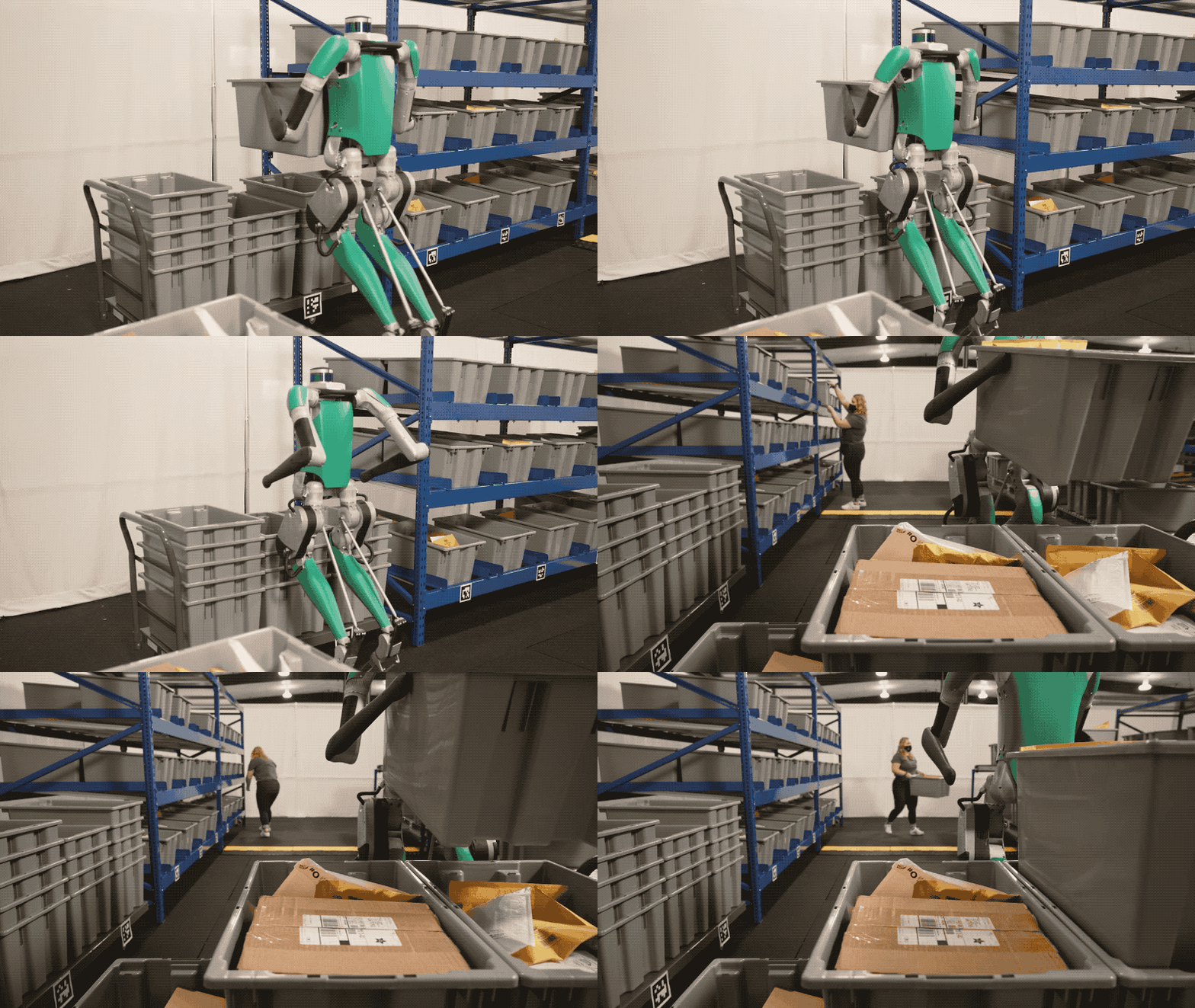
I will say for sure that I definitely know more about Agility Robotics than I did this time last week, after speaking with the Oregon-based company’s CEO and CTO. The conversation was ostensibly about a new video the team released showcasing Digit doing some menial tasks in a warehouse/fulfillment setting.

Some key things I learned:

  1. Agility sold a dozen Cassie robots, largely to researchers.
  2. It’s already sold “substantially more” Digits.
  3. The team includes 56 people, primarily in Oregon (makes sense, as an OSU spinout), with plans to expand operations into Pittsburgh, everyone’s favorite rustbelt robotics hub.
  4. Agility is consulting with “major logistics companies.”
  5. In addition to the Ford delivery deal, the company has its sights set on warehouse tasks in hopes of offering a more adaptable solution than ground-up warehouse automation companies like Berkshire Gray.

Image Credits: Agility Robotics

Oh, and a good quote about job loss from CEO Damion Shelton:

The conversation around automation has shifted a bit. It’s viewed as an enabling technology to allow you to keep the workforce that you have. There are a lot of conversations around the risks of automation and job loss, but the job loss is actually occurring now, in advance of the automated solutions.

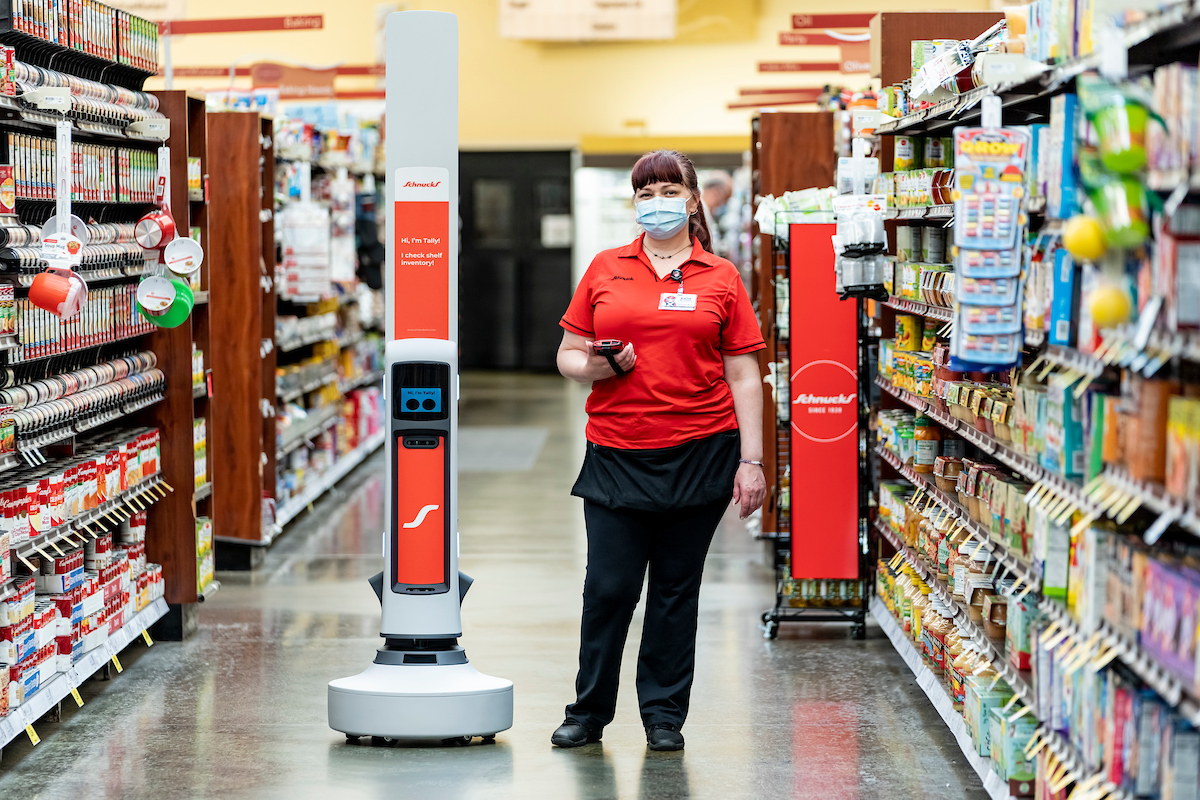
Agility hopes to start rolling out its robots to locations in the next year. More immediate than that, however, is this deal between Simbe Robotics and midwestern grocery chain, Schnuks. The food giant will be bringing Simbe’s inventor robots to all of its 111 stores, four years after it began piloting the tech.

Schnuck Markets deploys Tally robot by Simbe Robotics to its stores – bringing shelf insights for better shopping experience. Photographed on Friday, Aug. 13, 2021, in Des Peres, Mo.

Simbe says its Tally robot can reduce out of stock items by 20-30% and detect 14x more missing inventor than standard human scanning.

Carbon Robotics (not to be confused with the prosthetic company of the same name that made it onto our Hardware Battlefield a few years back) just raised $27 million. The Series B brings its total funding to around $36 million. The Seattle-based firm builds autonomous robots that zap weeds with lasers. We highlighted their most recent robot in this column back in April.

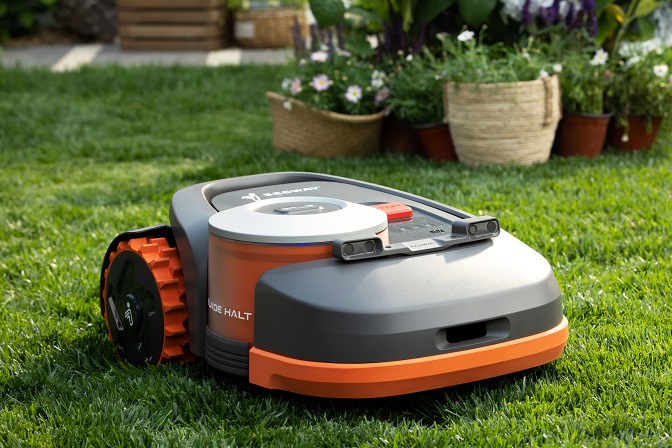
And seeing how we recently updated you on iRobot’s continued indefinite delay for the Terra, here’s a new robotic mower from Segway-Ninebot.

Image Credits: Segway-Ninebot

Segway’s first robotic lawnmower is designed for a lawn area of up to 3,000 square meters, has several features of a smart helper in the garden and is the quietest mower on the market with only 54 dB. The Frequent Soft Cut System (FSCS) ensures that the lawn is cut from above and the desired height is reached gradually. Offset blades allow cutting as close as possible to edges and corners.

That’s it for the week. Don’t forget to sign up to get the upcoming free newsletter version of Actuator delivered to your inbox.


from blogger-2 https://ift.tt/3BzsXcj
via IFTTT

Tuesday, August 24, 2021

Samsung to invest $205B in semiconductor, biopharma and telco units by 2023, creating 40,000 jobs

Samsung Group, South Korea’s tech giant, announced on Tuesday that it will invest $205 billion (240 trillion won) in their semiconductor, biopharmaceuticals and telecommunications units over the next three years to enhance its global presence and lead in new industries such as next-generation telecommunication and robotics.

The investment will be led by Samsung affiliates including Samsung Electronics and Samsung Biologics. It also unveiled a mergers and acquisitions plan to fortify its technology and market leadership.

With setting aside $154.3 billion (180 trillion won) for home ground, Samsung expects to create 40,000 new jobs by 2023 through the investment.

This announcement comes days after Samsung Electronics vice chairman Jay Y. Lee was released on parole on 13 August right before South Korea’s Liberation Day. People speculated Samsung would be able to move forward with major investments once he was freed from prison, according to local media reports.

Samsung’s latest investment will be used for semiconductors, biopharmaceuticals and the next-generation telco units, according to the company’s statement.

Samsung Electronics plans to develop advanced process technology and expand the business with artificial intelligence (AI) and data centers for its system semiconductors while it will focus on up-to-date technology such as EUV-based sub14-nanometer DRAM and over 200-layer V-NAND products for the memory business. Samsung had announced in May the company will invest $151 billion in its logic chip and foundry sector, to be the top logic chip maker, by 2030.

Samsung Biologics and Samsung Bioepis plan to establish two new plants, in addition to a fourth factory that is under construction, for expanding the contract development manufacturing organization (CDMO) business, the statement said.

South Korea’s largest conglomerate also will support its ongoing R&D in new technologies and emerging application in areas such as AI and robotics along with the next generation OLED, quantum-dot display and high-energy density batteries development.


from blogger-2 https://ift.tt/3jcirS1
via IFTTT

Monday, August 23, 2021

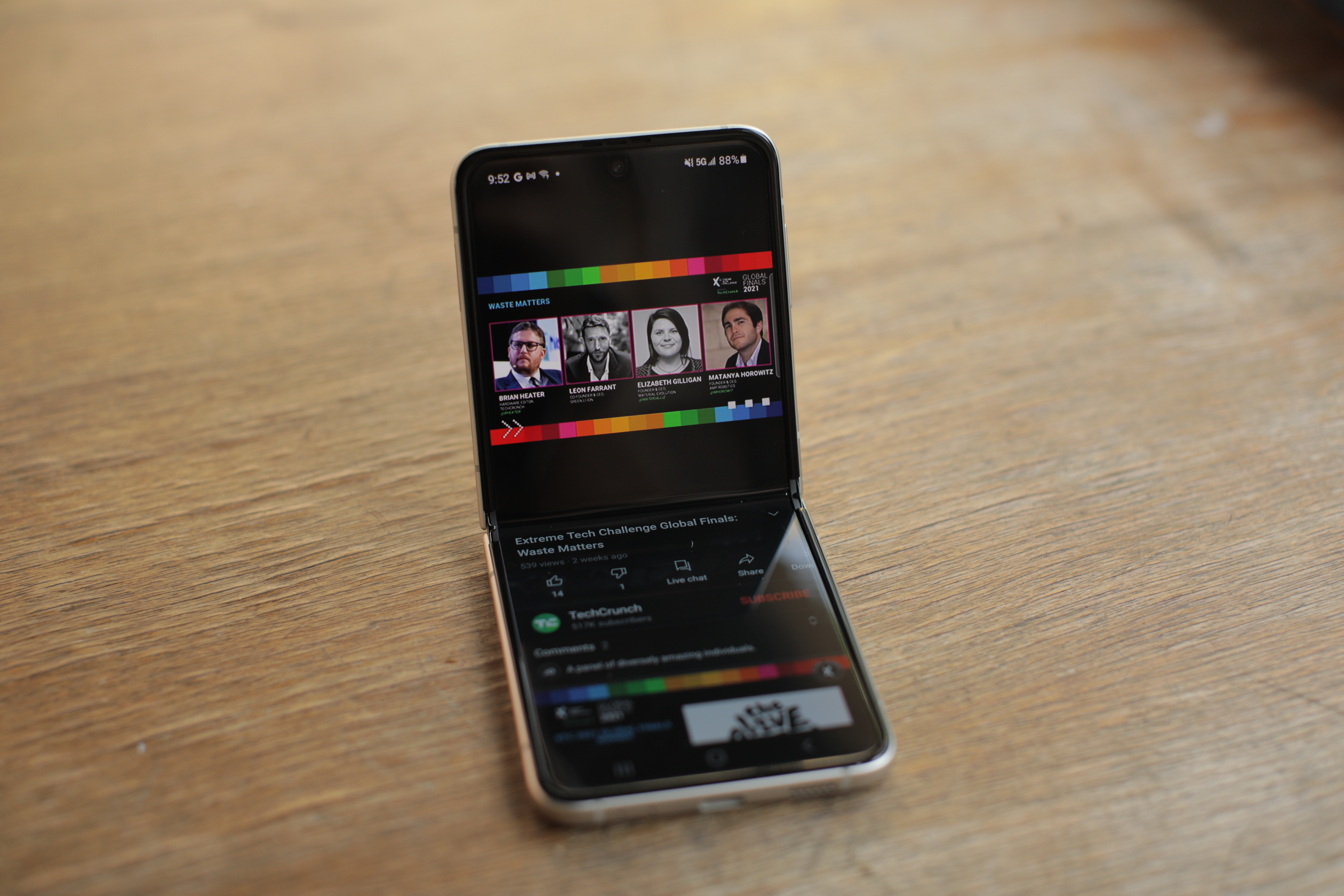
Samsung’s Galaxy Z Flip 3 is the foldable to beat

I took a long walk on Saturday. It’s become a routine during the pandemic, a chance to unwind after too many hours indoors, while seeing parts of the city that would otherwise be lost to subway rides in normal years. Saturday was more purpose-driven, heading to a newly opened Trader Joe’s before Henri unleashed itself on the Eastern Seaboard.

Taking respite from the early rain, I found a food court in Long Island City, ordered a shawarma and pulled the Galaxy Z Flip from my pocket. I unfolded the phone, popped the new Galaxy Buds in my ears and watched a baseball game on the MLB.TV app. The Flip really made sense in that moment, open in landscape mode at a 135-degree angle to keep the 6.7-inch screen upright. When the game ended (spoiler, it didn’t end well), I snapped the phone shut, stuck it in my pocket and went on my way.

It doesn’t always come with a piece of new technology, but sometimes you get lucky and have an experience where it just clicks. There were plenty of jokes about the long-ago death of the clamshell when the first Flip arrived. Those won’t be going away anytime soon, of course, but the phone also offered the first sense for many that maybe Samsung was heading in the right direction with its foldable ambitions.

Image Credits: Brian Heater

Setting aside the early flaws with the first Galaxy Fold (we’ve covered them ad nauseum elsewhere), the device is also unwieldy. While it’s true the foldable screen affords you the ability to carry around a screen that might otherwise be impossible, it’s a large device when folded, and the opportunities to unfold don’t readily present themselves. The Flip splits the difference nicely between screen size and portability. In terms of display size, it’s effectively a Galaxy Note that snaps in two and fits nicely in your pocket.

Most of the talk of Samsung mainstreaming foldables has centered on the Galaxy Z Fold — mostly from the company itself. Samsung has made a big to-do about positioning the Fold as its latest flagship — augmenting or, perhaps replacing, the Note in its lineup. The Fold 3 certainly blurs the lines with the addition of S Pen functionality, but the Flip is the much clearer bridge between Samsung’s existing flagships and the foldable future it envisions.

Mainstreaming foldables was always going to be a tricky proposition. Right out of the gate, they were hit with negative coverage over production issues and prices; $2,000 is a lot to pay for a product you essentially have to handle with kid gloves. You shouldn’t have to worry about accidentally damaging your daily driver through normal use. The Flip benefits from the mistakes of earlier fold generations, getting a more robust design and water resistance as a result.

Perhaps even more importantly, however, is pricing. The Galaxy Z Flip is Samsung’s first foldable under $1,000. Now, granted, it’s literally one penny under that threshold — a price point that puts it in line with expensive premium phones from the likes of Samsung and Apple. But in the world of foldables, that’s a really big win. The first couple of generations could — to some degree — survive on novelty alone.

Image Credits: Brian Heater

As more of these devices make their way into the world, utility supersedes novelty. But growing popularity also means scale — and, as a result, price drops. For the first time, buying a Samsung foldable is not the financial equivalent of buying two phones. That’s a much more significant threshold than the Galaxy Fold dropping $200 over its previous generation.

The company noted this week, that “in just 10 days since announcement pre-orders for the Galaxy Z Fold3 and Galaxy Z Flip3 have already surpassed total global Samsung foldables sales in all of 2021, also making it the strongest pre-order for Samsung foldables ever.” There are a lot of factors here, including a lower price, more robust design, the absence of a new Note and an aggressive push to get consumers to preorder. But it’s safe to say the line is, at the very least, trending the right way.

Expectedly, the company’s numbers don’t break down sales in terms of Fold versus Flip. Admittedly, the Fold is more fully featured, and 7.6 inches of screen is better than 6.7 inches of screen, when it comes, to, say, watching a full movie. But for most people in most instances, the Galaxy Flip is a better choice. I can say with no hesitation: The Samsung Galaxy Z Flip is the most mainstream foldable on the market.

If you’re not sold on the importance of foldables, such a statement understandably doesn’t mean much. But for a vast majority of people looking to make the leap to what is increasingly looking like a key part of the mobile future, the Flip is an obvious choice. And while it’s easy to make fun of the clamshell design as a relic of a bygone era, there’s a reason phones went that way in the first place. One assumes a big part of the reason they largely went away is that — until now — smartphones weren’t foldable.

Image Credits: Brian Heater

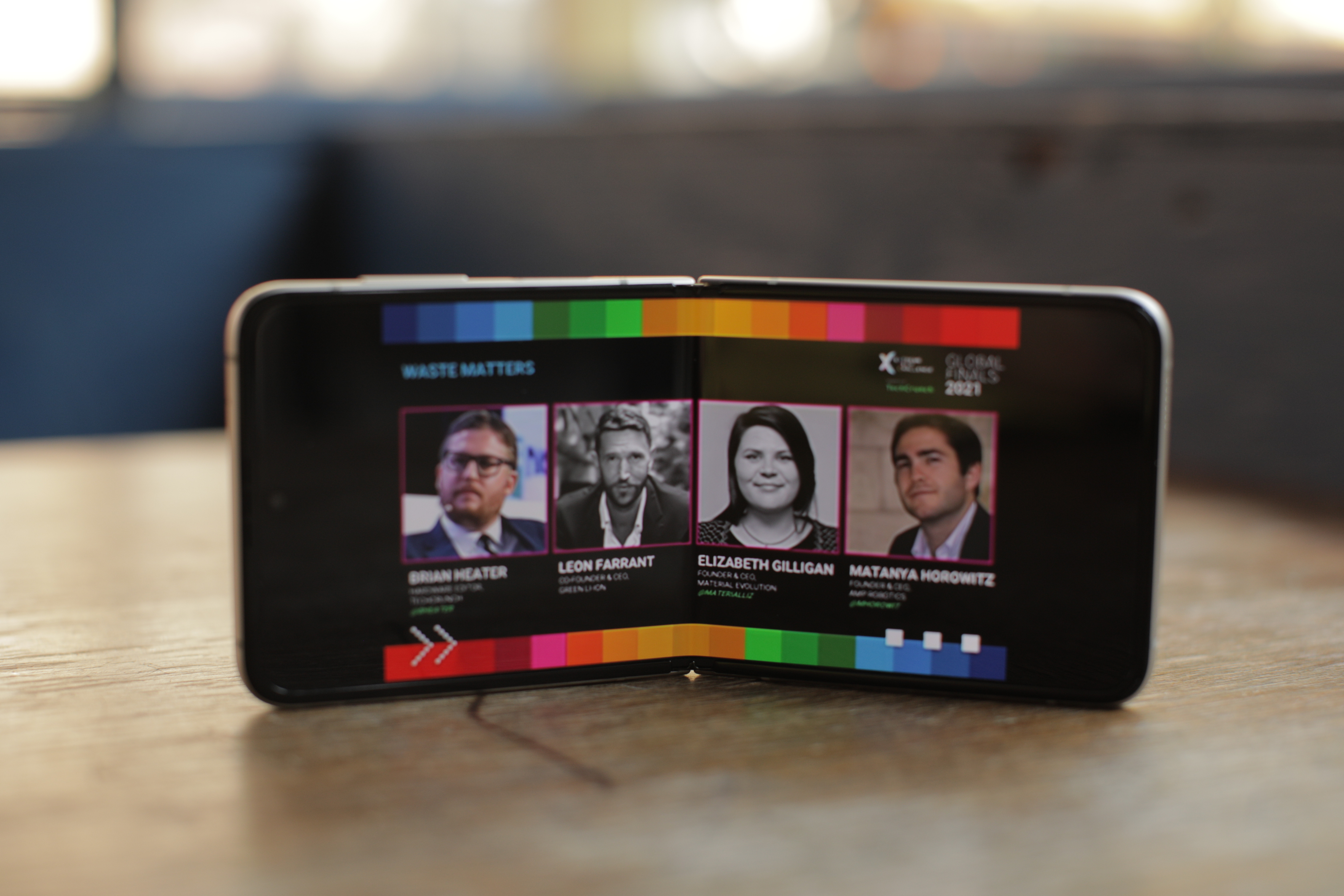
Samsung gets the design language right here. The Flip 3 is easily the company’s best-looking foldable to date. The dual-color shell is striking. The company sent along a cream color, which I’m not particularly fond of, but the green, lavender and even plain black or white are quite striking. It pairs well with the strip of black that houses the exterior display, which has been bumped from 1.1 to 1.9 inches. It doesn’t sound like a lot, sure, but that’s a healthy increase on a screen this size.

Of course, you’re losing the full exterior screen functionality you get on the Fold. The Flip’s display is effectively a quick-glance secondary screen for notifications. Pull it out, and it shows you the time, date and how much battery you’ve got left. Swipe right and you’ll see your notifications.

Swipe left and you get an alarm or timer, with the option of adding more widgets to the screen, including weather, media playback (effectively audio play/pause) and Samsung Health Metrics. It’s a small list, but one that will no doubt increase if more people pick up the Flip. Swipe down for some quick settings and Swipe up for Samsung Pause.

In a time when many of us are trying to make a concerted effort to minimize our phone use, I appreciate the dichotomy between the two screens. It’s a much clearer line in the sand than the one separating the Fold’s 6.2- and 7.6-inch screens. Phone closed = checking my notifications. Phone open = engagement. When the time comes to open the phone, the Flip is a much easier proposition than the phones. I haven’t quite mastered the art of the one-handed open just yet, but it’s much easier to execute on the fly than the Fold, which is effectively like opening a book. The biggest downside to the form factor in terms of speed is there’s no quick way to fire off a photo.

Image Credits: Brian Heater

Taking photos is far more deliberate, requiring one to open the phone to see the internal view finder. You can, however, snap off some selfies by double-pressing the power button, with the small front-facing screen doubling as a small viewfinder. Swiping to the left toggles between still, while swiping up and down changes the level of zoom. It’s a bit awkward and clunky, but the pair of 12-megapixel cameras (wide and ultra-wide) will get you a much better selfie than most pinhole cameras (including the Flip’s 10 megapixel lens).

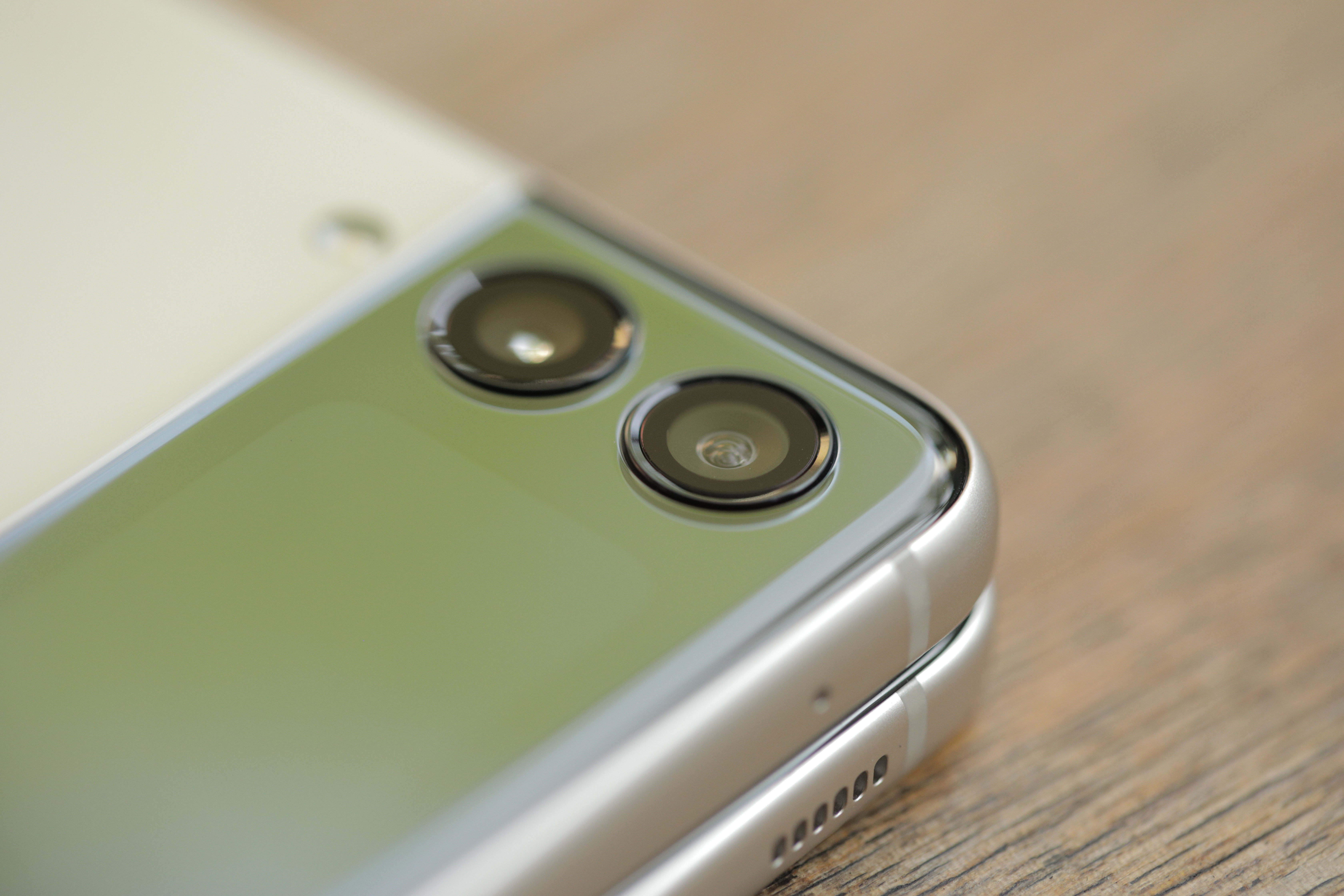
Like the Fold, the rear cameras (which are also the front-facing cameras, depending on how you look at it) are largely unchanged since the Flip 2. A dual-camera system can feel almost antiquated in 2021, but for most intents and purposes, they do the trick, coupled with Samsung’s many years of camera software experience. The 22:9 aspect ratio means more than a quarter of the screen is occupied by the controls out of necessity.

[gallery ids="2192880,2192883,2192882,2192881,2192879,2192874,2192873,2192872,2192871,2192870"]

The aspect ratio in general merits comment. It’s, like, really, really tall when open. It’s a nice amount of real estate to have when, say, scrolling through Gmail or Twitter. But when watching video, you’ll often encounter pillarboxing — letterboxing on the sides of the screen. The video world simply isn’t ready for 22:9, and quite frankly, it probably won’t ever be.

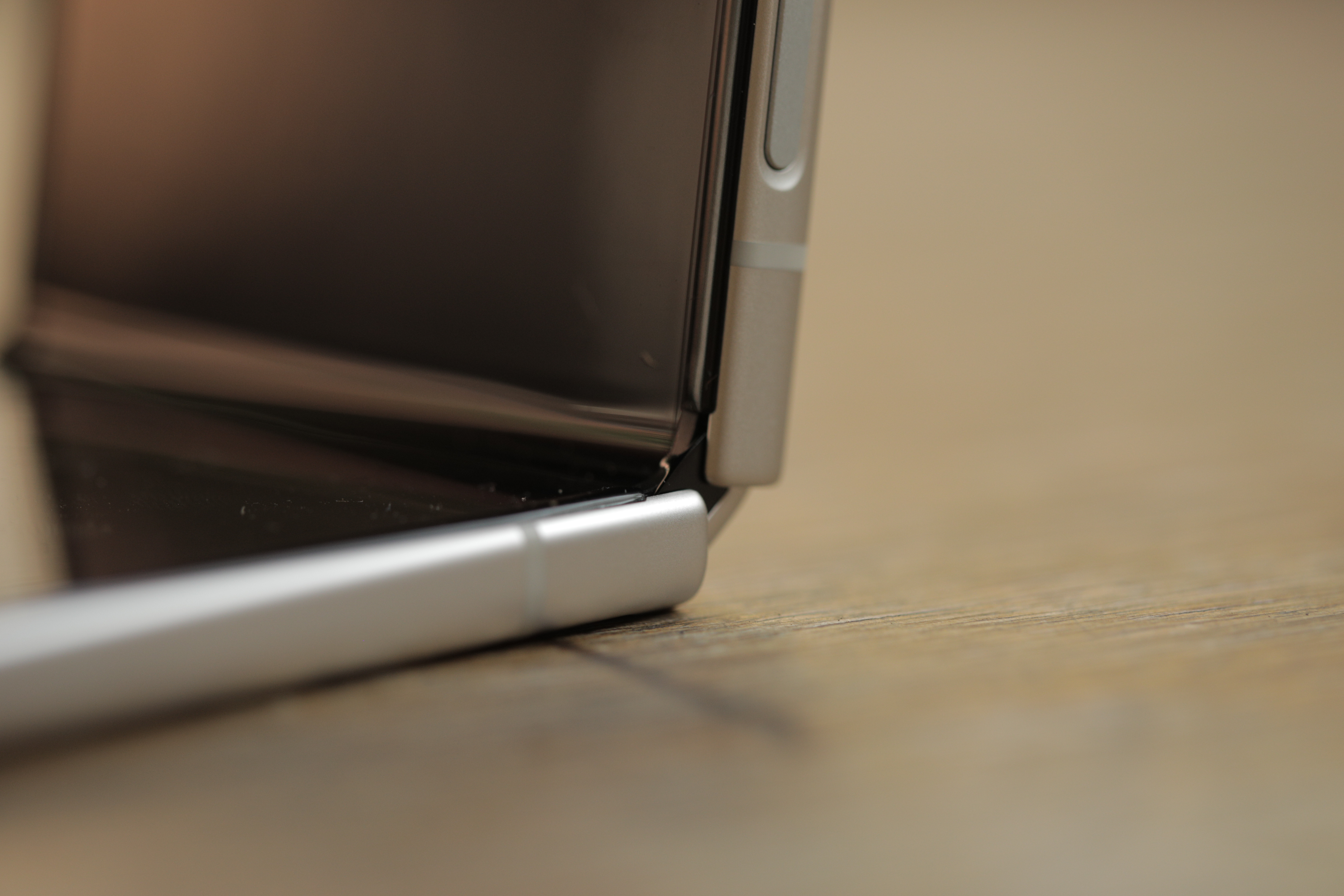
And then, of course, there’s the seam. It’s right there in the center of the lovely 2640 x 1080, 425 ppi screen. And barring some unforeseen breakthrough in foldable tech, I frankly don’t see it disappearing any time soon. I understand why that might be a deal breaker, though I’ve largely gotten used to it after spending time with these devices.

Like the Fold, the Flip runs on the Snapdragon 888 processor. Predictably, the lower cost comes with less in the way of RAM and storage, at 8 and 128GB on the Flip, to the Fold’s 12 and 256GB. Another $150 will upgrade the storage 256GB here. While Samsung mostly hasn’t skimped much on the internals, the 3,300 mAh battery does fall short.

Battery life is an issue with the Fold and an even bigger problem on the Flip — in fact, it’s the biggest complaint here. Moderate to heavy use is going to require getting near a charging cable before the day is over. Maybe not a huge deal in these pandemic days, but something to consider as we re-enter the world. Certainly long, unplugged plane rides are out of the question.

Image Credits: Brian Heater

Again, I can totally sympathize with that being a deal breaker. You pay $1,000 for a phone, you want a battery that’s going to get you through a day of use, worry-free. And certainly it’s something for Samsung to focus on in gen four.

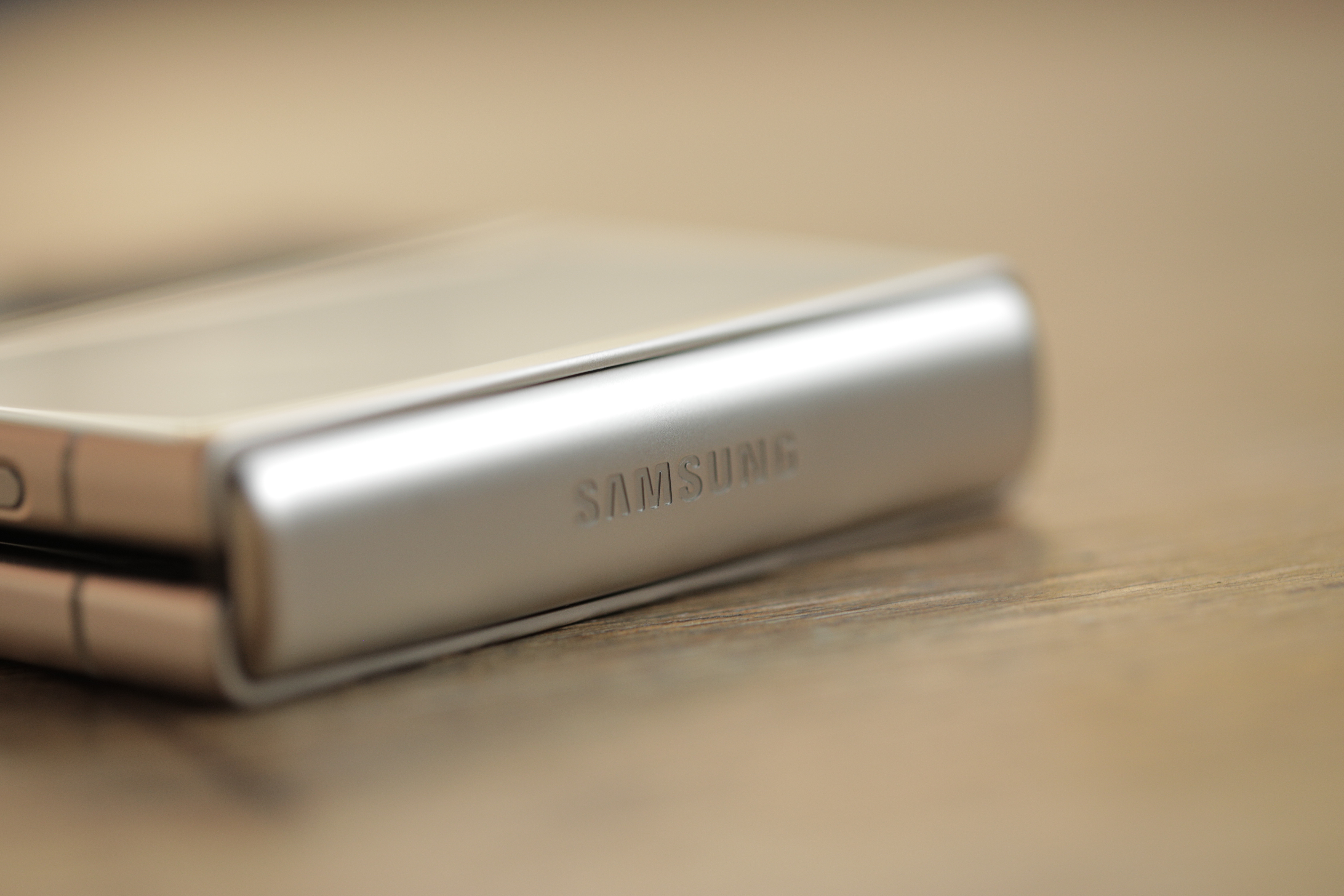
As it stands, the Galaxy Z Flip 3 has the benefit of previous generations, with a stronger aluminum frame, improved screen protector and IPX8 water resistance (no dust resistance rating, for reasons outlined in the Fold review). It’s not a perfect phone, but it’s a strong sign of how far Samsung’s foldables have come in three generations, coupled with a sub-$1,000 price point.

The device is likely to be second fiddle as the company continues to push the Fold as its flagship foldable. But for most people looking to enter the world of foldable phones, the Flip is the easy choice.


from blogger-2 https://ift.tt/3ycNnG2
via IFTTT