Monday, April 15, 2019

Unfolding the Samsung Galaxy Fold

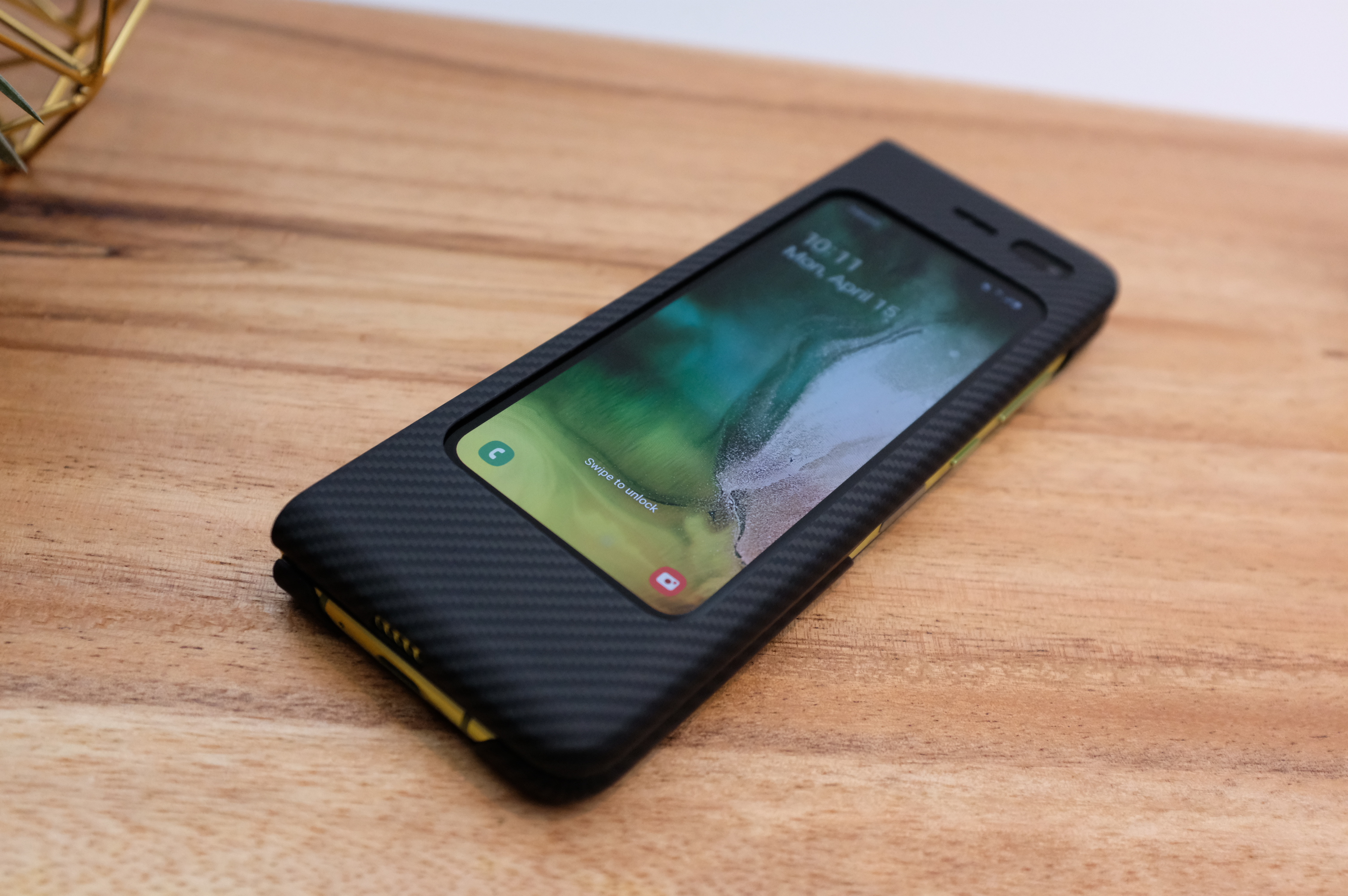
The Galaxy Fold is real. I’ve held it in my hands — a few of them, actually. Samsung’s briefing this morning was littered with the things, in different colors and different states of unfolded. A month or so ago, this was anything but a given.

After eight years of teasing a folding device, Samsung finally pulled the trigger at its developer’s conference late last year. But the device was shrouded in darkness. Then in February, it took the stage as the Galaxy Fold, but there was no phone waiting for us. Ditto for Mobile World Congress a week later, when the device was trapped like a carbonite Han Solo behind a glass display.

With preorders for the phone opening today, ahead of an expected April 26 sale, things were getting down to the wire for Samsung. But this morning, at an event in New York, the Galaxy Fold was on full display, ready to be put through its paces. We happily did just that in the hour or so we had with the product.

Once you get over the surprise that it’s real and about to ship, you find yourself pretty impressed with what Samsung’s done here. It’s easy to get frustrated about a product the company’s essentially been teasing since showing off its first flexible display at 2011, but a radically new form factor is an easy contender for first-generation woes. The fold, on the other hand, is a device that’s been run through the wringer.
Samsung’s already shown us what fold testing looks like in a promotion video that debuted a few weeks back. The handset was subject to 200,000 of those machine folds, which amounts to a lot more than the life of the product. And yes, before you ask, they were subjected to drop testing, the same sort of violent gadget abuse Samsung puts the rest of its gadgets through — both open and closed.

Ditto for the eight-point battery test it’s been subjecting all of its devices to since the Note 7. That’s doubly important given the fact that the Galaxy Fold sports twice the battery. All told, it has 4380mAh, split in two, on either side of the fold. That amounts to “all day battery life” according to Samsung. That’s the same claim you’ll get on most of these devices ahead of launch. Though the Fold apparently presents an extra layer of ambiguity, given that the company isn’t entirely sure how people are actually going to use the thing, once they get it in their hands.

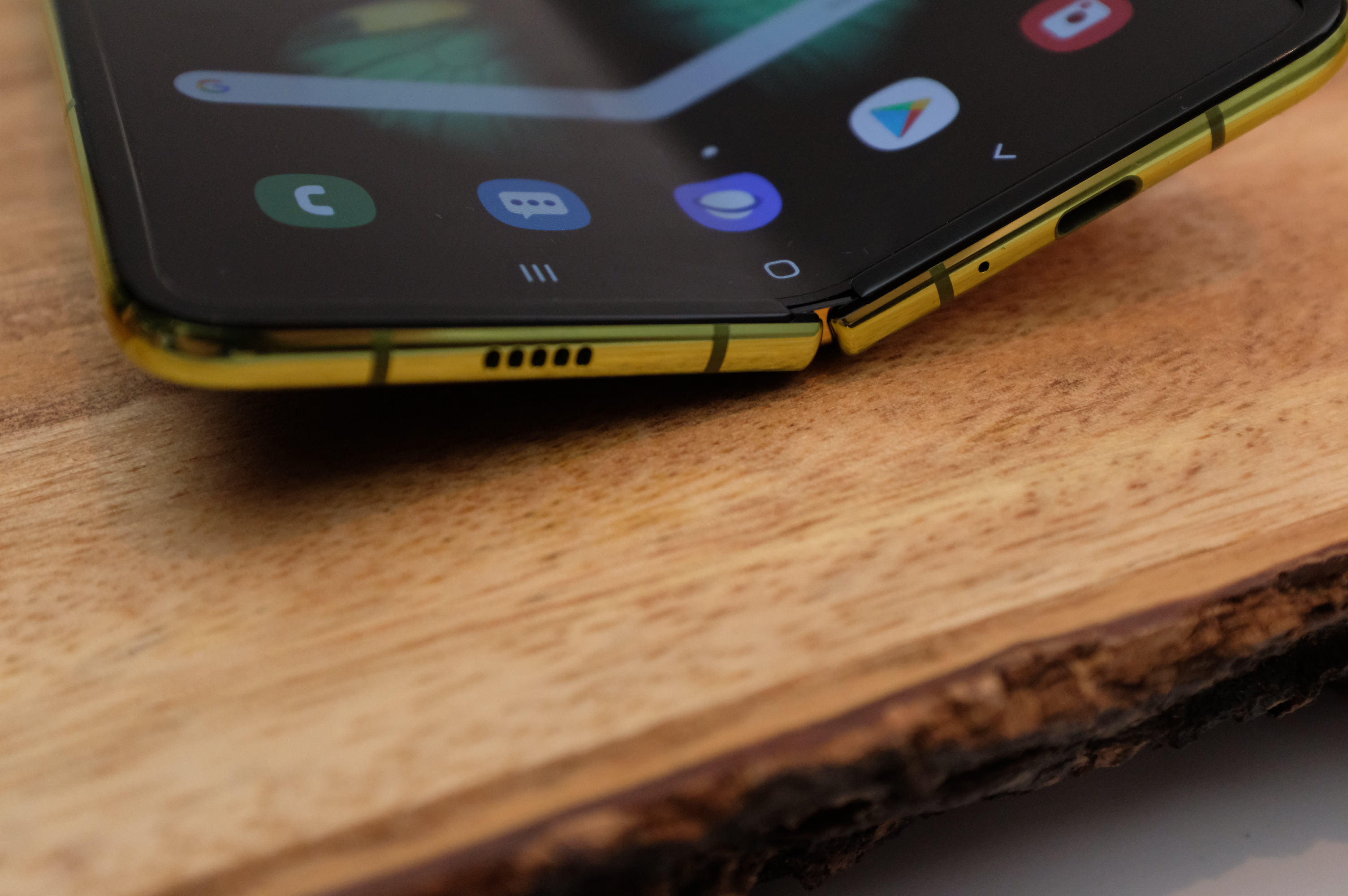
The folding mechanism works well, snapping shut with a satisfying sound, thanks in part to some on-board magnets hidden near the edge. In fact, when the Fold is lying screen down, it has the tendency to attract pieces of metal around it. I found myself absent-mindedly opening and closing the thing. When not in use, it’s like an extremely expensive fidget spinner.
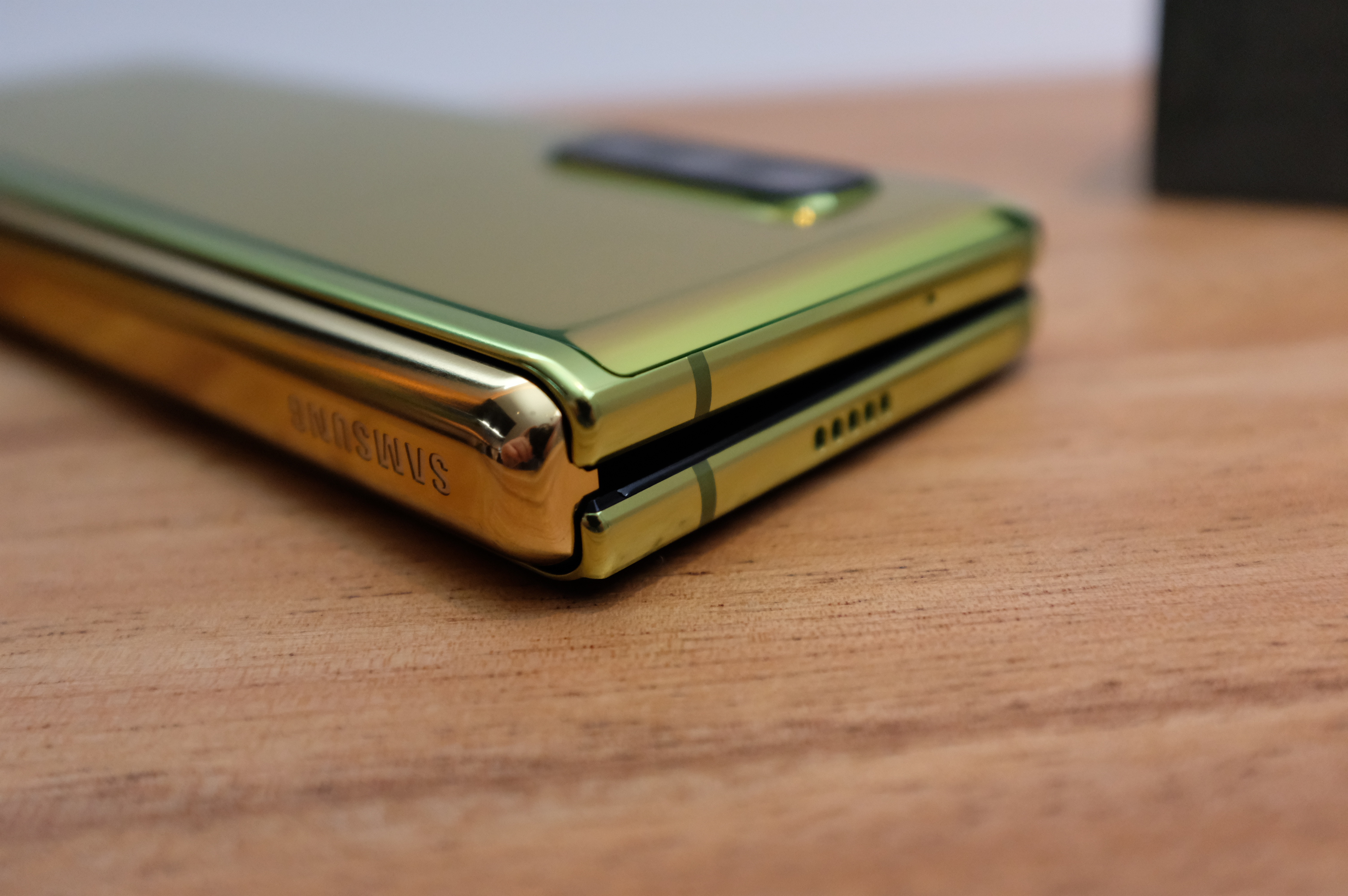
Samsung’s done a remarkable job maintaining the design language from the rest of the Galaxy line. But for the odd form factor, the Fold looks right at home alongside the S10 and the like. The rounded metallic corners, the camera array and, yes, the Bixby button are all on board here.

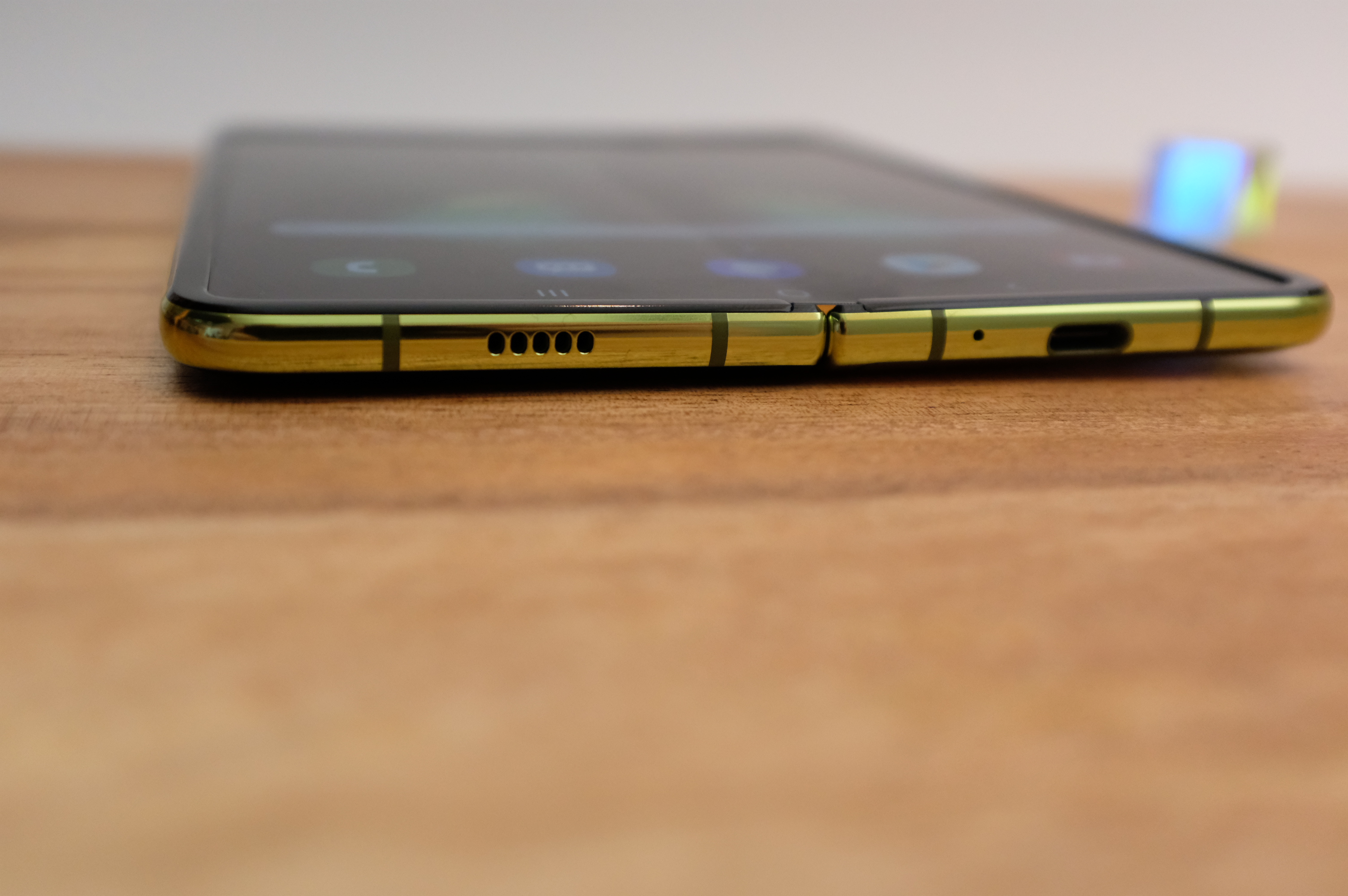
The edges are split in two, with each screen getting its own half. When the Fold is open, they sit next to each other, with a small gap between the two. When the phone is folded, they pull apart, coming together at a 90 degree angle from the hinge. It’s an elegant solution, with a series of interlocking gears that allow the system to fold and unfold for the life of the product.

Unsurprisingly, Samsung tested a variety of different form factors, but said this was the most “intuitive” for a first-gen product like this. Of course, numerous competing devices have already taken different approaches, so it’s going to be fascinating watching what the industry ultimately lands on when more of these products are out in the world.
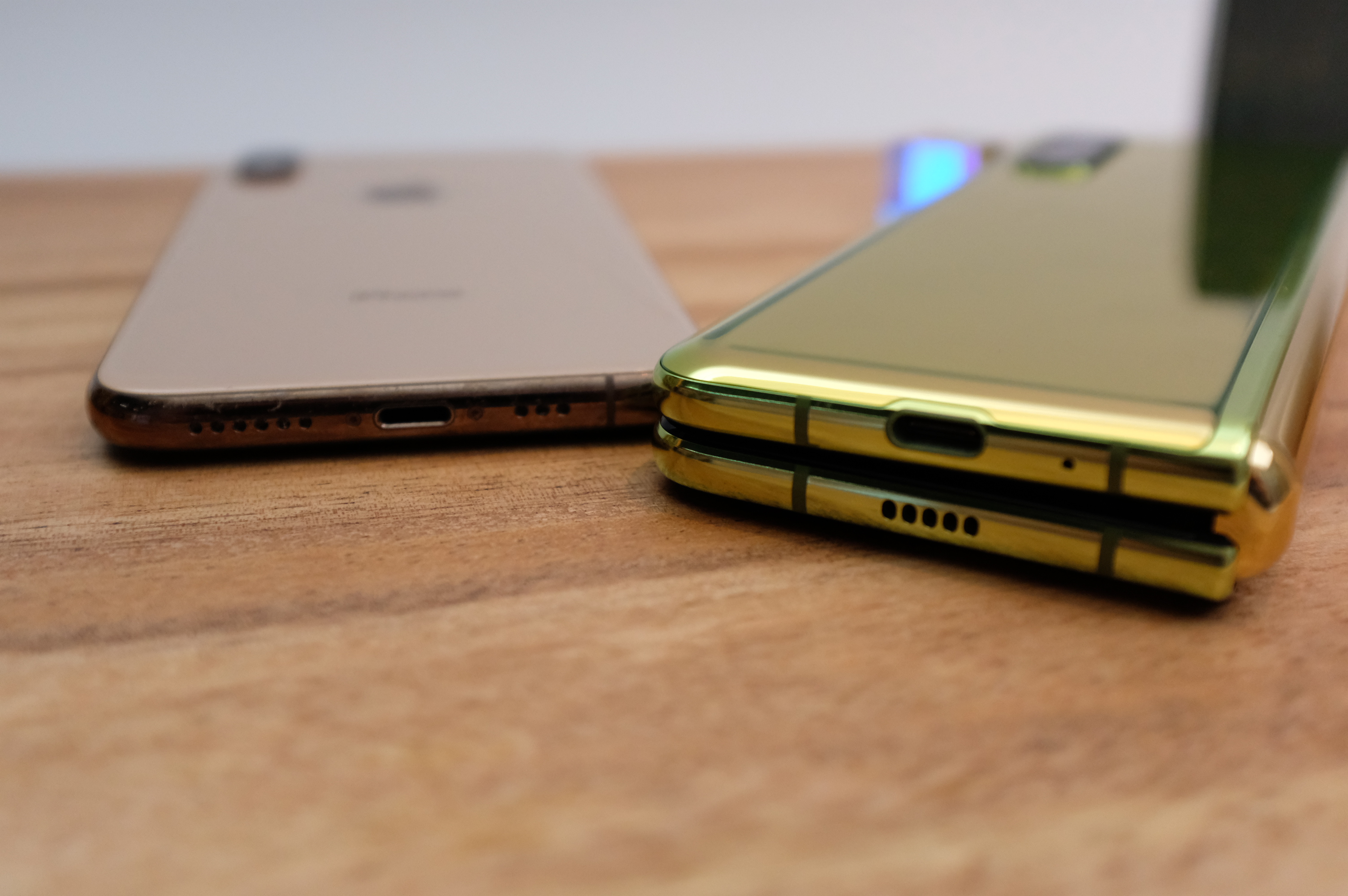
Unfolded, the device is surprisingly thin — a hair under the iPhone XS. Folded, it’s a bit beefier than two iPhones, owing to a gap between the displays. While the edges of the device come into contact when closed, they form a long, isosceles triangle, with a gap that increases as you move toward the middle.

Unfolded, the seam in the middle of the display is, indeed, noticeable. It’s subtle, though. You’ll really only notice it as your finger drags across it or when the light hits it the right way. That’s just part of life in the age of the folding phone, so get used to it.

[gallery ids="1812546,1812545,1812544,1812543,1812542,1812541,1812540,1812539,1812538,1812537,1812536,1812535,1812534,1812533,1812532"]

The inner display measures 7.3 inches. Compare that to, say, the iPad Mini’s 7.9. So, small for a tablet, but way too big to stick in your pocket without folding it up. The size of the interior display renders the notch conversation a bit moot. There’s actually a pretty sizable cutout in the upper-right corner for the front-facing camera.

Samsung’s been working with Google and a handful of developers, including WhatsApp and Spotify, to create a decent experience for users at launch. There are two key places this counts: app continuity and multi-app windows. The first lets you open an app on the small screen and pick up where you left off on the big one, once unfolded. The second makes it possible to have three apps open at once — something that’s become standard on tablets in the last couple of years.
Both work pretty seamlessly, though the functionality is limited to those companies that have enabled it. Samsung says it’s an easy addition, but the speed with which developers adopt it will depend largely on the success of these devices. Given that Samsung’s worked hand in hand with Google/Android on this, however, gives the company a big leg up on the competition.

All told, I’m pretty impressed with what amounts to a first-gen product. This thing was a long time in the making, and Samsung clearly wanted to get things right. The company admittedly had some of the wind taken out of its sails when Huawei announced its own folding device a few days later.

That product highlighted some of the Fold’s shortcomings, including the small front-facing screen and somewhat bulky design language. The Fold’s not perfect, but it’s a pretty solid first take at a new smartphone paradigm. And with a starting price of $1,980, it’s got a price to match. You’re essentially paying double for twice the screen.
Samsung, Huawei and the rest of the companies exploring the space know that they’re only going to sell so many of these things in the first go-round at this price point. Everyone’s still exploring aspects like folding mechanisms, essentially making early adopters guinea pigs this time out.

But while the fold doesn’t feel like a phone that’s achieved its final form, it’s a surprisingly well-realized first-generation phone.


from blogger-2 https://tcrn.ch/2IybokE
via IFTTT

Thursday, April 11, 2019

Samsung Galaxy Fold pre-orders open tomorrow

There are early adopters, and then there are early adopters. Anyone who bites the bullet and picks up Samsung’s $1,980 and up Galaxy Fold falls into the former category. And then there are those who’ll be the first to Samsung’s site when the company opens up pre-orders on its inaugural foldable tomorrow.

Samsung is really squeezing as much out of this as possible — and understandably so. This thing was a long time in the making. Yesterday, it announced that it had begun mass production on foldable OLEDs for the device. A couple of weeks back, it showed its fold testing in action via video.

As for the devices themselves, we haven’t seen much beyond what Samsung showed off on-stage at an event in San Francisco earlier this year. That includes the behind-glass debut at Mobile World Congress a week later — certainly not the same sort of confidence Huawei displayed with its own device announced at that show.

Not the kind of thing that lends a lot of confidence to such a pricey purchase, but such is the plight of the early early adopter.

The Galaxy S10 5G, meanwhile (a product we’ve actually seen in person, mind), will be available through the company’s site next month.


from blogger-2 https://tcrn.ch/2X2cOI6
via IFTTT

Friday, April 5, 2019

Samsung’s upcoming Q1 earnings are going to be ugly

It’s that time again folks, Samsung has reported guidance for its upcoming Q1 quarter — and things don’t look good.

Samsung is forecasting that revenue for the quarter will reach 51-53 trillion KRW ($44.87-$46.63 billion), which would represent a drop of around 15 percent on one year previous. The Korean tech giant reported a record operating profit in Q1 2018 — $13.76 billion — but this time around that is forecast to fall by a whopping 60 percent for the current quarter of business. According to Bloomberg, that would be the company’s worst slump for four years.

Following a record year is never going to be easy, but the forecast Q1 2019 operating profit of 6.1-6.3 billion KRW — around $5.5 billion — represents a pretty steep 43 percent drop on the previous quarter. That’ll give Samsung shareholders plenty to worry about.

The company’s pre-earnings guidance doesn’t go into details on the predictions, but last year’s record profits were largely down to the success of its consumer handset business and also a strong market for memory chips. There have been plenty of warning signs that those good times might not last.

Samsung itself played down those impressive Q1 2018 results multiple warnings on the future — my colleague Brian Heater pointed out that the words “slowing growth” appeared seven times in Samsung’s announcement at the time — due to concerns around the company’s display panel business and a slowing growth within the general smartphone industry.

As we well know, analyst reports show that people are buying fewer phones for a range of reasons. That’s one explanation for Apple’s multi-device approach which pushes its top-of-the-range model to well beyond the $1,000-mark. Slowing growth means a need to extract more revenue from the most loyal users, to thus increase the overall average selling price (ASP).

Samsung has long played in the mid-tiers — where it is up against tough competition from the likes of Xiaomi, Oppo, Huawei and others from China — but it’ll be interesting to see if it shifts its top-end approach.

We’ll know more when the company releases its full Q1 earnings report later this month so stayed tuned.


from blogger-2 https://tcrn.ch/2WLlnHa
via IFTTT

Thursday, March 28, 2019

Xiaomi teases another look at its foldable phone

Xiaomi is back with another teaser of the foldable concept device it first showed off in January.

This time around, in a video posted to its Weibo account, the Chinese company showed off the device working in tablet mode and, after folding, regular phone mode to illustrate how seamlessly it can be tucked up and put away… in this case atop of a cup of noodles.

Video: hat tip The Verge

Xiaomi has said it is developing a device — the previous video included a call-out for ideas and feedback — so the project isn’t likely as advanced as soon-to-launch products from Samsung, Huawei or lesser known Chinese brand Royole.

Unlike those three, Xiaomi’s offers two foldable edges instead of just one. That would appear to present a much tougher challenge in terms of design and logistics, but this new teaser (and there’s no doubt Xiaomi chose it carefully) seems to show impressive results. The phone folds nicely in terms of hardware and software, but you’d imagine those edges will make it thicker than others.

It’s all ifs and buts for now, though, since Xiaomi isn’t giving up details of what this product might become… or even whether it will become one at all. But Xiaomi being Xiaomi, you’d imagine that when it does drop, it won’t just be the two folds that set it apart from the rest. The Chinese firm is massively price-sensitive, so you can expect that it’ll price any foldable phone it releases much lower than the $2,000 or so that Samsung and Huawei are asking for their gen-one efforts.


from blogger-2 https://ift.tt/2FGOXYx
via IFTTT

Wednesday, March 27, 2019

Watch Samsung fold the crap out of the Galaxy Fold

We’ve not seen a lot of the Samsung Galaxy Fold. The device didn’t make its way off-stage at the Unpacked event in late February, and a week later, it was trapped behind glass at Mobile World Congress. But Samsung insists that not only is the handset real, it’s actually going on stage pretty soon.

What we have seen, however, are videos. There’s this one from MWC, and today the company dropped another more behind the scenes video, in which the forthcoming foldable is put through Samsung’s in-house stress testing.

The company’s claims of lasting around 200,000 folds and unfolds are pretty standard for these kinds of devices. As noted, that amounts to around 100 folds a day for over five years — longer than most of us hold onto a phone, though for $2,000, who knows?

The new video shows how Samsung and other companies determine that sort of massive number, using mechanical devices. It says the 200,000 number takes around a week for the devices to complete. It’s pretty mesmerizing. Honestly, I would happily watch a livestream, while waiting to get my hands on the device.


from blogger-2 https://ift.tt/2OrjT1V
via IFTTT

Thursday, March 14, 2019

AI photo startup Polarr raises an $11.5 million Series A

Bay Area photography startup Polarr announced this morning that it has raised an $11.5 million Series A. The new round of funding, led by Threshold Ventures with participation from Pear Ventures and Cota Capital, brings the startup’s total funding to around $12.5 million, according to the latest Crunchbase figures.

At the moment, the company is probably best known for its photography app for iOS and Android, which utilizes machine learning and AI to improve image editing. The company says it has around four million monthly active users.

This round of funding will go toward research and development, engineering and partnerships, the latter of which are starting to become a big business for Polarr. In fact, it’s using the news to highlight the fact that it was tapped to bring its technology to the Samsung Galaxy S10’s native camera app. Polarr has previously teamed with other big hardware names, including Qualcomm and Oppo.

“As deep learning compute shifts from the cloud to edge devices, there is a growing opportunity to provide sophisticated and creative edge AI technologies to mobile devices,” CEO Borui Wang said in a release tied to the news. “This new round of financing is a tangible endorsement of our approach to enable and inspire everyone to make beautiful creations.”

Polarr’s tech is becoming increasingly valuable as phone makers look to differentiate their handsets’ imaging outside of the hardware. Notable recent generations of handsets from top companies like Samsung, Apple and Google have leaned heavily on AI and ML updates to stand out from the crowd.


from blogger-2 https://ift.tt/2HkYy9G
via IFTTT

Wednesday, March 13, 2019

Tetrate nets $12.5 million to bring microservices to the corporate masses

Tetrate, a company bringing commercial services and support to the open source projects –Istio and Envoy — providing network management functions for the microservices that make up modern mobile applications, has launched with $12.5 million in new financing.

The company, founded by top engineers at Google who started the Istio project, raised its initial financing from a slew of institutions and big names in enterprise software including Pankaj Patel, Former Chief Development Officer at Cisco; Guido Appenzeller, Former CTO Cloud & Networking at VMware; BV Jagadeesh, founder and CEO of Netscaler and Shiva Rajaraman, Chief Product Officer of WeWork.

On the institutional investment side, Dell Technologies Capital led the financing, which also included Intel Capital, Samsung NEXT, 8VC, and Rain Capital.

Tetrate was able to bring this motley band of investors together to back its foray into professionalizing services and support around a toolkit that’s helping to redefine application development.

The company is supporting open source projects Istio and Envoy, which developers use to create what’s called a “service mesh” that orchestrates how microservices on a distributed data center platform communicate with one another and work together as part of an application.

It’s corollary in the old software world that I initially wrote about would be the middleware layer for in a client-server architecture. (Much of this was foreign to me before I read this excellent primer from ZDNet, which spelled out a lot of what’s going on for me).

One of the key things that microservices address, and that Tetrate will provide support for, is to support the management of different microservices at scale.

Think of the service mesh as the toolkit that keeps microservices communicating with each other and enabling applications at the level of executable code. So tools like Istio are used to manage the network without impacting the services that are running on top of it.

Tetrate was actually founded by some of the architects behind the development of Istio. “I was at Google for the last ten years most recently working as a product manager in Google Cloud,” says Tetrate co-founder and chief executive Varun Talwar. Indeed, Google was where Talwar and his colleagues developed the Istio toolkit.

Talwar says that the Istio toolkit was born out of the needs of the developers in the Kubernetes community. “It decouples the operations from the development,” Talwar says of the Istio service. “You can apply policy management.”

Talwar and his colleagues took the covers off the Istio project in May of 2017 at Glucon and brought in big names to support its use including IBM and Red Hat (now IBHat? RedBM?). A little less than one year later, Talwar left Google to start Tetrate.

Now, with the new financing from its backers, Tetrate is going to bring enterprise-grade extensibility, scalability, and performance to the open source tools that its founders helped develop, according to a statement.

“Customers are going through a journey of modernization and public cloud adoption,” said Talwar, in a statement. “Tetrate’s mission is to create the tools and technologies that help customers with availability and manageability of their applications as they undergo this transformation.”

The company is releasing a set of certified builds of envoy proxy and other open source tools to speed the adoption of microservices development in businesses. The company is also partnering with Google and the Cloud Native Computing Foundation for operating hybrid computing environments with Istio.

“Open source should be an integral part of any company’s software and operations strategy today,” said Envoy founder and Lyft Engineer Matt Klein, in a statement. “Interoperability will be the key factor in the next phase of cloud adoption, so having deep roots within the open source community gives Tetrate instant credibility among cloud-first companies.”


from blogger-2 https://ift.tt/2CjThej
via IFTTT