Tuesday, May 5, 2020

Xiaomi launches Mi Commerce in India to boost sales amid lockdown

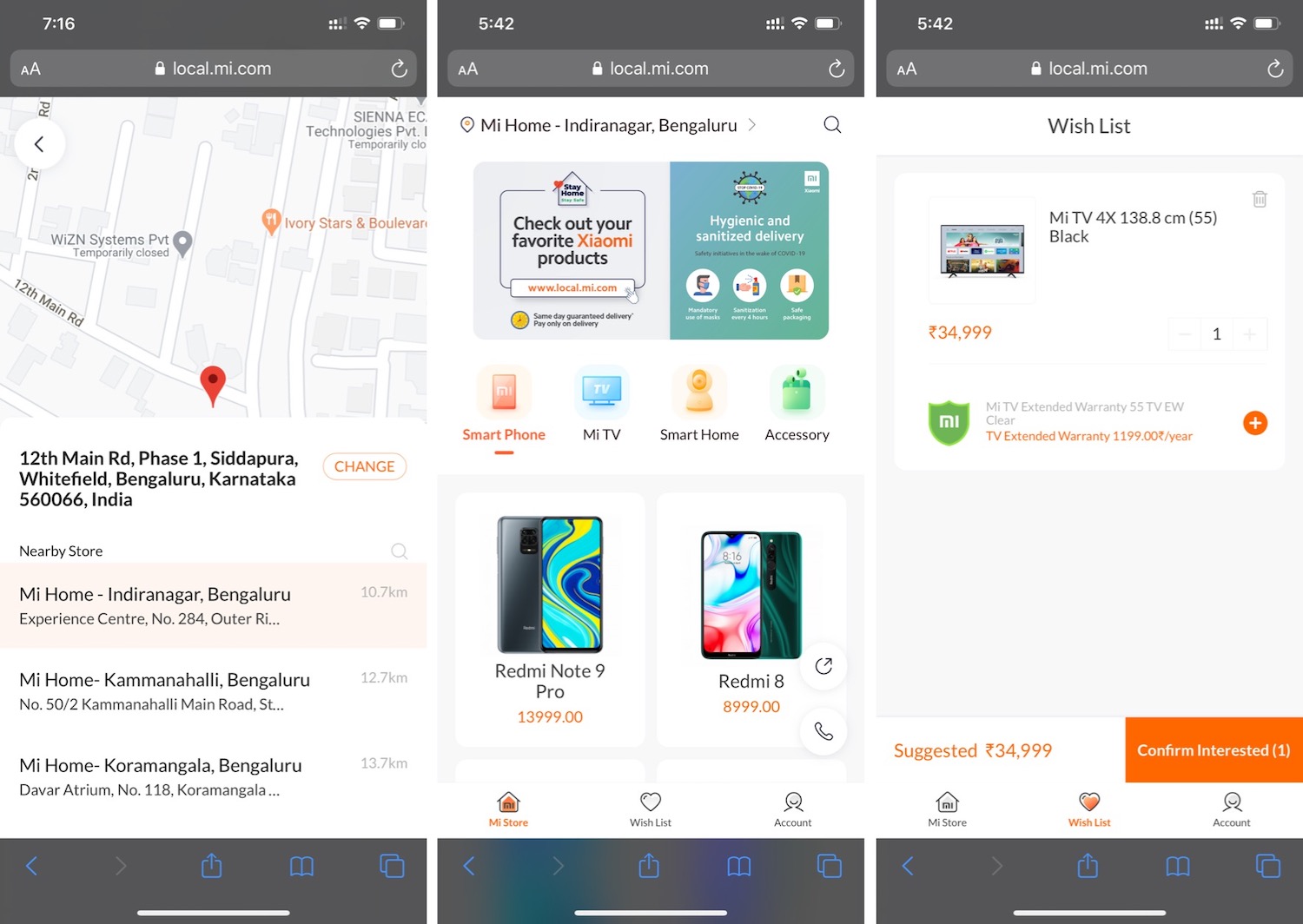
Xiaomi today launched a new e-commerce service in India that allows people in the nation to easily browse and order its handsets and other products from nearby physical retail stores as the Chinese giant rushes to kickstart its sales in its biggest overseas market.

Dubbed Mi Commerce, the service allows people to locate nearby stores that are either run by Xiaomi or those that have tie-ups with the company and browse smartphones, TVs, electric lamps, and a range of other products.

Users can express their “interest” to purchase the selected item through the app that would prompt the retail store to place a confirmation call. The retail store would deliver the item and then process the payment, Xiaomi said. A spokesperson told TechCrunch that Mi Commerce is available only in India currently.

Xiaomi has also launched a WhatsApp Business account that operates on a similar flow. Users can send a message to +91 8861826286 to initiate the conversation with retail stores through Facebook-owned service.
The shift to what is often described in the industry as an online to offline model comes as Xiaomi, like other smartphone vendors, looks to make up its lost sales in recent weeks. India ordered a nationwide lockdown in late March that shut retail shops, and restricted e-commerce firms to only service grocery orders.

According to Hong Kong-headquartered research firm Counterpoint, no smartphone units were sold in India, the world’s second largest smartphone market, in April.

In a call with reporters, Xiaomi executives said they were hopeful that the Indian market would attain at least 80% of its momentum by the end of the year. Counterpoint slashed its smartphone projections for India last month, saying it now expects the market to shrink by 10% this year. Indian smartphone market has consistently grown year-by-year in the last decade.

Mi Commerce would additionally also help potential customers maintain social distance and avoid errands to stores that would otherwise expose them to novel coronavirus.

Xiaomi said it was working with the government for an update on the resumption of smartphone manufacturing plants that are also shut since the lockdown was ordered in March. The company executives said they currently have inventory to meet demand for three to four months.

The Chinese giant is also providing working capital to its retail store partners, it said.

Samsung, which lost the tentpole position in India’s smartphone market to Xiaomi in 2018 and recently the second spot to Vivo, did not respond to TechCrunch’s request for comment on any similar efforts it has made — or not made — in India.

On Monday, e-commerce firms including Amazon and Walmart in India resumed their service for people in more than 80% zip codes in the country. A lockdown would remain in place for another two weeks in India, but New Delhi has eased some restrictions.


from blogger-2 https://ift.tt/2W5yQfl
via IFTTT

India’s Glance tops 100 million daily active users in 21 months

Glance, which serves media content, news, and casual games on the lock screen of Android-powered smartphones, has amassed 100 million daily active users, it said today.

The subsidiary of ad-firm InMobi Group reached the milestone in 21 months in what appears to be the shortest duration for any popular internet service to gain their first 100 million daily active users, said Naveen Tewari, founder and chief executive of InMobi Group, in an interview with TechCrunch.

Glance uses AI to offer personalized experience to its users. The service replaces the otherwise empty lock screen with locally relevant news, stories, and casual games. Late last year, InMobi acquired Roposo, a Gurgaon-headquartered startup, that has enabled it to introduce short-form videos on the platform.

“Introducing short-form videos and games on Glance has helped us increase the engagement level. About 25% of our users actively play games on Glance,” said Tewari. The firm is now working to make these short-form videos available in many local languages. (You can also try the service on your mobile web browser or through its preview app on Google Play Store.)

Glance ships pre-installed on several smartphone models. The subsidiary maintains tie-ups with nearly every top Android smartphone vendor including Xiaomi, the top player in India, and Samsung.

But users can easily disable the service, said Tewari, adding that the 100 million users the firm is reporting today are those who consciously engage with content on Glance. Users spend about 25 minutes consuming content on Glance each day, he said.

Sitting on the lock screen, perhaps the most coveted real estate on a smartphone to reach a user, has allowed Glance to deliver any information to a very large number of users in a short time. Tewari said more than 50 million users reacted to Glance informing them about India’s Prime Minister Narendra Modi’s speech last month surrounding the lockdown in the country, for instance.

“We are not just a short-form video platform. We are not just a gaming platform nor one that serves just news. Given where we sit, we cater to nearly everything that is out there across the world. So everyone has something to consume,” he said.

The service is currently available in India, its biggest market with more than 80 million users, Indonesia, Malaysia, Thailand, and the Philippines. Tewari said the firm plans to roll out Glance across the globe in the next two years.

Glance, which raised $45 million last year, is currently not monetizing its users. Tewari said he has experimented with a few ideas, but won’t make any push on this front for another one to two quarters.


from blogger-2 https://ift.tt/2z8VKth
via IFTTT

Friday, May 1, 2020

An already struggling smartphone market takes a big hit from COVID-19

Quarter after quarter, familiar stories have appeared. The smartphone market, once seemingly bulletproof, has suffered. The list of factors is long, and I’ve written about them ad nauseam here, but the CliffsNotes version is: costs are too high, innovation is too incremental and most people already own a device that will be plenty good for the next few years.

But 2020 was going to be different. Smartphone makers were set to finally give consumers a reason to upgrade in the form of 5G. The first handsets appeared in earnest last year, but between a much wider carrier roll out, lower-cost 5G radios from Qualcomm and the arrival of a 5G iPhone, this was going to be the year the next-gen wireless technology helped reverse the smartphone slide.

And then COVID-19 disrupted everything. For many of us, life is on hold — and will likely continue to be for months. I’m writing this from my home in Queens, N.Y., the hardest-hit county in the hardest-hit country in the world. It still feels strange to type that, even though it’s been a reality for a month and half now.

Purchasing a smartphone is most likely the last thing on anyone’s mind during what is shaping up to be the worst global pandemic since the 1918 flu pandemic. With a number of key manufacturers reporting quarterly earnings this week, the numbers are starting to bear out this disconnect. Earlier this week, both Samsung and LG reported weak mobile numbers. Yesterday, Apple reported revenue of $28.96 billion, down from $31.1 billion the same time last year.

More troubling, all three companies appeared to be united in suggesting that the worst might be yet to come. Samsung suggested that both mobile and TV demand would “decline significantly” in the following quarter. LG used virtually the same exact wording, stating that, “market demand is expected to decline significantly YoY due to COVID-19 pandemic.” For its part, Apple simply didn’t issue guidance for the next quarter, a surefire indication of uncertainty in these uncertain times — to borrow a phrase from every commercial airing currently.


from blogger-2 https://ift.tt/2WvMPKH
via IFTTT

Thursday, April 30, 2020

Smartphone shipments dropped 13% globally, and COVID-19 is to blame

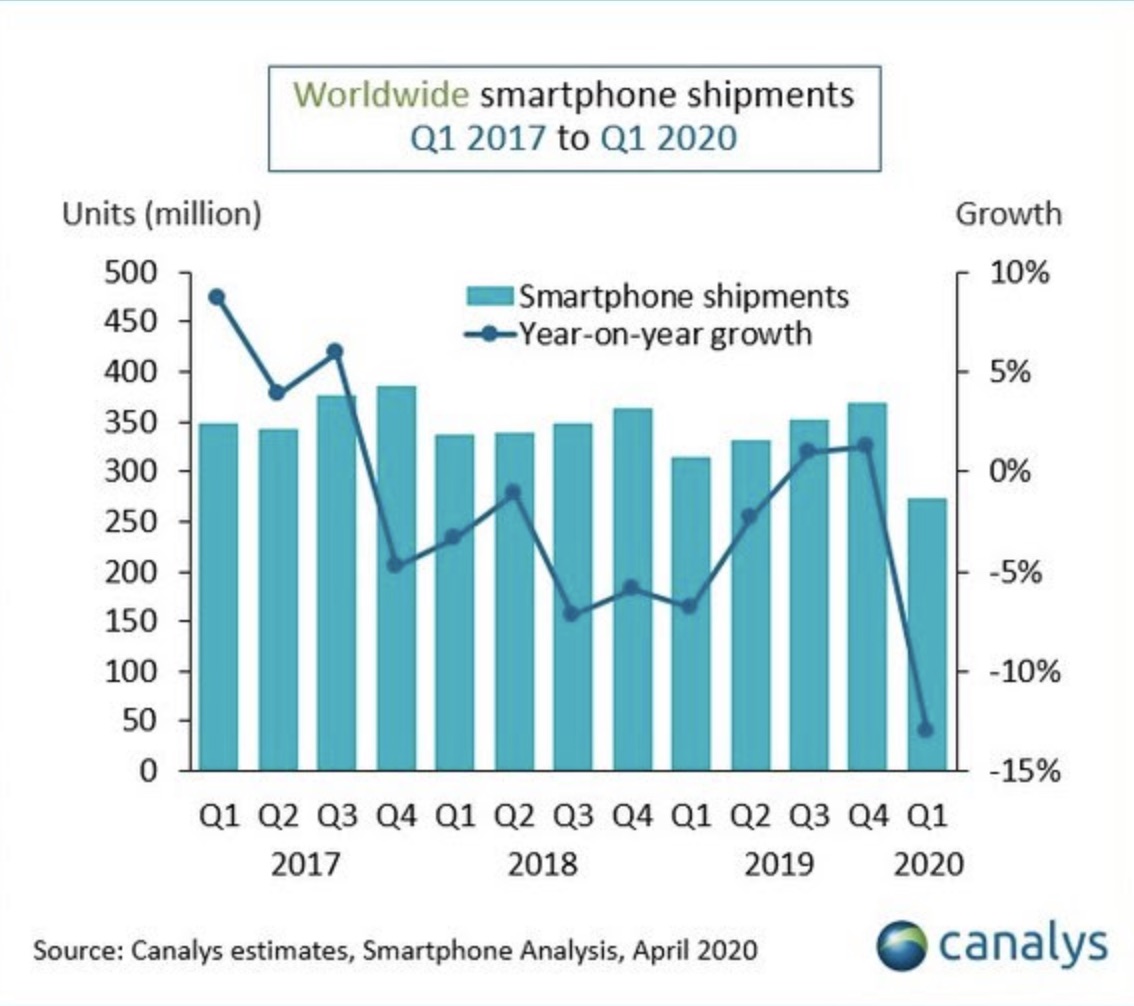
We knew it was going to be bad — but not necessarily “lowest level since 2013” bad. As Apple was busy reporting its earnings, Canalys just dropped some of its own figures — and they’re not pretty. After two quarters of much-needed growing, the global smartphone market just took a big hit. And you no doubt already know who the culprit is.

The mobile industry joins countless others that have taken a massive hit due to the COVID-19 pandemic, with shipments dropping 13% from this time last year. Here’s a graph for those of you who are visual learners:

Analyst Ben Stanton used the word “crushed” to describe the novel coronavirus’s impact on the mobile market. “In February, when the coronavirus was centered on China, vendors were mainly concerned about how to build enough smartphones to meet global demand,” he writes. “But in March, the situation flipped on its head. Smartphone manufacturing has now recovered, but as half the world entered lockdown, sales plummeted.”

First it was impact on the global supply chain, which is centered in Asia, along with a drop in demand among consumers in China. As Europe, the U.S. and other locations continue to live under shelter in place order, demand in those markets has taken a significant hit. People are stuck inside and many have lost jobs — it’s not really the ideal time to consider shelling out $1,000+ for what still seems a luxury for many.

Samsung regained the top spot, while still losing significant numbers. Both it and the number two company, Huawei, were down 17% for the quarter. Apple, at number three, dropped 8%. Chinese manufacturers Xiaomi and Vivo saw some gains, at 9- and 3%, respectively.

There are bound to be rough times ahead as well. Per Stanton, “Most smartphone companies expect Q2 to represent the peak of the coronavirus’ impact.” Apple noted the uncertainty of its own earnings by opting not to issue guidance for next quarter.


from blogger-2 https://ift.tt/3c4tG9f
via IFTTT

Wednesday, April 29, 2020

Samsung expects COVID-19 to hurt smartphone and TV sales, but increase demand for memory

In its first-quarter earnings report today, Samsung said it expects the COVID-19 pandemic to continue impacting its business for the rest of the year, cutting into sales for smartphones and TVs, but increasing demand for PCs, servers and memory chips as people continue to work or study from home.

Samsung’s results for the first-quarter of 2020 was in line with the guidance it released earlier this month. Operating profit was 6.45 trillion Korean won (about $5.3 billion). Revenue fell about 7.6% from the previous quarter to 55.33 trillion won, due to a seasonal drop in demand for displays and consumer electronics, and the impact of the pandemic.

The COVID-19 pandemic has caused more than 3 million confirmed cases around the world and more than 217,000 deaths, and resulted in shelter-in-place orders in countries around the world and a global recession.

Samsung said that because the pandemic’s impact through the second half of 2020 remains uncertain, it plans to make flexible investments and adjust its product mix to adapt. Because it expects competition among manufacturers to increase as they try to recover from a weak first half, Samsung said it will continue to launch premium products like a new foldable and Note devices, and expand 5G to more mass-market smartphones.

Samsung’s display panel business saw a decline in earnings during the first quarter due to weak seasonality and lower sales in China during COVID-19 shutdowns, and it expects demand to continue being impacted by the pandemic and postponement of major sporting events like the Summer Olympics.

On the other hand, Samsung expects to see solid performance in its memory business as remote work, online education, online shopping and streaming entertainment services continue putting more demands on cloud providers and data centers. As a result, Samsung will speed up its transition to 1Z-nm DRAM and 6th-generation V-NAND flash memory.

Samsung also said it plans to offset store and plant closures around the world through flexible supply networks, improving its online sales capabilities, and tailoring promotions and logistics for different market.


from blogger-2 https://ift.tt/2xmLJIA
via IFTTT

Tuesday, April 21, 2020

Samsung’s Galaxy Watch blood pressure monitoring app approved by South Korean regulators

Samsung Electronics announced today that its blood pressure monitoring app for Galaxy Watches has been approved by South Korean regulators. Called the Samsung Health Monitor, the app will be available for the Galaxy Watch Active2 during the third quarter, at least in South Korea, and added to upcoming Galaxy Watch devices.

TechCrunch has contacted Samsung for more information on when the app, which uses the Galaxy Watch Active2’s advanced sensor technology, will be available in other markets.

It was cleared by South Korea’s Ministry of Food and Drug Safety for use as an over-the-counter, cuffless blood pressure monitoring app. The app first has to be calibrated with a traditional blood pressure cuff, then it monitors blood pressure through pulse wave analysis. Users need to recalibrate the app at least once every four weeks.

According to a recent report by IDC, in the last quarter of 2019, Samsung wearables ranked third in terms of shipments, behind Apple and Xiaomi, with volume driven by its Galaxy Active watches. Samsung has sought to differentiate its smartwatches with a focus on health and fitness monitoring, including sleep trackers.


from blogger-2 https://ift.tt/3cBIlZi
via IFTTT

Saturday, April 18, 2020

Samsung’s new ‘eco’ TV packing transforms into cat houses, shelves and magazine racks

Here’s a nice thing. It’s not revolutionary or life-changing, but it’s nice. And right now we can all use a little bit of nice. Earlier this month, Samsung announced an addition to its line of “eco-packing” that will turn TV boxes in a wide variety of different “furniture.” I use furniture in quotes here because it is, in fact, still cardboard.

As someone who has transformed a box or two into a piece of pet shelter in his time, however, I’m pretty on-board with the whole thing.

It’s a bit like Nintendo Labo for grownups, with a QR code that unlocks instructions for transforming the containers into a wide range of different objects, including shelves, magazine racks and even cat houses. The longevity of each will be entirely dependent on usage and your specific cat.

To start, the boxes will be used to ship The Serif, Frame and Sero TV models. They’ll be shopping with the TVs starting this month. Samsung’s approach earned it a CES Innovation Award back in January. 


from blogger-2 https://ift.tt/34NH2Uw
via IFTTT