Friday, April 17, 2020

Samsung’s new Galaxy Watch app reminds you to wash your damn hands, dummy

A few months ago, the idea of hand washing app would have seemed trivial, at best. We’re all adults here, right? We’ve been washing our hands our entire life. But things change. It’s mid-April and we’re afraid to go outside and engage with other humans — and thorough hand-washing is one of very few tools we have in our collective arsenal.

Life, am I right?

According to Samsung, “a small group of designers and developers from Samsung Research Institute-Bangalore, or SRI-B’s UX and wearable teams, worked round-the-clock over the last two weeks to come up with a solution that helps you keep healthy and safe.”

They came out the other side with Hand Wash, a Galaxy Watch app designed to remind wearers to wash their hands for at least 20 seconds. There are preset intervals for the reminders, which can be customized by the wearer. The app gives a buzz at the end of 25 seconds — the extra five seconds were tacked on for the application of soap.

The app tracks washings and shows the amount of time that’s elapsed since you last washed. It’s the kind of things that would be absolutely crazy-making normally, but these days are anything but. It’s available now for download in the Galaxy Store.


from blogger-2 https://ift.tt/34RAEvq
via IFTTT

Tuesday, April 14, 2020

Google said to be preparing its own chips for use in Pixel phones and Chromebooks

Google is reportedly on the verge of stepping up their hardware game in a way that follows the example set by Apple, with custom-designed silicon powering future smartphones. Axios reports that Google is readying its own in-house processors for use in future Pixel devices, including both phones and eventually Chromebooks, too.

Google’s efforts around its own first-party hardware have been somewhat of a mixed success, with some generations of Pixel smartphone earning high praise, including for its work around camera software and photo processing. But it has used standard Qualcomm processors to date, whereas Apple has long designed its own custom processor (the A-series) for its iPhone, providing the Mac-maker an edge when it comes to performance tailor-made for its OS and applications.

The Axios report says that Google’s in-house chip is code-named ‘Whitechapel,’ and that it was made in collaboration with Samsung and uses that company’s 5-nanometer process. It includes an 8-core ARM-based processor, as well as dedicated on-chip resources for machine learning and Google Assistant.

Google has already taken delivery of the first working prototypes of this processor, but it’s said to be at least a year before they’ll be used in actual shipping Pixel phones, which means we likely have at least one more generation of Pixel that will include a third-party processor. The report says that this will eventually make its way to Chromebooks, too, if all goes to plan, but that that will take longer.

Rumors have circulated for years now that Apple would eventually move its own Mac line to in-house, ARM-based processors, especially as the power and performance capabilities of its A-series chips has scaled and surpassed those of its Intel equivalents. ARM-based Chromebooks already exist, so that could make for an easier transition on the Google side – provided the Google chips can live up to expectations.


from blogger-2 https://ift.tt/2K1wjvN
via IFTTT

Saturday, April 11, 2020

Decrypted: Zoom’s security fallout, Crowdstrike’s new CTO, Bugcrowd raises $30M

Another week in quarantine.

As the world adjusts to working from home under mandatory stay-at-home orders, hackers are keeping busy. Microsoft said this week that coronavirus-related attacks are on the rise but still make up just a fraction of the overall malicious activity. Cybersecurity companies seem to be faring mostly well — in part thanks to the uptick of attacks, but also the challenges of securing the workforce as hundreds of millions work from home.

But as coronavirus dominates the headlines, the wheels of government keep turning. Lawmakers are trying to push through a controversial bill that critics say would undermine encryption, which keeps everything from your phone to your online banking accounts safe. One startup is bracing for a showdown. Signal, the end-to-end encrypted messaging app, sounded the alarm when it warned this week that it may exit the U.S. market if Congress passes the controversial EARN IT Act.

In a blog post this week, Signal engineer Joshua Lund wrote it would “not be possible for a small nonprofit like Signal to continue to operate within the United States.”

Will encryption become the latest causality of this tumultuous year?


THE BIG PICTURE

Zoom slapped with more security woes, but calls in the cavalry

A growing number of companies and governments, from SpaceX and Google to Taiwan and Germany, have banned Zoom. Not even the U.S. Senate is taking any chances with the video-calling software, which has faced a steady stream of headlines critiquing its security practices and privacy policies. But Zoom’s popularity, undoubtedly sparked by the mass working from home to stem the spread of the coronavirus pandemic, seems to be weathering the storm.


from blogger-2 https://ift.tt/34rHkzW
via IFTTT

Tuesday, April 7, 2020

Samsung earnings guidance stays upbeat despite global macro crisis

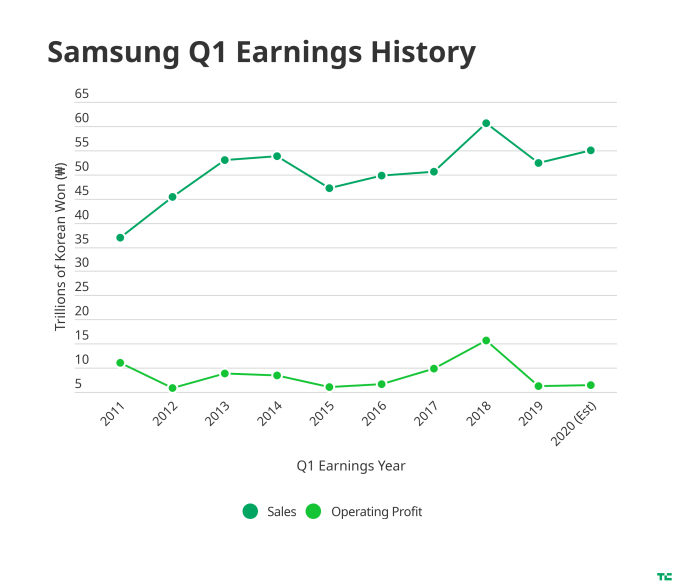
Samsung overnight released its earnings guidance for the first quarter of 2020, stating that it expected sales of $45.4 billion and an operating profit of roughly $5.3 billion. The company’s fiscal year is aligned to the standard calendar year, and it will announce official earnings results on April 23.

Those numbers are slightly up from last year’s first quarter, which had sales of $43.3 billion and an operating profit of roughly $5.1 billion.

Those sales and profits are in line with Samsung’s historical first quarter earnings, which have been relatively stagnant over the past few years, with the minor exception of 2018, which saw a bump to both revenues and profits.

Samsung recognizes four main segments: consumer electronics (19.2% of sales and includes smart devices like TVs), IT & Mobile (51.9%, and includes key flagship products like the Galaxy line of smartphones), Device Solutions (39.4%, which includes display components, memory, and semiconductors) and Harman (4.2%, which includes audio and connected car technology), which it acquired in 2016 for $8 billion.

Samsung had been on a tear until the crisis around COVID-19. From August last year to February this year, the company’s stock soared roughly 50% on encouraging electronics news in the smartphone, DRAM and components businesses, only to sink about 15% in the increasingly dire global macro environment.

South Korea was among the first countries to institute wide-scale responses to the advent of the novel coronavirus, which has affected everything from manufacturing to logistics to transoceanic shipping. Most of Samsung’s first quarter coincides with these initiatives, perhaps indicating that the economic damage from the global pandemic may be somewhat limited.

Nonetheless, demand for products in the company’s key profit centers is likely to be soft as consumers cut back on spending this year given the massive global recession underway. The company must also navigate the intensifying trade war between the U.S. and China, two of its largest export markets.


from blogger-2 https://ift.tt/2JN7TGq
via IFTTT

Monday, March 16, 2020

Online printing site Doxzoo exposed thousands of customer files

Doxzoo proudly says on its website that your “documents are in safe hands.” But for some time, that wasn’t true.

The U.K. printing company left its customer files on a cloud storage bucket, hosted on Amazon Web Services, without a password. Anyone who knew the easy-to-guess bucket name could access the massive trove of customer files. By the time that the company secured the bucket, it contained more than 250,000 customer-uploaded files.

When reached by email, Paul Bennett, one of the company’s directors, confirmed the exposure.

“The data we store [with Amazon] is solely the files we use for printing their documents and we have a clear privacy policy on our website to cover how this data is held,” said Bennett.

“We frequently review processes and technical architectures to ensure we adhere to current best practices. We are committed to providing the best possible service to our customers and take the security of their personal data very seriously,” he added. “We have already sought guidance from the ICO on our data security and the precautions we take.”

But a spokesperson for the U.K.’s Information Commissioner’s Office (ICO) said it has not received a notification of a security lapse from Doxzoo.

“People have the right to expect that organization’s will handle their personal information securely and responsibly,” the ICO spokesperson said. “Where that doesn’t happen, people can come to the ICO and we will look into the details. When a data incident occurs, we would expect an organization to consider whether it is appropriate to contact the people affected, and to consider whether there are steps that can be taken to protect them from any potential adverse effects.”

Companies that fall foul of European data protection rules can be fined up to 4% of their annual turnover.

At the time of writing, Doxzoo has made no mention on either its blog or its social platforms about the security lapse.

Doxzoo finds itself in similar company to Rallyhood, a Sprint contractor, the Democratic Senatorial Campaign Committee, FormGet, Mixcloud, and Samsung, all of which have in the past year left sensitive data online by mistake.


from blogger-2 https://ift.tt/2Qk6ryZ
via IFTTT

Friday, March 13, 2020

5G devices were less than 1% of US smartphone purchases in 2019

No surprise, really, that 5G smartphone sales are on the way up. Frankly, there’s really no other way to go, according to the latest numbers from NPD’s Mobile Phone Tracking. The firm noted that 5G handsets accounted for less than 1% of total sales in the U.S.

The hurdles are also what you’d expect: namely, pricing and the lack of 5G availability. There’s also the fact that for much of 2019, there simply weren’t that many phones to purchase. When the devices did start arriving from companies like LG, Samsung and OnePlus, the numbers started trending upward, with an increase of roughly 9x from the first to the second half of the year.

Awareness, too, increased notably. Some nine in 10 surveyed consumers in the U.S. had some familiarity with 5G in the second half of the year, up from 73% in the first half. Meanwhile, 65% expressed “interest” in purchasing the tech. How that translates to actual sales, however, is another question entirely.

That should improve as the price of manufacturing these devices comes down, thanks to lower-cost components from companies like Qualcomm. And in markets like the U.S., 5G coverage will be greatly expanded by year’s end, making it a much more appealing purchase. And, of course, never underestimate the impact of Apple’s first 5G iPhone.

Smartphone manufacturers have very much been banking on the increased interest in 5G to help correct the larger trend of flagging sales.

Of course, it remains to be seen how COVID-19 will impact sales. It seems safe to assume that, like every aspect of our lives, there will be a notable impact on the number of people buying expensive smartphones. Certainly things like smartphone purchases tend to lessen in importance in the face of something like a global pandemic.


from blogger-2 https://ift.tt/2vhx4gJ
via IFTTT

Wednesday, March 4, 2020

Alipay owner Ant Financial takes minority stake in Klarna

Some big moves in the payments platform space: Ant Financial Group, the owner of China’s Alipay payment platform has announced it’s taking a minority stake in Swedish payments platform Klarna — which has a strong European presence and a flagship product that lets shoppers buy now and pay later in interest-free instalments (typically 14 or 30 days after the purchase).

The pair have not disclosed terms of the deal but Reuters reported the stake amounts to less than 1% and was made up of existing and new shares. It also cites its source telling it the stake was done at a “slight uptick” to Klarna’s $460 million funding round last August — which valued the company at $5.5BN.

A spokeswomen for Klarna told us it’s not disclosing the value of the investment but she confirmed Reuters reporting, saying the stake is less than 1%.

Ant Financial is part of Chinese ecommerce and retail services multinational giant, Alibaba Group, which took a 33% stake in the fintech affiliate back in 2018 that gave it direct ownership of its suite of products and services — including an investment fund, micro-loans, insurance services, a digital bank and the Alipay mobile payments platform. 

Prior to today’s news, Klarna and Alipay had already been collaborating via Alibaba’s global ecommerce marketplace, AliExpress — which offers Klarna’s ‘Pay later’ option in multiple markets.

Now the pair touted their deepening partnership as set to bring more “innovative and convenient” financial services to consumers worldwide.

They are also clearly hoping to further grease the wheels of East to West ecommerce by expanding opportunities for China’s growing middle class to tap into Klarna’s network of European and global merchants via their preferred online payment method.

Commenting in a statement, Klarna CEO Sebastian SiemiÄ…tkowski said: “For too long consumers have had to endure non-intuitive, boring and overly complex services when shopping both online and offline. At the heart of this cooperation between Klarna and Alipay is a shared ambition of innovating truly superior shopping experiences and creating destinations of inspiration for consumers across the world.”

“Alipay, and the wider Alibaba Group, have truly set the global pace on retail innovation and the app economy. We are delighted in this confidence shown in Klarna in defining the future of payments and shopping and are very much looking forward to working together further in the future,” he added.

Klarna said its technology is being used by more than 200,000 retailers and e-commerce platforms globally at this point, including AliExpress, H&M, ASOS, Expedia Group, IKEA, Farfetch, Adidas, Spotify, Samsung and Nike.

Last year it said it added over 75,000 new merchants — describing itself as a “strategic growth partner” for these retailers and claiming it’s driving “millions of referrals and traffic each month” from owned channels to partner merchants from consumers who it says are actively seeking where they can shop with Klarna. (It claims a base of 85 million shoppers.)

Ant Financial, meanwhile, has been working on expanding Alipay’s global footprint by cutting local deals in markets outside China where it cannot build up its transaction volume organically. Notably, back in 2015, it  took a stake in India’s One97 — which operates a major local mobile payment platform, Paytm.

TechCrunch’s Ingrid Lunden contributed to this report


from blogger-2 https://ift.tt/39nfu9U
via IFTTT