Sunday, December 2, 2018

Bright spots in the VR market

Virtual Reality is in a public relations slump. Two years ago the public’s expectations for virtual reality’s potential was at its peak. Many believed (and still continue to believe) that VR would transform the way we connect, interact, and communicate in our personal and professional lives.
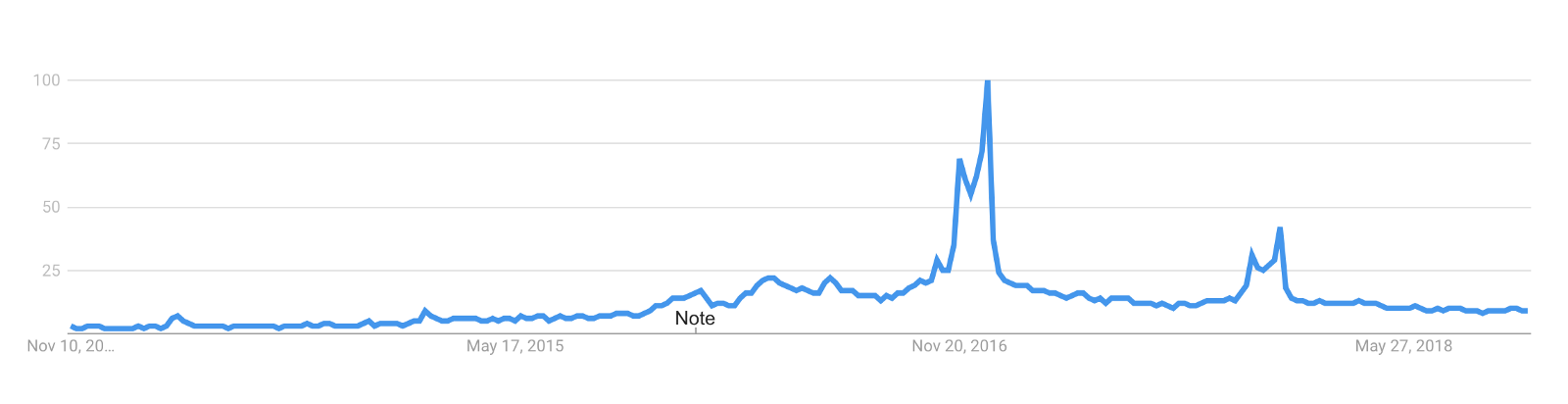
Google Trends highlighting search trends related to Virtual Reality over time; the “note” refers to an improvement in Google’s data collection system that occurred in early 2016

It’s easy to understand why this excitement exists once you put on a head mounted display. While there are still a limited number of compelling experiences, after you test some of the early successes in the field, it’s hard not to extrapolate beyond the current state of affairs to a magnificent future where the utility of virtual reality technology is pervasive.

However, many problems still exist. The all-in cost for state of the art headsets is still out of reach for the mass market. Most ‘high-quality’ virtual reality experiences still require users to be tethered to their desktops. The setup experience for mass market users is lathered in friction. When it comes down to it, the holistic VR experience is a non-starter for most people. We are effectively in what Gartner refers to as the “trough of disillusionment.”

Gartner’s hype cycle for “Human-Machine Interface” in 2018 places many related VR related fields (e.g., Mixed Reality, AR, HMDs, etc.) in the “Trough of Disillusionment”

Yet, the virtual reality market has continued its slow march to mass adoption, and there are tangible indicators that suggest we could be nearing an inflection point.

A shift towards sustainable hardware growth

What you do and do not consider a virtual reality display can dramatically impact your view on the state of the VR hardware industry. Head-mounted displays (HMDs) can be categorized in three different ways:

  • Screenless viewers — affordable devices that turn smartphones into a VR experience (e.g., Google Glass, Samsung Gear VR, etc.)
  • Standalone HMDs — devices that are not connected to a computer and can independently run content (e.g., Oculus Go, Lenovo Mirage Solo, etc.)
  • Tethered HMDs — devices that are connected to a desktop computer in order to run content (e.g., HTC Vive, Oculus Pro, etc.)

2018 has seen disappointing progress in aggregate headset growth. The overall market is forecasted to ship 8.9M headsets in 2018, up from an approximate aggregate shipment of ~8.3M in 2017, according to IDC. On the surface, those numbers hardly describe a market at its inflection point.

However, most of the decline in growth rate can be attributed to two factors. First, screenless viewers have seen a significant decline in shipments as device manufacturers have stopped shipping them alongside smartphones. In the second quarter of 2018, 409K screenless viewers were shipped compared to approximately 1M in the second quarter of 2017. Second, tethered VR headsets have also declined as manufacturers have slowed down the pricing discounts that acted as a steroid to sales growth in 2017.

Looking at the market for standalone HMDs, however, reveals a more promising figure. Standalone VR headsets grew 417% due to the global availability of the Oculus Go and Xiaomi Mi VR. Over time, these headsets are going to be the driver of the VR market as they offer significant advantages compared to tethered headsets.

The shift from tethered to standalone VR headsets is significant. It represents a paradigm shift within the immersive ecosystem, where developers have a truly mobile platform that is powerful enough to enable compelling user experiences.
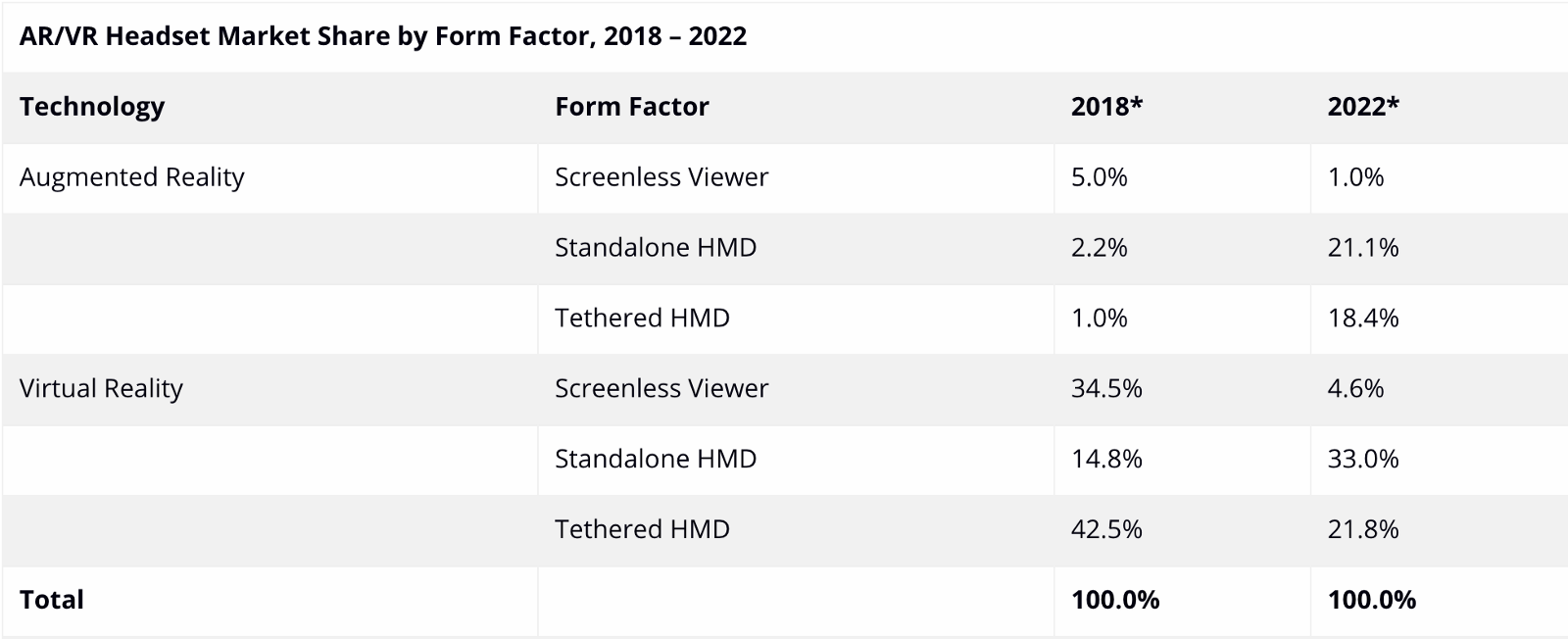
IDC forecasts for AR/VR headset market share by form factor, 2018–2022

A premium market segment

There are a few names that come to mind when thinking about products that are available for purchase in the VR market: Samsung, Facebook (Oculus), HTC, and Playstation. A plethora of new products from these marquee names —  and products from new companies entering the market —  are opening the category for a new customer segment.

For the past few years, the market effectively had two segments. The first was a “mass market” segment with notorious devices such as the Google Cardboard and the Samsung Gear, which typically sold for under $100 and offered severely constrained experiences to consumers. The second segment was a “pro market” with a few notable devices, such as the HTC Vive, that required absurdly powerful computing rigs to operate, but offered consumers more compelling, immersive experiences.

It’s possible that this new emerging segment will dramatically open up the total addressable VR market. This “premium” market segment offers product alternatives that are somewhat more expensive than the mass market, but are significantly differentiated in the potential experiences that can be offered (and with much less friction than the “pro market”).

The Oculus Go, the Xiaomi Mi VR, and the Lenovo Solo are the most notable products in this segment. They are the fastest growing devices in this segment, and represent a new wave of products that will continue to roll out. This segment could be the tipping point for when we move from the early adopters to the early majority in the VR product adoption curve.

A number of other products have also been released throughout 2018 that fall into this category, such as Lenovo’s Mirage Solo and Xiaomi’s Mi VR. Even more so, Oculus recently announced that  they’ll be shipping a new headset called Quest this spring, which will sell for $399 and will be the most powerful example of a premium device to date. The all-in price range of ~$200–400 places these devices in a segment consumers are already conditioned to pay (think iPad’s, gaming consoles, etc.), and they offer differentiated experiences primarily attributed to the fact that they are standalone devices.


from blogger-2 https://ift.tt/2QvmQlo
via IFTTT

Thursday, November 29, 2018

South Korea indicts group for allegedly leaking Samsung flexible display tech to Chinese company

Prosecutors in South Korea have indicted the chief executive and eight other employees of Toptec Co for allegedly selling information about Samsung’s flexible OLED displays to a Chinese company. The charges detail that the company received more than $13.8 million for the information, Bloomberg reports.

Toptec, a Samsung supplier that manufactures display-related equipment, has denied the charges in a statement. “Our company has never provided Samsung Display’s industrial technology or business secrets to a Chinese client. Our company will fully cooperate with legal proceedings to find the truth in court.” The company’s share price is down 20 percent at the time of writing.

Samsung’s flexible display tech probably makes you think of their weird and yet-to-be-released foldable phone that they just showed off earlier this month. Samsung’s been deep in the flexible display business for a while though even if their bends have been less acute like the designs of much older handsets like the Galaxy S6 Edge.

The Chinese company was not named in the suit though there are a number of companies working to produce flexible displays for smartphones.

South Korea’s national interests are deeply intertwined with the business dealings of Samsung, and the threat of intellectual property theft to China is one which they seem to be taking very seriously. We have reached out to Samsung for comment.


from blogger-2 https://ift.tt/2KIfENE
via IFTTT

Wednesday, November 28, 2018

Google Fi now officially supports most Android devices and iPhones

Google is making a major move to expand the availability of its Fi wireless service.

It’s been a few years since Google launched Project Fi with the promise of doing things a bit differently than the large carriers. Because it could switch between the cell networks of multiple providers to give you the best signal, the service only ever officially supported a select number of handsets. You could always trick it by activating the service on a supported phone and then moving your SIM card to another (including an iPhone), but that was never supported.

That’s changing today, though. The company is opening up Fi — and renaming it to Google Fi — and officially expanding device support to most popular Android phones, as well as iPhones. Supported Android phones include devices from Samsung, LG, Motorola and OnePlus. iPhone support is currently in beta, and there are a few extra steps to set it up, but the Fi iOS app should now be available in the App Store.
One thing you might not get with many of the now-supported phones is the full Fi experience, with network switching and access to Google’s enhanced network features, including Google’s VPN network. For that, you’ll still need a Pixel phone, the Moto G6 or any other device that you can buy directly in the Fi store.

Fi on all phones comes with the usual features, like bill protection, free high-speed international roaming and support for group plans.

To sweeten the deal, Google is also launching a somewhat extraordinary promotion today: If you open a new Fi account — or if are an existing user — you can buy any phone in the Fi shop today and get your money back in the form of a travel gift card that you can use for a flight with Delta or Southwest, or lodging with Airbnb and Hotels.com. There’s some fine print, of course (you need to keep your account active for a few months, etc.), but if you were looking at getting Fi anyway, like to travel and want to get a Pixel 3 XL, that’s not a bad deal at all.

The fine print is below:

Travel on Fi with Any Device Purchase Promotion Terms (Google Fi)

Limited time, 24-hour offer applies to any qualifying device purchased from fi.google.com from 11/28/18 12:00 AM PT through 11/28/18 11:59 PM PT, or while supplies last. When you purchase a qualifying device on fi.google.com, you can redeem a travel gift card in the amount you paid for the device, excluding taxes (details below).

To qualify for this promotion, a device must be activated within 15 days of device shipment and remain active for 60 consecutive days within 75 days of device shipment. The device must be activated within the same plan that was used to purchase the device. Activation must be for full service (i.e., activation does not apply to a data-only SIM).

This offer is available for new Google Fi customers as of 11/28/18 12:00 AM PT and existing, active Google Fi customers. If the customer is new to Google Fi, the customer must transfer (port-in) their current personal number over to Google Fi during sign up. The number being transferred must be currently active and have been active with the previous carrier and the customer since 8/28/18 12:00 AM PT.

After the terms have been satisfied, the customer will receive an email from Google Fi (around 75 – 90 days after device activation) with instructions on how to obtain a gift card from Tango subject to Tango’s terms and conditions. The user can redeem gift card amounts with select travel partners: Airbnb, Delta Airlines, Hotels.com, and Southwest Airlines. Gift cards may also be subject to the terms of the travel partners.

If Fi service is paused for more than 7 days or cancelled within 120 days of activation, the value of the gift card will be charged to your Google Payments account to match the purchased price of the device. Limit one per person. This offer is only available for U.S. residents ages 18 and older, and requires Google Payments and Google Fi accounts. Unless otherwise stated, this offer cannot be combined with other offers. Offer and gift card redemption are not transferable, and are not valid for cash or cash equivalent. Void where prohibited.


from blogger-2 https://ift.tt/2Q1TueS
via IFTTT

Monday, November 26, 2018

Last minute Cyber Monday deals

Listen, I know you’re tired of deals. I get it. You already woke up at 1AM on Black Friday to head to Best Buy in your pajama pants. But if we just stick together and follow the rules, we’ll get through the holiday gift season in one piece. We got this.

What follows is far from a comprehensive list of the deals you’ll be able to find online today, but should help you get started on your holiday shopping — or just pick up a little something for yourself, if you’re so inclined.

Ring Video Doorbell 2 ($60 off) – As always, Amazon’s flooding Cyber Monday with deals on its own devices. At 30-percent, with a third-gen Echo Dot thrown in, the Ring doorbell just might be the best of the bunch.

Buy a Samsung Galaxy, get an Echo Show free – Amazon’s also got some deep discounts on the Samsung Galaxy Note 9, S9 and S9+, with bundled Echo devices thrown in for good measure. Sorry Bixby.

Apple iPad ($80 off) – Walmart’s got a bunch of deals on Apple products — while supplies last.

Apple Watch Series 3 ($50 off) – Sure it’s not the latest version — but it’s still a solid deal for the holidays.

Fitbit Ionic ($70 off) – The Versa is admittedly the better of Fitbit’s new smartwatches, but $70 off is a solid deal for the larger device. 

GoPro Hero7 ($70 off) – A solid discount for the leading action cam. 


from blogger-2 https://ift.tt/2KzVvZU
via IFTTT

Samsung apologizes, promises compensation for factory conditions

Weeks after reaching a settlement, Samsung issued an apology over factory conditions leading to the illness and death of workers. “We offer our sincere apology to our workers who have suffered with illnesses and their families,” executive Kinam Kim said during a press conference late last week.

The apology is the result of longstanding health complaints levied against the company’s LCD and chip manufacturing lines, resulting in dozens of employees suffering illnesses including brain tumors and leukemia, according to The Associated Press.

An advocacy group had been fighting on behalf of workers after the 2007 death of one employee from leukemia. In addition to the public apology, Samsung will pay up to ~$133,000 per employee, for illness contracted from working conditions, including miscarriages and cancers in workers’ children.

In its apology, Samsung called previous efforts “insufficient,” promising to improve working conditions going forward. The electronics giant has promised to issue compensation for workers by 2028.


from blogger-2 https://ift.tt/2Rfec7Q
via IFTTT

Monday, November 19, 2018

A closer look at Royole’s foldable display

You’d be forgiven if Royole doesn’t ring any bells. Even here China, it’s far from a household name. Still, the Shanghai-based startup recently secured an undisclosed Series E, vaulting its valuation to an apparent $5 billion, up from $3 billion in late 2016.

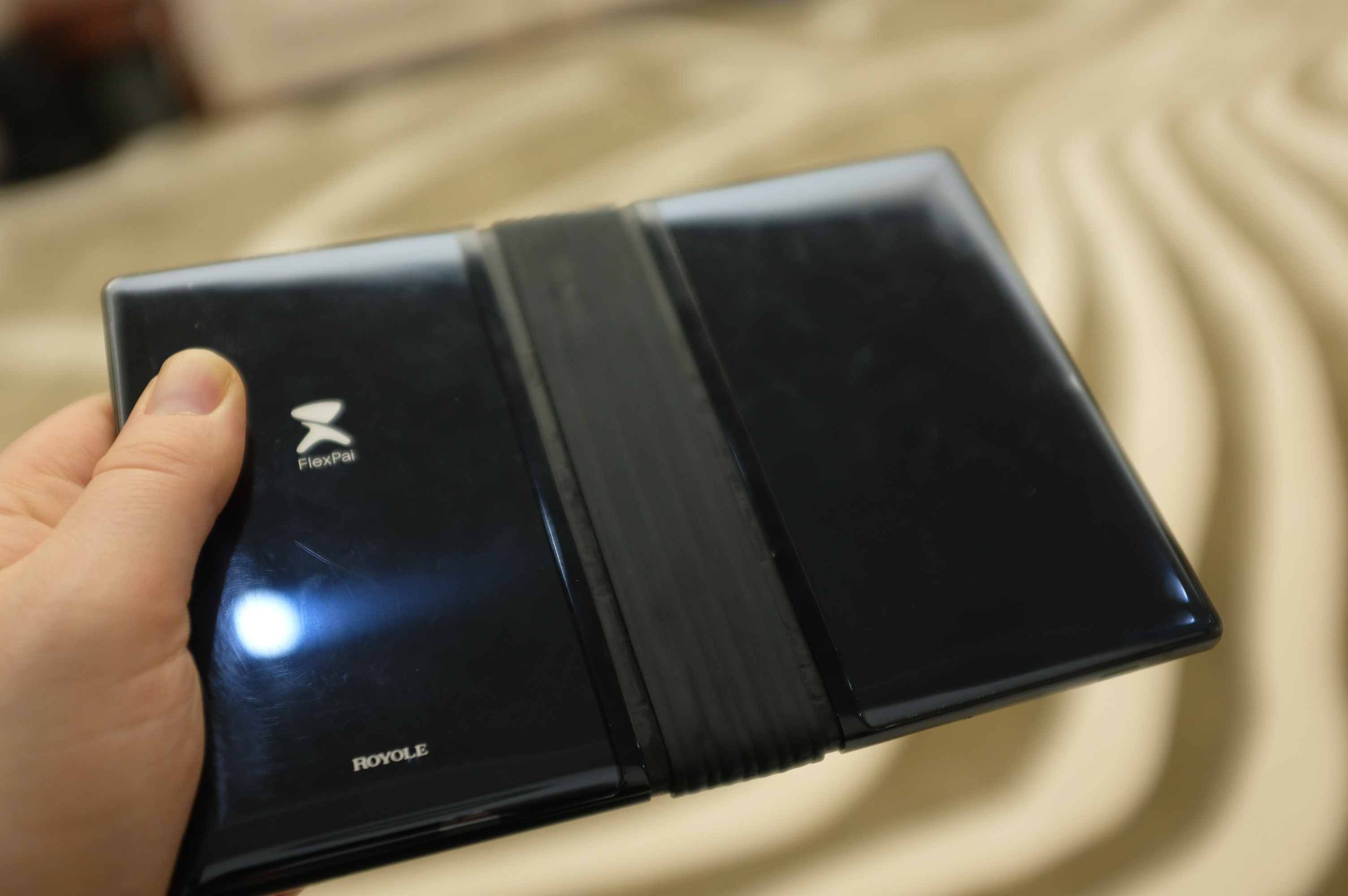
Founded in 2012, Royole’s best-known release was a wearable cinema display. That changed last month, however, when it surprised the industry by announcing the imminent arrival of the FlexPai, a flexible screen smartphone that appears on track to to beat the Samsung Galaxy X to market.

The FlexPai’s anticipated December release seemingly came out of nowhere. Like competitors, Royole had shown off its proprietary folding technology as part of a standalone demos, but it hadn’t teased the arrival of a smartphone until the device was ready to ship. It’s a far cry, certainly, from the not ready for prime time prototype Samsung marched out on stage last month.

At an event in Shenzhen, CEO Bill Liu told TechCrunch that the company was built around the desire to bring the technology to market. “We started from the flexible displays and flexible sensors,” he explained. “We started the company with a focus on the flexible displays and sensors. And then along the way, we realized this could be a huge application for the technology.”

A foldable smartphone was simply the first product that made sense for the underlying tech. With development dating back a half-dozen year, Royole was the first to achieved the industry’s long standing goal of delivering a foldable screen — beating even the massive Samsung to market.

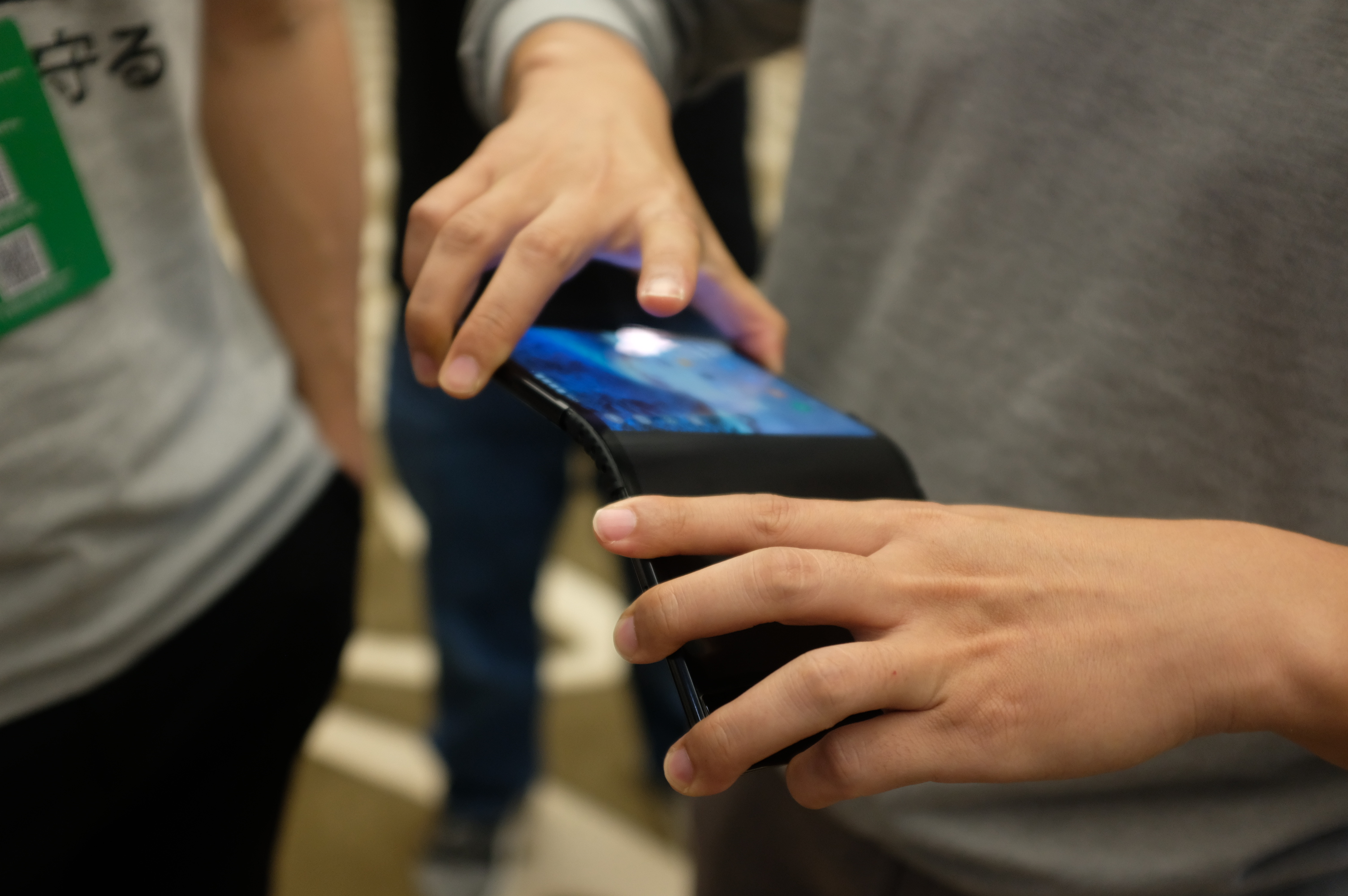
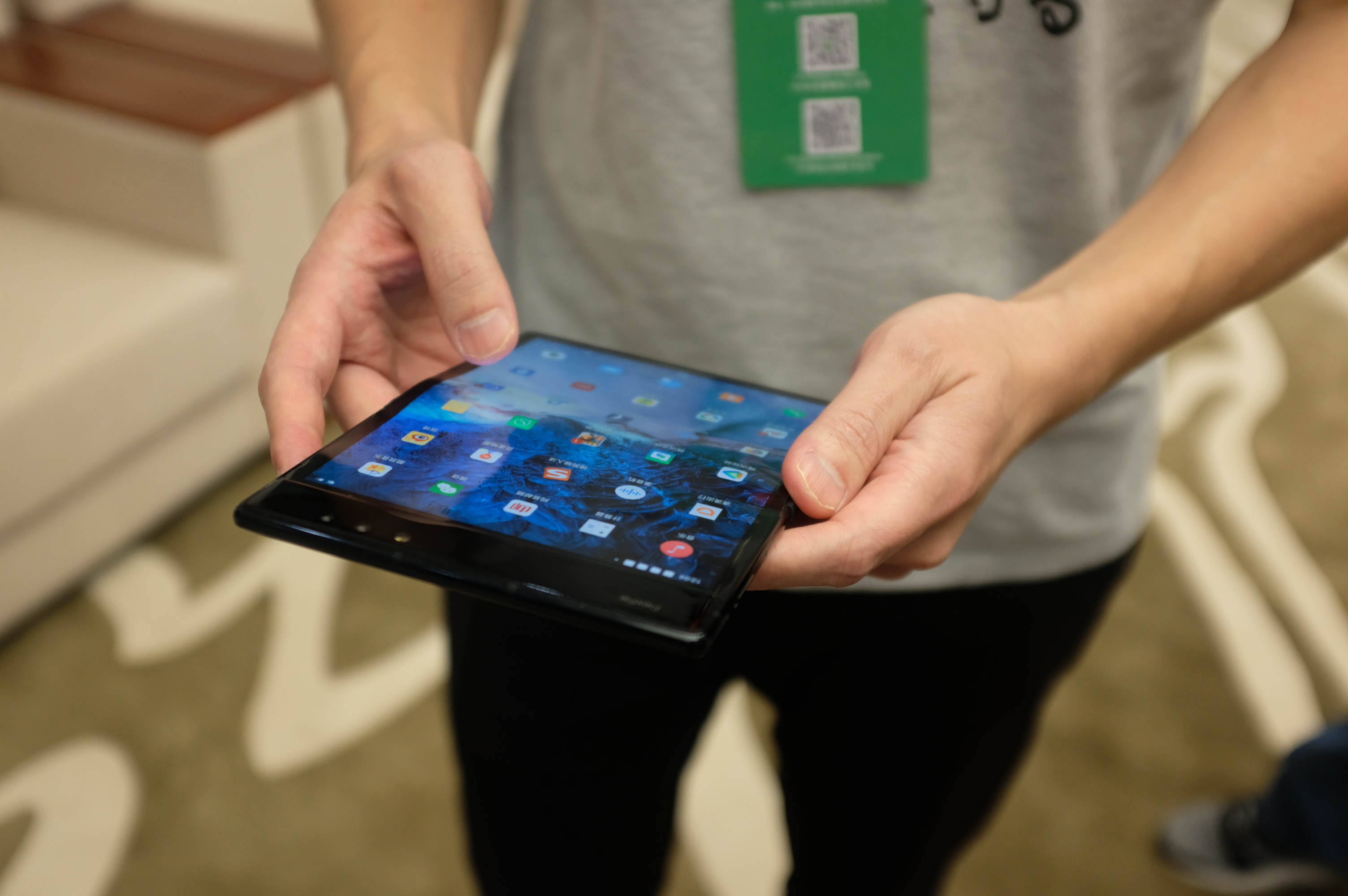
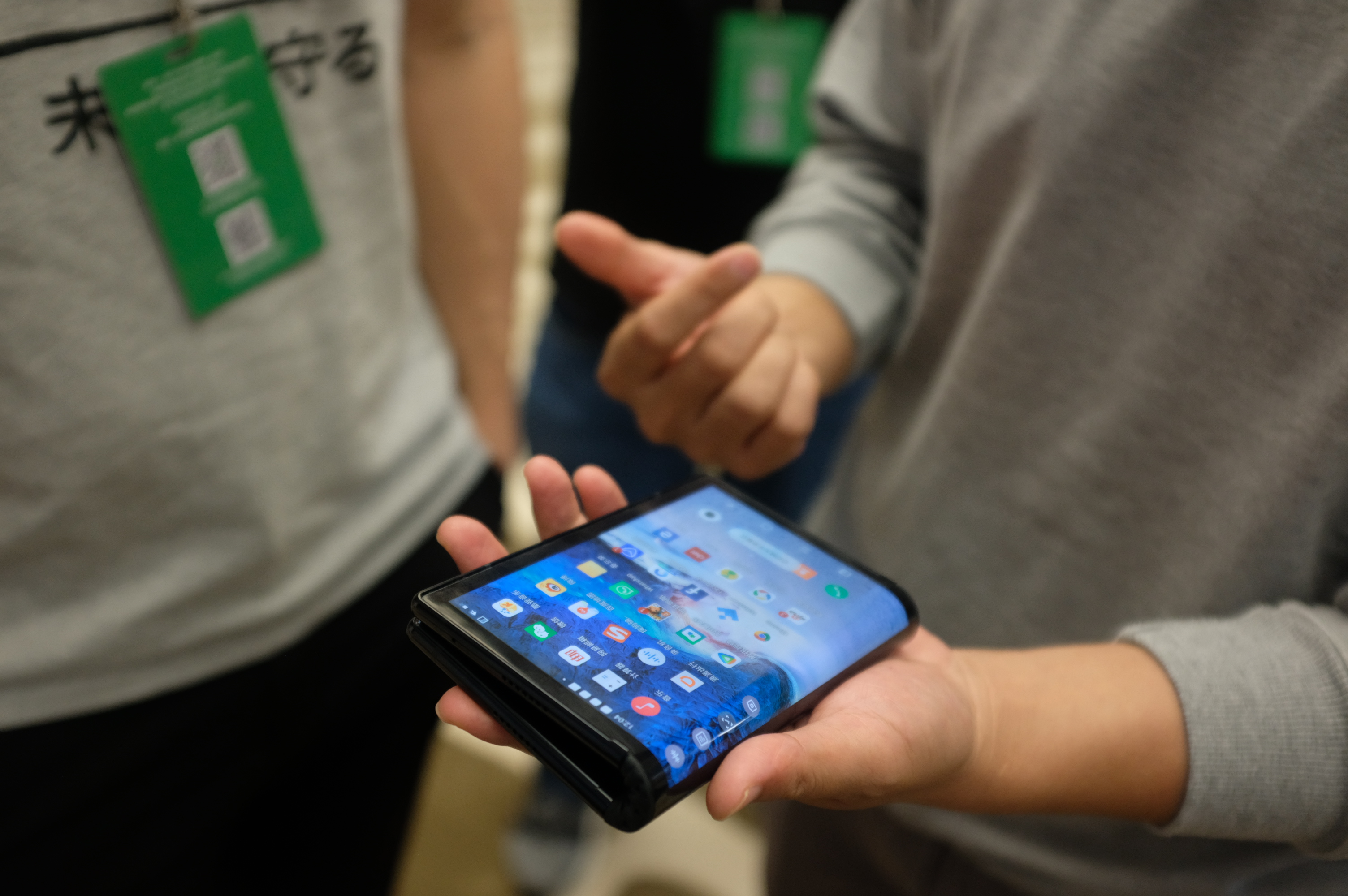
Being first isn’t always a blessing in this industry, but it’s an impressive feat, nonetheless. The FlexPai is real. I can’t speak to the scalability of the product, until it actually starts shipping out next month, but I can attest to the fact that at least one of the things exists in the world. I held it in my hands. I folded it. It worked.

It’s a difficult problem and Royole solved it with in-house technologies. No one can take that away from the company. I can’t say my initial apprehensions were ultimately dissuaded, however. The FlexPai mostly works as desired, but the execution isn’t what ultimately the kind of premium product one would expect, given the ultra-premium price tag (around $1,300 American).

Liu happily dropped the phone a couple of times on stage, in an attempt to put to rest any durability question. While the display ultimately didn’t crack or scratch, the flexible material looks almost like cellophane and sports crinkles that catch the light — the clarity also leaves something to be desire.

As far as portability, it’s true that you can fold it up and stuff it in your pocket, though it’s pretty chunky when you do so. Ultimately, these are first generation products — and likely a result of a company pushing to be first to market, knowing full well that companies like Samsung were breathing down its neck.

Royole sees potential to license the technology out for other categories. “Right now for the smartphone industry, we haven’t done any licensing,” said Liu. “For industrial applications like automotive or media, we do have customers. We sell the licenses to them, and we’ve already sold a lot of licenses.”

The company will also be working with developers to create content for the new form factor, with a $30 million program it launched last month. The Chinese version is due out in December.


[gallery ids="1748404,1748425,1748424,1748423,1748422,1748421,1748420,1748419,1748418,1748417,1748416,1748415,1748414,1748413,1748412,1748411,1748410,1748409,1748408,1748407,1748406"]

from blogger-2 https://ift.tt/2TprmAI
via IFTTT

Tuesday, November 13, 2018

MetaCert’s Cryptonite can catch phishing links in your email

MetaCert, founded by Paul Walsh, originally began as a way to watch chat rooms for fake Ethereum scams. Walsh, who was an early experimenter in cryptocurrencies, grew frustrated when he saw hackers dumping fake links into chat rooms, resulting in users regularly losing cash to scammers.

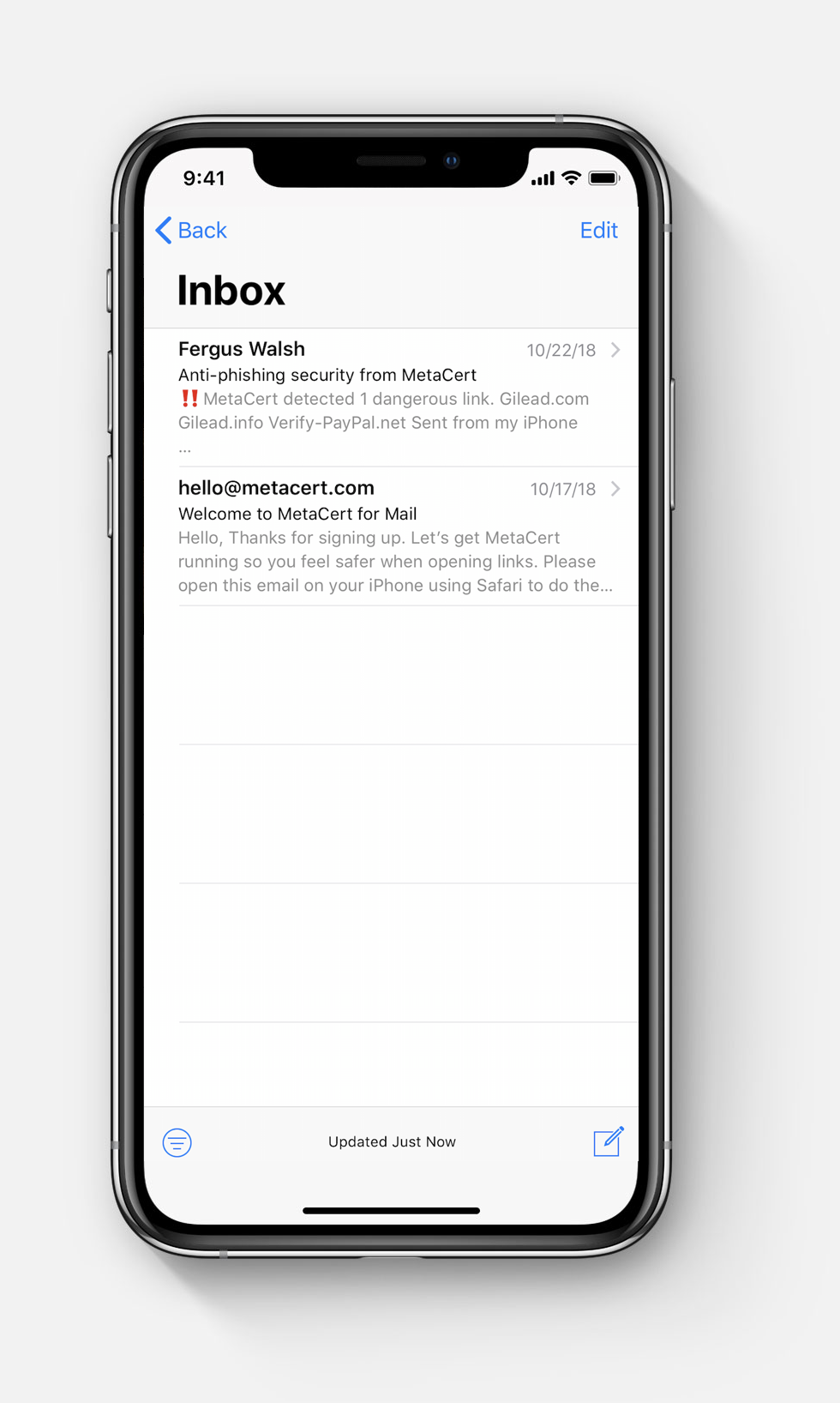
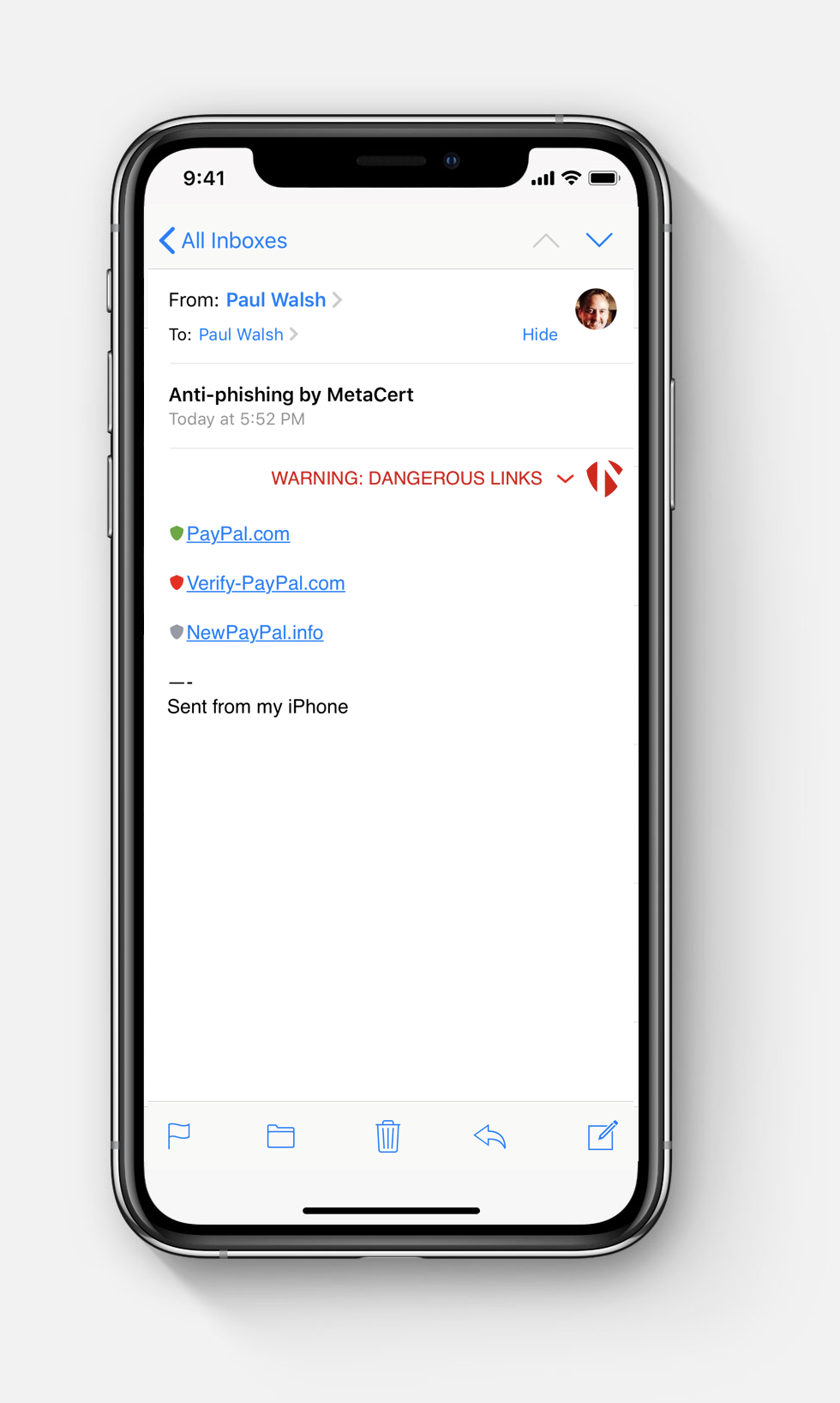
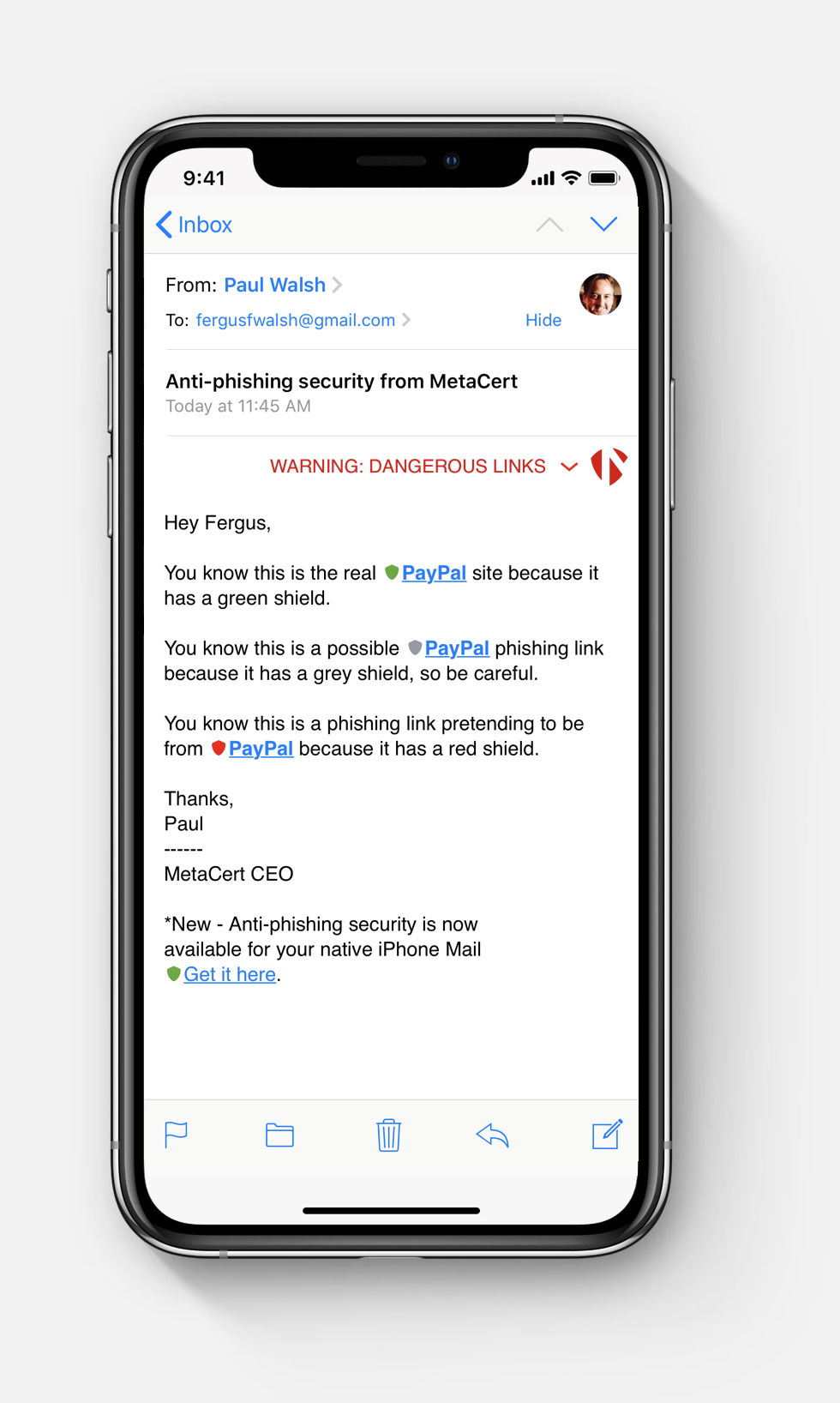
Now Walsh has expanded his software to email. A new product built for email will show little green or red shields next to links, confirming that a link is what it appears to be. A fake link would appear red while a real PayPal link, say, would appear green. The plugin works with Apple’s Mail app on the iPhone and is called Cryptonite.

“The system utilizes the MetaCert Protocol infrastructure/registry,” said Walsh. “It contains 10 billion classified URLs. This is at the core of all of MetaCert’s products and services. It’s a single API that’s used to protect over 1 million crypto people on Telegram via a security bot and it’s the same API that powers the integration that turned off phishing for the crypto world in 2017. Even when links are shortened? MetaCert unfurls them until it finds the real destination site, and then checks the Protocol to see if it’s verified, unknown or classified as phishing. It does all this in less that 300ms.”

Walsh is also working on a system to scan for Fake News in the wild using a similar technology to his anti-phishing solution. The company is raising currently and is working on a utility token.

Walsh sees his first customers as enterprise and expects IT shops to implement the software to show employees which links are allowed, i.e. company or partner links, and which ones are bad.

“It’s likely we will approach this top down and bottom up, which is unusual for enterprise security solutions. But ours is an enterprise service that anyone can install on their phone in less than a minute,” he said. “SMEs isn’t typically a target market for email security companies but we believe we can address this massive market with a solution that’s not scary to setup and expensive to support. More research is required though, to see if our hypothesis is right.”

“With MetaCert’s security, training is reduced to a single sentence ‘if it doesn’t have a green shield, assume it’s not safe,’ ” said Walsh.


from blogger-2 https://ift.tt/2qSpR0V
via IFTTT